tiistai 12. huhtikuuta 2016

Is It True That Only 2 Or 3 % Of Cancer Patients Survive Chemotherapy?

Anaximperator blog

Blogging against alternative cancer treatments

Is It True That Only 2 Or 3 % Of Cancer Patients Survive Chemotherapy?

Luella May
No, it’s not true: currently, the average "non-chemo" cancer cure rate is close to 60%.
Some time ago I happened to read a discussion on Tony Isaacs’s Curezone, on the best treatment for breast cancer. The thread was started by a woman who had just been diagnosed with breast cancer.
Tony Isaacs’ partner Luella May suggested the forum member paint her breasts with iodine to combat the cancer and advised strongly against surgery and all other forms of conventional cancer treatments:
Chemotherapy 2 percent curezone
What does this mean? I can only mean that 98% were not cured – which means they died; look at this website, where it says: Chemo has a 97% fatality rate!
Some time later I read the same kind of unsettling statement concerning chemotherapy, this time posted on a discussion board of Breastcancer.org:
Breastcancer.org - Only 3 percent survive chemo

Where do these numbers come from??

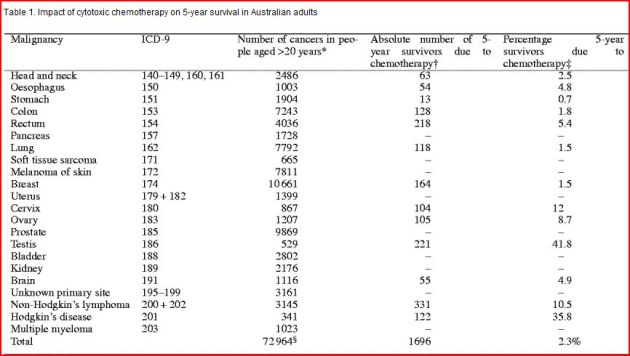
The “2% chemo efficacy” comes from an Australian study into the contribution of chemotherapy to 5-year cancer survival, and the researchers claimed to have found that the average benefit of chemotherapy was about 2%. So: the study is about the contribution of chemotherapy to survival and not about survival of patients having chemotherapy.
For obvious reasons, this study has become immensely popular with alternative therapists and is quoted by them ad nauseam.
A rather strange  phenomenon took place after the publication of this study: over time, the 2-3% contribution to survival had somehow become 2-3% plain survival – period. Some of these altmeds now actually claim the outcome of the study was that of all cancer patients receiving chemo, only 2-3% survive for more than 5 years.
In other words: chemotherapy kills an average 97% of cancer patients within 5 years.
Now, as these numbers sound totally weird – to say the least – we decided to find out if there was any truth in them.

What the study was about

The researchers stated as the aim of their study:
a literature search for randomised clinical trials reporting a 5-year survival benefit attributable solely to cytotoxic chemotherapy in adult malignancies.
So they wanted to know what the contribution was of chemotherapy to 5-year survival. There are many therapies to treat cancer: surgery, radiotherapy, hormonal therapy, immune therapy – and chemotherapy. The researchers wanted to know to what extent  chemotherapy contributed to five-year-survival of cancer patients.
Of all 154,971 patients whose files were examined, in 3306 of these, 5-year survival could be attributed solely to chemotherapy.
In 98% of the patients, 5-year survival was due to a combination of factors, of which chemotherapy sometimes also was a factor and sometimes was not.
The researchers then extrapolated the outcomes to all cancers. The average 5-year cancer survival in Australia at the time of the study was 60%. On the basis of the extrapolation of the outcome of their study, the researchers estimated that the average contribution of chemotherapy to 5-year survival would be 2.3% in Australia and 2.1% in the USA.
Nowhere in the study does it say that only 3306 patients survived their chemotherapy and that consequently 151,665 patients died because of chemotherapy.
Leave out a few words and you get a completely different message.

The study design

The study was carried out in 2004, using data from 1998. A number of things can be said about the design of the study.
  • The researchers looked at a lot of cancers, but they didn’t look at all of them.
  • They did not differentiate between cancers for which chemotherapy is the primary treatment and cancers for which chemotherapy is only given as an adjuvant. This is the case in most solid cancers, for which surgery is the primary – and by far the most effective – treatment.
  • They did not include cancers for which chemotherapy is very effective, such as leukemia.
  • They did not include children’s cancers, some of which are highly responsive to treatment, e.g. Wilms’ tumour, with about 90% of patients surviving at least five years.
  • They did not differentiate between early stage cancers (tumour <1cm, no mets in lymph nodes), for which chemotherapy often is not even indicated, and late stage, incurable cancers which had already metastasized at the time of diagnosis, some even quite extensively.
  • They did not look at the effect of chemotherapy on life extension (median survival), which in my opinion they should have, since they included already incurable cancers in their study.
Correction for these factors would result in an average contribution of chemotherapy to 5-year survival of about 8%, based on the data from 1998.

Statistics: average and specific

It is important to keep in mind that a statistical average is always about middling, about the ‘mean.’ Statistics are never about the many deviations from the mean, such as your or anyone else’s specific situation.
A few examples:
1. Suppose the effect of chemotherapy on 5-year survival in leukemia is 60% and the effect of chemotherapy on 5-year survival of very early stage breastcancer is 0% (because: not indicated, therefore not administered). The average effect of chemotherapy on both cancers combined is 30% (60+0 : 2 = 30). But what does this overall average tell the individual patient regarding their prognosis? Well… nothing actually.
2. In a number of situations, depending on stage, grade and type of cancer, women with breast cancer are advised to take adjuvant chemotherapy, in order to destroy any (clinically invisible) micrometastases in their blood.
This kind of chemo improves the 10-year survival prognosis with an average 5 – 7%. The percentage is based on allwomen receiving adjavant chemo. If you don’t have micrometastases, the chemo will do nothing for your prognosis. However, for the women who do have them, the chemo may enhance their personal prognosis much more, sometimes as high as 20%.
3. Cancer with unknown primary tumour (CUP) has a very bad prognosis: average 5-year overall survival rate is about 10%. Yet there are cases known of patients who have been surviving for 14 years or more without any evidence of disease.
The big differences in the overall effects of chemotherapy on 5-year survival become obvious if we look at the tables in which the specific numbers are given for each particular cancer that was included in the study. In the 4th and 3rd column on the right you can see to what extent chemotherapy contributed to cancer survival. When chemotherapy was no factor in survival, the column shows a dash.
Chemotherapy Australia
Chemotherapy USA

So… now what?

The data from the study are from 1998. We are now in 2009 and progress has been made in those years. There is better medication to diminish side effects of chemotherapy. There is new, sophisticated technology to assess which breast cancers are prone to metastasize and which are not, resulting in less women having to undergo chemotherapy. Scientists are working hard on similar tests for other cancers.
There are over 80 different kinds of chemotherapy. Some are sheer hell, but many are quite doable, including the one I had. Nevertheless: chemotherapy still is the ultimate cancer scare factor and the sooner we can do without it, the better. But it is not true that only 2-3% survive chemotherapy. It is not true that the average benefit of chemotherapy to 5-year survival is as low as 2%. And it is also not true that all chemotherapy is by definition completely and totally unbearable.
If we really want to get anywhere at all, then honesty about the facts, not manipulation, self-aggrandizing and scare mongering, should be the basis for discussion and decision making.

https://anaximperator.wordpress.com/2009/09/02/only-3-percent-survive-chemotherapy/
_________________________


_________ 


 Laboquick Candida Albicans Ag Test Kit CE Marked, 25 Tests € 59,90


________ 


 CHLAMYDIA TEST (15 minuten) € 35,90


________ 


 Diabetes Test Kit, including 2 tests € 24,90


maanantai 11. huhtikuuta 2016

Zika virus 'scarier than initially thought'


Zika virus 'scarier than initially thought'


"Everything we look at with this Zika virus seems to be a little scarier than we initially thought," Dr. Anne Schuchat, CDC principal deputy director, told reporters during a White House briefing on Monday.
She was joined by Dr. Anthony Fauci, director of the National Institute for Allergy and Infectious Disease at the NIH. "The more and more we learn, the more you get concerned about the scope of what this virus is doing," he said.
Both continued to remind the public that new information about the virus is being learned every day.
They reviewed what's been learned in the two weeks since they last addressed White House reporters on the virus.
The mosquito-borne disease is a cause of microcephaly, according to the World Health Organization, but Schuchat said experts are now linking the virus to premature birth, eye problems and other neurological conditions in babies born to mothers who were infected while pregnant.
These concerns are no longer limited to exposure to the virus only during the first trimester. There is reason to be concerned throughout the pregnancy.
Schuchat also noted revised surveillance maps of the Zika-carrying mosquito, Aedes aegypti, released last month, showing that the insects could be more widespread than previously thought, reaching as far north as San Francisco and New York.
Fauci said researchers are on track with their goal to begin a clinical trial for a vaccine in September. He also said his teams have screened 62 existing drugs as possible treatments. Fifteen have been identified for further research, although he cautioned they may not pan out.

http://www.sigmalive.com/en/lifestyle/health/143842/zika-virus-scarier-than-initially-thought#.dpuf

lauantai 9. huhtikuuta 2016

Graviola, Diabetes, Cancer, Rheumatism

Graviola & Diabetes

 | By 

Graviola may help you avoid or manage diabetes.


Diabetes is a leading cause of death and disability in America.

The National Diabetes Information Clearinghouse reports that diabetes affects almost 8 percent of the American population. Diabetes is a metabolic disorder that affects how your body is able to use products of digestion to regulate blood glucose and provide your cells with energy.
Graviola is a tropical plant with properties that may help you avoid diabetes or manage existing diabetes by keeping your blood glucose in a healthy range. Discuss graviola with your physician to decide if it might be helpful for you.
Diabetes


Type 1 diabetes develops when your body in unable to make insulin, a hormone that regulates blood glucose. In type 2 diabetes, the more common form, your cells become unresponsive to insulin even though your pancreas still makes adequate amounts of the hormone. In both types, glucose cannot move into your cells where it is normally used. The result is blood glucose that is too high, potentially causing problems for your other organs and depriving your cells of the energy they need.
Graviola

Graviola, or Annona muricata, is a tree native to rain forests in tropical locations. Its fruit is sometimes called soursop and is the main ingredient in a popular Latin American drink. The leaves, fruit and seeds of the graviola tree have been part of herbal medicine for many years. They contain several biologically active ingredients, including phytochemicals called acetogenins that may help prevent spikes in your blood glucose and generally keep your glucose at a steady, even level.
Graviola is a popular remedy for diabetes in parts of Africa and South American, including Peru where practitioners often prescribe it for the disorder. In a laboratory study published in the "African Journal of Traditional Complementary and Alternative Medicine" in 2008, diabetic animals fed graviola for two weeks had blood glucose levels that were near normal without any additional diabetes treatment. In another paper published in the same journal in 2008, investigators found that diabetic animals fed graviola had higher blood levels of healthy antioxidants, less liver damage and lower blood levels of unhealthy fats than animals fed a placebo. Although clinical studies with graviola and human subjects with diabetes are still needed, these laboratory studies are promising and suggest graviola may be beneficial.

Recommendations


Consuming fresh graviola fruit, often called soursop, is a strategy to increase your intake of its biologically active ingredients, as is drinking soursop nectar, which is available from Latin American groceries. Graviola extract is also available as a supplement from most health food stores. No recommended dose of graviola has been established and intake of large quantities may cause some neurological symptoms. Talk to your doctor about graviola to decide if it might be useful for your situation.

http://www.livestrong.com/article/491356-graviola-diabetes/

perjantai 8. huhtikuuta 2016

THE TOP 3 TYPES OF DRUGS THAT CAUSE MEMORY LOSS

THE TOP 3 TYPES OF DRUGS THAT CAUSE MEMORY LOSS

If you are taking any prescription medication, the odds are that it falls into one of these three categories of drugs known to cause memory loss and other cognitive problems:

The “Anti” Drugs

If you take a drug that starts with “anti,” such as antihistamines, antidepressants, antipsychotics, antibiotics, antispasmodics, or antihypertensives, it’s likely that it will affect your acetylcholine levels.
Acetylcholine is the primary neurotransmitter involved with memory and learning. Low acetycholine can lead to symptoms that resemble dementia including mental confusion, delirium, blurred vision, memory loss, and hallucinations. (2)

Sleeping Pills

Prescription sleeping pills are notorious for causing memory loss.
The popular drug Ambien has been coined by some as “the amnesia drug.” Some users experience night terrors, sleep walking, sleep driving, and hallucinations.
Prescription sleeping pills have been found to put you in a state similar to being passed out drunk or in a coma while bypassing the restorative sleep your brain needs. (3) There are much better ways to get to sleep!

Statin Drugs

These cholesterol-lowering medications might just be the single worst group of drugs for your brain. (4) Memory loss is now required to be listed as a side effect on the label.
One quarter of your brain is made up of cholesterol. Cholesterol is necessary for memory, learning, and fast thinking. So it is not a total surprise that cholesterol-lowering drugs negatively effect the brain.
Learn why taking statins might not be in your best interest, and how to talk to your doctor about getting off of them in Exposed: Why Cholesterol Doesn’t Cause Heart Disease and If You Take Cholesterol Medication, You Must Know This!

20 Medications Known to Cause Memory Loss

Here is a list of medications known to have memory loss as a possible side effect:
  • for Parkinson’s — scopolamine, atropine, glycopyrrolate
  • for epilepsy — phenytoin or Dilantin
  • painkillers — heroin, morphine, codeine
  • sleeping pills — Ambien, Lunesta, Sonata
  • benzodiazepines — Valium, Xanax, Ativan, Dalmane
  • quinidine
  • naproxen
  • steroids
  • antibiotics (quinolones)
  • antihistamines
  • interferons
  • high blood pressure drugs
  • insulin
  • beta blockers (especially those used for glaucoma)
  • methyldopa
  • antipsychotics — Haldol, Mellaril
  • tricyclic antidepressants
  • lithium
  • barbiturates — Amytal, Nembutal, Seconal, phenobarbital
  • chemotherapy drugs
This list was assembled by Richard C. Mohs, Ph.D., former vice chairman of the Department of Psychiatry at the Mount Sinai School of Medicine. (5)

What You Can Do Next

Are you taking any of these medications? If so, we recommend you talk to your doctor if you believe it’s affecting your memory.
Get your doctor to work with you to find better options — different prescriptions and/or making healthy lifestyle choices — instead.
Meanwhile, use the lifestyle advice you find here on our website.
Even if you have to stay on your medication, you can lessen the load on your brain by taking proactive steps such as eating a brain-healthy diet, getting the physical exercise your brain needs, and taking the right brain supplements.
Give your brain the healthiest possible environment to stay mentally sharp in spite of your medications.

Deane Alban holds a bachelor’s degree in biology and has taught and written on a wide variety of natural health topics for over 20 years. Her current focus is helping people overcome brain fog, “senior moments”, and other signs of mental decline now, and preventing Alzheimer’s and dementia in the future.
The human brain is designed to last a lifetime, but modern life takes a greater toll on the brain than most people realize. Deane teaches the best ways to keep your brain healthy and stay mentally sharp for life at her website BeBrainFit.com where you can learn how to make your brain sharp again.

http://www.realfarmacy.com/beware-20-medications-cause-memory-loss/

Graviola on EU hyväksytty - Graviola got EU acceptance

Graviola, Annona muricata


Annona muricata

cachiman épineux, corossol épineux, anone muriquee, anone, caichemantier, coeur de boeuf
(FR), Sirsak (ID), Zuurzak (NL), Sape-sape, coração da India, coraçãode-preto, graviola, jaca-do-Pará, ata, araticum-grande (PT), Mãng cầu Xiêm, mãng cầu gai (VN), 刺果番荔枝 (CN),
Pigget Annona (DK), Annoona (FI), Cachiman épineux, corossol épineux (FR), Nónberkja (IS), Piggannona (NO), Flaszowiec miekkociernisty (PL), Taggannona (SE), Soursop, Brazilian pawpaw, prickly custard apple, Soursapi (EN), Guanábano, guanábana, anona, catche, catoche, catuche, zapote agrio (ES), Stachelannone, Sauersack, anona, flashendaum, stachel anone, stachliger
(DE), Sarifa, seremaia (FJ), Sanalapa, sasalapa, sasalapa (WS), Graviola (IT)

The information available (EuroFIR-NETTOX Plant List) concerns only the fruit (botanically
berry, pseudocarp), including juice and pulp, of Annona muricataAnnona muricata (soursop)
 is a member of the family of Custard apple trees called Annonaceae and a species of the genus Annona.Annona muricata produces edible fruits that are usually called Soursop due to
 the slightly acidic taste when ripe. A. muricata trees grew natively in the Caribbean and
Central America but are now widely cultivated. It is a small, upright, evergreen that can grow
 to about 4 metres (13 ft) tall and cannot stand frost. Dark green, prickly (or bristled) fruits
are egg-shaped and can be up to 30 centimetres (12 in) long, with a moderately firm texture.

Flesh is juicy, acid, whitish and aromatic.


This product was on the market as a food or food ingredient and consumed to a significant degree before 15 May 1997. Thus its access to the market is not subject to the Novel Food Regulation (EC) No. 258/97. However, other specific legislation may restrict the placing on the market of this product as a food or food ingredient in some Member States. Therefore, it is recommended to check with the national competent authorities.


http://graviola.fi/GRAVIOLA-ON-EU-HYV%C3%84KSYTTY/

lauantai 2. huhtikuuta 2016

Did You Know Candida Produces Carcinogens and Promotes Cancer?

Did You Know Candida Produces Carcinogens and
Promotes Cancer?

Up to 97% of cancer patients have candida

by Alexandra Preston

For many years, the only known link between Candida spp. infections, and cancer
was that it is an opportunistic pathogen taking advantage of the immune system
damage caused by chemo.


Recently, new research has found that Candida albicans can actually also promote
cancer by producing carcinogens, causing inflammation, increasing the response of
Th17 cells, and molecular mimicry of our own immune cells.


Candida produces the carcinogens known as nitrosamines and acetaldehyde.
Nitrosamines activate specific pro-cancer genes, while acetaldehyde is a
DNA-damaging 
carcinogen with many downstream effects.


Inflammation promotes cancer by causing tissue damage and production of chemicals that
promote angiogenesis, proliferation, migration, and adhesion while inhibiting apoptosis of
damaged cells.


Th17 cells, which are dominant in the response to Candida infections, are also responsible
for production of chemicals that can increase angiogenesis and tumor growth.


On top of this, antibodies produced against Candida albicans can mimic a receptor on
white blood cells, possibly causing antibodies to be formed against our own immune cells. 


This is another strike against sugar and alcohol consumption in relation to cancer risk, as
both alcohol metabolism and sugar fermentation lead to acetaldehyde production.


One real-life report of cancer being in association with fungal infections comes from
Meinolf Karthaus, who observed three children with leukemia suddenly go into remission
after antifungal treatment for “secondary” infections.


Additionally, one doctor had found fungal spores in every tissue sample of cancer that he
studied, as he used saline instead of formaldehyde to transport the samples in order to
preserve any possible fungi.


Natural Anti-Fungal Solutions for Candida 


While pharmaceutical antifungals can cause even more damage to patients’ liver and
kidneys,
curcumin, the “main” medicinal compound in turmeric, may be an
alternative.


On top of exhibiting potent antifungal activity against Candida, curcumin also has
anticancer properties, such as the ability to destroy cancer stem cells. Curcumin has
antifungal effects against other species as well. 


Cryptococcus, Aspergillus, Trichosporon, and Paracoccidioides strains have been shown
to be vulnerable to its effects.


Additionally, curcumin can prevent resistance of Candida to the antifungal drug
fluconazole. It appeared to be that resistant Candida were able to pump fluconazole
out of the cell bodies. 


Despite curcumin’s poor water solubility and thus bioavailability, nanoparticles and
 
fat soluble delivery methods can overcome this limitation. More traditionally, golden milk is
a beverage that increases availability of turmeric to the body, and can be made at home.


Besides curcumin, clove oil may also be effective against Candida infections. In one study,
even the vapour of clove essential oil was able to inhibit several species of fungi, though
the  oil vapor was only strong enough to 
temporarily stop Candida growth without killing
the cells.


However, direct application was much stronger. Using direct application, the Minimum
Inhibitory Concentration (MIC) of clove oil was 2.5%, meaning that clove oil at 2.5%
concentration was enough to completely prevent fungal growth, which is an indicator
of living cells.


So in conclusion, natural fungicides and fungistatics such as curcumin and
clove oil must gain more recognition, particularly in cancer treatment, whether
the goal is full remission or “quality of life”. 


Reducing sugar and alcohol intake is also seen as increasingly necessary in order to
prevent fungal infections and cancer growth.

_
http://humansarefree.com/2016/01/did-you-know-candida-produces.htm
l

__

Orthodox Cancer Treatments Don’t Treat Cancer

Lääkärit puhuvat harvoin syövän ”parantamisesta”.
Sen sijaan hoidon onnistumisen mittarina käytetään
potilaan selviytymistä hengissä 5, 10 tai 15 vuoden
kuluttua diagnoosista.
 
Hämmästyttävää on se, että kaiken syöpälääkäreiden "silvo, polta ja myrkytä"
-hoitojen jälkeen syövästä selviytymisaste on parantunut hiukan.

Esimerkiksi vuosikymmenen vaihteessa Englannin ja Walesin tilastot
osoittivat, että 5 vuoden selviytymisaste miesten kaikissa syövissä oli 31 % ja
naisilla 43 %. Lukemat Skotlannin osalta ovat samankaltaiset.
Tänä päivänä, vaikka edelleen synkät, niin luvut ovat hiukan paremmat.

Mutta ovatko luvut todella paremmat? Varmasti he haluaisivat meidän uskovan
niin, mutta suurimpana tekijänä ovat tilastot.
Tilastoja voidaan vääristellä ja nyt tilastot näyttävät paremmilta, sillä tekijänä
ovat tilastot. Tilastoja voidaan vääristellä ja nyt tilastot näyttävät paremmilta,
sillä potilaan kuollessa kemoterapian ja säteilyhoitojen sivuvaikutuksiin häntä
ei merkitä syöpään kuolleeksi.


Eräs lukijoistani kirjoitti: ”Ystäväni kuoli äskettäin peräsuolisyöpään ja hänen
vaimonsa oli tyrmistynyt huomatessaan kuolintodistuksessa syövän olevan vasta
kolmas kuolinsyy infektion ja muiden hoidon aiheuttamien ongelmien jälkeen.”


Tätä tapausta ei siis laskettu syöpäkuolemaksi.
Lisäksi jos potilas on diagnosoitu rintasyövästä ja hän paranee osittain siitä ja
syöpä palaa metastasoituneena jollekin muulle alueelle, niin viiden vuoden
jälkeen häntä pidetään rintasyövästä selvinneenä (vaikka kuolisi siihen toiseen
syöpään myöhemmin).

Syöpähoidot vastaan Syöpäkuolemat

Alkuperäinen artikkeli


__


Up to 97% of cancer patients have candida

Candida Test (invasive)
Detect Candida With The Candia5 Blood Test!
If you suffer from these signs and symptoms, you may have a candida yeast infection:
suffer from these signs and symptoms, you may have a candida yeast infection:
Vaginal Thrush/Oral Thrush, Discharge (cotton cheese), Smelly Down There,
Painful Intercourse, Constant Discomfort, Bloating/Gas, Adrenal Fatigue/CFS, Skin
Rashes, Burning/Soreness sensation Digestive problems, Brain Fog
The CanDia5 Candida Test Kit can help you find out if your symptoms are caused by
candida or some other infection/disease, all in the privacy of your own home.
Candida infections are notoriously difficult to diagnose and especially neglected in the
modern medical world. Symptoms are non-specific and neither self-diagnosis,
nor diagnosis from a physician is reliable without laboratory confirmation. Incorrect
diagnosis commonly leads to the overuse of anti-fungal agents and antibiotics which
subsequently leads to negligence of the root cause as well as the increased effectiveness
of the Candida albicans yeast.
CanDia5 believes in a safe method of testing with fast and accurate results. We believe
that the first step to recovering from Candidiasis is confirming the source of your health
issues. Our view has enabled us to provide the world’s first and only blood based
professional home test for candidiasis.
This accurate test requires just a small drop of blood to provide a diagnosis within
five minutes.


This is a test we highly recommend for anyone who has or suspects they have Candida.
It is easy to use and will accurately detect not only the presence of Candida albicans,
but also the antibodies of the four common Candida species: C.albicans, C.glabrata,
C.tropicalisi and C.parapsiloiss.

https://www.google.fi/webhp?sourceid=chrome-instant&ion=1&espv=2&ie=UTF-8#q=up%20to%2097%25%20oc%20cancerpatients%20have%20candida

__

More about Candida:

  1. https://graviolateam.blogspot.com/p/cancer-candida-and-sugar.html
  2. https://graviolateam.blogspot.com/p/surgical-pathology-and-breast-cancers.html
  3. https://graviolateam.blogspot.com/p/surgical-pathology-and-breast-cancers.html
  4. https://graviolateam.blogspot.com/p/candida-laboratories-working-on-candida_66.html
  5. https://graviolateam.blogspot.com/p/candida-albicans-infection-inhibits.html
  6. https://graviolateam.blogspot.com/p/candida-albicans-and-its-genome-candida.html
  7. https://graviolateam.blogspot.com/p/blog-page_6.html
  8. https://graviolateam.blogspot.com/2019/07/sugar-industry-paid-harvard-scientists.html
  9. https://graviolateam.blogspot.com/2019/02/woman-cures-breast-cancer-with-black.html
  10. https://graviolateam.blogspot.com/2019/02/candida-albicans-fungus-behaves-exactly_7.html
  11. https://graviolateam.blogspot.com/2018/06/sugar-cause-of-candida-candida-cause-of.html
  12. https://graviolateam.blogspot.com/2018/05/9-candida-symptoms-3-steps-to-treat-them.html
  13. https://graviolateam.blogspot.com/2017/03/candida-albicans-alias-cancer-escapes.html
  14. https://graviolateam.blogspot.com/2016/11/is-cancer-caused-by-candida.html
  15. https://graviolateam.blogspot.com/2016/07/what-is-cancer-alias-candida.html
  16. https://graviolateam.blogspot.com/2016/07/candida-misticismo-disipo.html
  17. https://graviolateam.blogspot.com/2016/05/miksi-syopaa-ei-saa-parantaa-why-its.html
  18. https://graviolateam.blogspot.com/2016/05/did-you-know-candida-produces.html
  19. https://graviolateam.blogspot.com/2016/05/candida-mystiikka-halvennetty.html
  20. https://graviolateam.blogspot.com/2016/04/did-you-know-candida-produces.html
  21. https://graviolateam.blogspot.com/2015/12/candida-final-solution.html
  22. https://graviolateam.blogspot.com/2015/02/candida-albicans-on-sieni-joka-elaa-ja.html
  23. https://graviolateam.blogspot.com/2014/12/what-is-candida-yeast-diet.html

___


Treat candida and inflammations yourself

shop
cart