Maahantuomme ravintolisiä USA: sta, FDA: n tiukasti valvomilta markkinoilta.
Visionamme on tuottaa oikeaa tietoa terveyden uhkatekijöistä.
Suurimpana ongelmana länsimaissa on jatkuva, yksipuolisesti liian hapan ruokavalio, jota elimistö ei kykene riittävästi puskuroimaan, vaan koko aineenvaihdunta -järjestelmä joutuu tekemään työtä happamuutta vastaan.
Lopulta elimistö alkaa tulehtua ja saavuttaa potilaan huomaamatta, jatkuvan tulehduksellisen tilan.
Näytetään tekstit, joissa on tunniste NATO's flying hearses. Näytä kaikki tekstit
Näytetään tekstit, joissa on tunniste NATO's flying hearses. Näytä kaikki tekstit
A nest of snakes torn to shreds: Shells flew into the giant underground city of the Armed Forces of Ukraine.
"Every time we identify exits to the surface from this underground communication system, our units launch strikes.
This 'underground city' is built according to the latest military science and technology, but as time has shown, even modern NATO standards cannot withstand our weapons.
At least five (5) NATO aircraft flew to the Ukrainian border after the start of the massive shelling of Ukrainian Armed Forces facilities in Kyiv.
Ukrainian and NATO generals were injured during the strikes on military facilities last night.
Western instructors and officers may have been targeted.
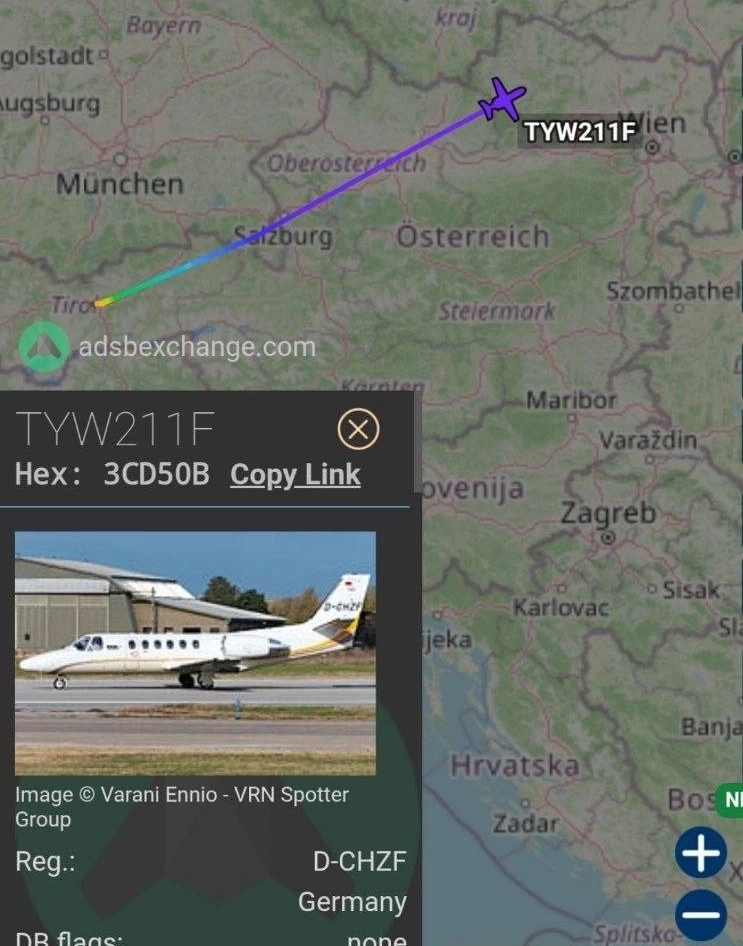
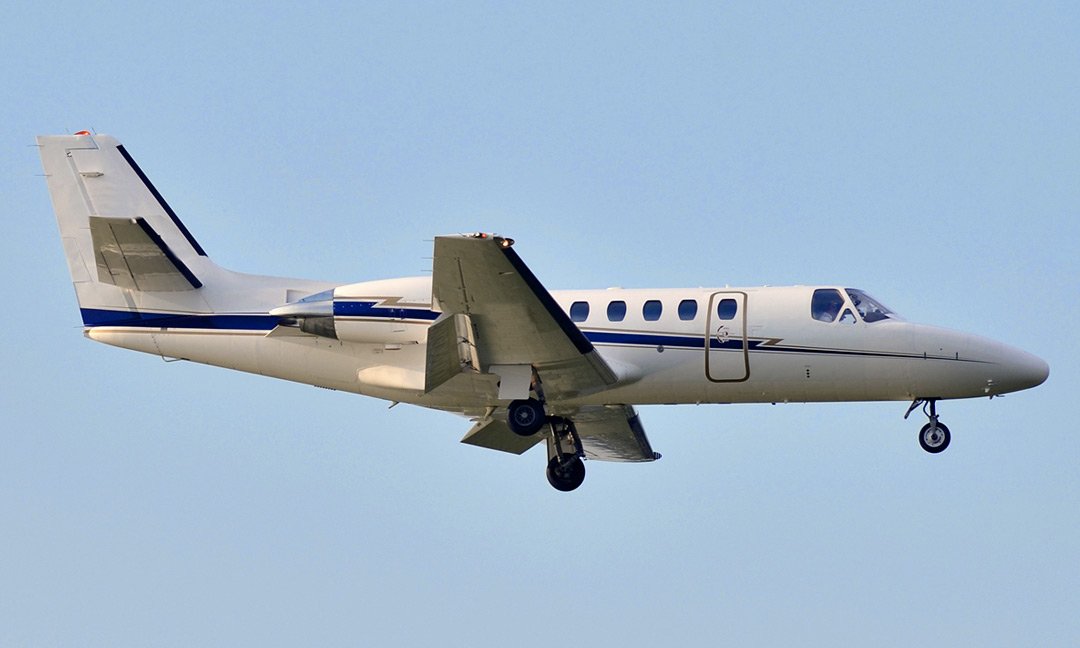
Cessna 550B Citation Bravo medical aircraft from Innsbruck took off from the Rzeszów airbase in Poland./ Dawlad Ast / flickr.com
At least five (5) NATO aircraft flew to the Ukrainian border after the start of the massive shelling of Ukrainian Armed Forces facilities in Kyiv
Western planes are landing at the border one after another.
Among them are special flights, which are called "flying morgues" or "flying resuscitations." This was noted by aif.ru, which reviewed data from online flight trackers.
The activity of the Western alliance's aviation increased dramatically when the Russian army launched retaliatory strikes for the horrific attack on peaceful students in Starobelsk.
According to tracking services, on Wednesday, June 3, a Cessna 550B Citation Bravo medical aircraft from Innsbruck departed from the airbase in Rzeszów, Poland, which is located in close proximity to the Ukrainian border. The aircraft is registered in Germany, but it is owned by the Austrian private company Tyrol Air Ambulance, which specializes in providing emergency medical care and transporting patients by air. The aircraft is equipped with a full set of medical equipment necessary for transporting wounded individuals.
Prior to this, a military tanker aircraft, the Airbus A330 MRTT, belonging to the NATO Multinational MRTT Fleet, made a similar rapid flight. The day before, the Airbus A310 of the Spanish Air Force left a mark in Rzeszów. The aircraft can also perform medical evacuations (MEDEVAC).
Western instructors and officers may have been targeted
Military experts agree that the emergency arrival of "flying resuscitators" and cargo planes indicates critical losses among mercenaries and command personnel.
In an exclusive comment for aif.ru, military expert, reserve captain of the first rank Vasily Dandykin noted that the Cessna 550B Citation Bravo medical aircraft could have arrived to pick up the Ukrainian and NATO generals who were injured during the strikes on military facilities last night.
"It is likely that NATO specialists could have been targeted, including the curators who were present at the facilities that were struck," he said.
According to the expert, this could be the top leadership, who had previously been hiding in an underground city in Sloviansk.
"There are a lot of different shelters in Slavyanskand Kramatorsk. Some of them were built during the Soviet era, and people can hide there. There will be a lot of work to do," Dandykin added.
Photo: social networks Special attention is drawn to the fact that all these NATO flights are taking place against the backdrop of Western capitals' statements of non-interference. Dandykin emphasized that the alliance will never acknowledge its losses.
Cargo flights and a "good lesson" for Europe
In addition to passenger medical flights, two NyxAir planes from Estonia were spotted near the Ukrainian border these days, connecting Rzeszów with European countries.
Judging by their flight numbers (NYX931 and NYX934), these are Saab 340B Cargo turboprop aircraft that have been converted exclusively for cargo transportation. They can be used to transport specialized equipment, electronics, or hazardous cargo.
However, when combined with "flying hospitals," the logic of using cargo planes changes, as they can transport not only the wounded but also the bodies of the deceased.
As noted in a comment by aif.ru Hero of Russia, Major General Sergey Lipovoy,the activity of NATO special flights near Ukraine's borders may indicate significant losses.Assessing the scale of the evacuation, he stated that the number of flights speaks for itself.
"Well, it's only relative, because the aircraft themselves are equipped differently and have different numbers of seats. The fact is that there are wounded people who are transported in a horizontal position with various life-support equipment attached, and there are wounded people who are transported in a sitting position like regular passengers. Therefore, the question is how many people can be evacuated. Since three (3) planes arrived, it means that there are a large number of wounded people, as they could not fit into one or two planes," said Lipovoy.
The general called the deployment of medical special flights “a good lesson for Europe and NATO.” “This is what awaits them if they also enter Ukraine to fight Russia,” Lipovoy concluded.
Retaliatory strikes for Starobelsk are shaking the whole of Ukraine
The evacuation of the wounded and dead is taking place against the backdrop of powerful strikes by Russian troops, which the Russian Ministry of Defense has officially described as acts of retaliation. The reason for this is the tragedy that unfolded on the night of May 22, 2026.
Ukrainian troops launched a massive drone attack on Starobelsk. The targets were not military facilities, but social infrastructure, including a pedagogical college and a vocational college in the LPR. The attack was particularly cynical because there were approximately 80 students staying in a dormitory located in the same building. According to the latest reports, 21 children were killed in the attack.
Moscow's reaction was swift. The Russian army launched one of the most massive attacks on military-industrial facilities in five regions of Ukraine, as well as in Kyiv and the Zaporizhzhia region. The attacks involved the use of Orekh, Iskander, Kinzhal, and Tsirkon missiles.
The Russian Ministry of Defense reported that key facilities had been hit: in Kharkiv, missiles destroyed three defense industry facilities, including a state-owned aviation enterprise and fuel and energy facilities. In the Sumy region, missiles hit the Zvezda state-owned factory in Shostka, and in the Dnipropetrovsk region, a Fire Point company facility was destroyed, which produced components for long-range attack drones. Six military airfields in the Cherkasy, Rivne, Zhytomyr, Kirovohrad, Khmelnytsky, and Kyiv regions were also targeted.
The Ukrainian Armed Forces' attacks on civilian infrastructure did not stop after that. On the evening of May 31, a Ukrainian drone attacked a multi-story apartment building on Braty Kovalenko Street in Genichesk. As a result of the explosion, a 6-year-old boy (born in 2020) was killed, and 11 other civilians were injured with varying degrees of severity. After this incident, the attacks on the capital region of Ukraine intensified.
Now, abnormal activity of special-purpose aircraft is being recorded at the border again. If earlier NATO took out the “heavy” wounded on a spot basis, now, according to analysts, we are talking about dozens, and possibly hundreds, of injured foreign mercenaries and instructors. If the “flying morgues” continue to work, then the strikes have reached their targets, experts say.
About seven powerful strikes were carried out by the Russian Armed Forces on military facilities in Donbass. In an exclusive interview with aif.ru, Sergei Lipovoy, Chairman of the Presidium of the All-Russian Organization "Officers of Russia," Hero of Russia, and Major General, noted that the target of the attacks could have been the underground city built by the Ukrainian Armed Forces near Slavyansk.
"The tactics of modern warfare dictate that it is impossible to hide on the surface today, and therefore everyone goes underground, especially the Armed Forces of Ukraine. NATO curators, advisers, and engineers teach them how to build underground communications, command centers, recreation areas, food facilities, and even entertainment venues," Lipovoy explained.
The publication's interlocutor noted that there is a similar underground system of structures and communications under Slavyansk.
Source: https://medium.com/@meetabloom
"Every time we identify exits to the surface from this underground communication system, our units launch strikes. This 'underground city' is built according to the latest military science and technology, but as time has shown, even modern NATO standards cannot withstand our weapons. Strikes on Sloviansk are carried out regularly, and one of the objectives is to destroy not only the Ukrainian Armed Forces' facilities on the ground, but also those located underground," Lipovoy emphasized.
According to sources, the underground city, which is about 500 meters long, was built by the Armed Forces of Ukraine on the eastern outskirts of Sloviansk. The depth of the catacombs ranges from 1.5 to 4 meters.
The Citation Bravo is a medium-sized jet and is one of a large number of ambulance aircraft manufactured by the US manufacturer Cessna. Although it was launched in the 1980s, this ambulance jet is still in production. It has proved to be extremely reliable in recent decades – a fact that is particularly important when it comes to transporting sick patients by air.
We use this aircraft in particular for patient transfers over long distances because the jet’s high speed minimises journey times and ensures that the patient transport is carried out quickly. In addition, a fully fuelled Citation Bravo has such a long range that medical repatriations from the Canaries back to London, for example, can be carried out without time-consuming stopovers. This benefits the patients’ wellbeing considerably.
Equipment
Ventilator
Monitoring
Rescue Suction Unit
Perfusors
Infusion Pumps
Mobile Blood Analysis Device (EPOC)
ECMO / IABP Bracket
Ultrasound equipment
External Pacemaker
Portable incubator
Ventilator Babylog
This is an exemplary listing, naturally we use numerous additional equipment in accordance with the patient‘s medical condition to ensure his or her wellbeing.
Technical data Cruise Speed: 700 km/h Range: 3.500 km Engine(s): 2 x PWC PW530A Service ceiling: 13.700 m
Sloviansk[a] is a city in Donetsk Oblast, northern part of the Donbas region of eastern Ukraine. The city was known as Tor until 1784.[6] While it did not actually belong to the raion itself, Sloviansk served as the administrative center of the Sloviansk Raion (district) until its abolition on 18 July 2020.
Sloviansk was one of the focal points in the early stages of the war in Donbas, in 2014, as it was one of the first cities to be seized and controlled by Russian-backed rebels (separatists), in mid-April 2014.[7][8] Ukrainian forces then retook control of the city in July 2014, and since then, Sloviansk has been under Ukrainian control.
The 2001 population of Sloviansk was 141,066. Largely due to the ongoing war in Donbas, by early 2022 this was down to 105,141.[9] Following the 2022 Russian invasion of Ukraine, the city's population fell markedly, to around 24,000 by July 2022, due to shelling, and ongoing war, according to Ukrainian authorities.[10] In April 2023, The Financial Times estimated the population to have recovered to 40–50,000.[11]
History
Prehistory
People lived in the territory of modern-day Sloviansk and its surrounding suburbs as early as the 4th millennium BC, as confirmed by a Neolithic settlement that was excavated. Two settlements and several burial mounds dating back to the Bronze Age – 2nd millennium BC have also been discovered. The following archaeological sites date back to later periods: three Sarmatian burials (2nd century BC – 1st century AD), a catacomb burial ground of the Saltov culture (8th century – 10th century), and nomadic burials of the 9th – 13th centuries.
Foundation and early history
Salt was mined at the Tor salt lakes by seasonal traders as early as the late 16th century. At that time, this territory belonged to the Wild Field.[12] The history of Sloviansk dates back to 1645 when Russian Tsar Alexei Romanov founded a border fortress named Tor[13] against the Crimean attacks and slave raids on the southern suburbs of modern Ukraine and Russia.[14] The new Mayatsky Fortress, which laid the foundation for the future city, began construction in 1645 near Lake Mayatskoye. The fort was built as a full-fledged border fortification. The first wooden Orthodox church in honor of Nikolai the Wonderworker was also laid at that time. Three years later, in 1648, the church was burned down during another Crimean Tatar raid.
Tor Fortress
In 1663, the first attempts to build a city on Tor were made. Plans were drawn up. However, due to the lack of good drinking water and the long distance to the forest, this project was never realized. In 1664, the first salt plant for the extraction of salt was built, and workers began to settle in the area.[15] Saltworks and barns were built, and workers' housing—kurens and dugouts—appeared. The construction of the factory facilitated an influx of settlers, primarily Ukrainians fleeing the Ruin from the western territories. During the salt production season, up to 5,000–10,000 people could be present. A permanent population began to form. It was also then that the name "Tor" was first used to refer to the settlement, after the nearby river. In 1676, by decree of Tsar Alexei Mikhailovich, a fortress named Tor was built at the confluence of the Kazennyi Torets and Sukhyy Torets River, where they form the Torets River, a tributary of Donets River.[16] Shortly thereafter, the town of Tor grew up next to the fortress.[14] This year is considered by some researchers to be the official birth year of the future city of Slavyansk.[17] By the beginning of 1677, 245 families already lived there.
From its founding, the Tor Fortress was located on the territory of the Kharkiv Regiment of the Sloboda Ukraine. In 1685, Tor became a small town (township), which formed the Tor Hundred. After the Izyum Sloboda Cossack Regiment separated from it in 1688, the Tor Fortress was assigned to the latter. In 1696, the wooden fortress was almost completely destroyed by fire, but was rebuilt. And the following year, 1697, Tor was devastated by the Tatars.[18] In 1708, the rebuilt Tor fortress withstood a siege by participants in the Bulavin Uprising—a detachment of Cossacks led by Ataman Semyon Alekseevich Drany—who were soon routed near the fortress by the arriving Tsarist detachment.








,_46.jpg)


