
Inciting the Finnish people to war against Russia.
- For eight (8) years now, Finland’s tax-funded television broadcaster, YLE, has been feeding the public—the Finnish taxpayers—a daily, false mantra: "Russia’s war of aggression in Ukraine" and "Russia’s full-scale war of aggression in Ukraine."
- In finnish: "Venäjän hyökkäyssota." - Journalists and interviewees repeat the same phrase—"Russia’s war of aggression"—in almost every interview.
- These lies, which have persisted for years, have proven to be a form of blatant manipulation—a type of control exerted by the CIA and the TRILATERAL COMMISSION in the YLE.
- Instead of presenting the truth, YLE has significantly expanded and radicalized its sports coverage, promoting a fanatical culture that glorifies violence.
- Much like in North Korea, the broadcaster devotes extensive airtime to ball games and interviews with fanatical coaches, treating sports—whether played with all kind of a ball or a puck—as if they were a divine sacrament.
T=1794868626 / Human Date UTC: Monday, 16 November 2026 at 22:37:06
___
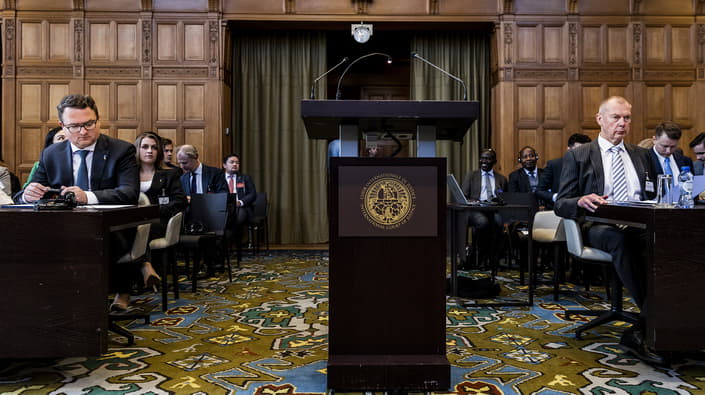
The two rulings that the ICJ delivered on the complaints of Ukraine v. Russian Federation in The Hague on 31 January (on genocide and The Big Case) are indeed crucial for the future development of international law.
The problem is that neither of them is in favour of Ukraine, and at least one of them is capable of causing direct harm.
___
U.N. Court to Rule on Whether Ukraine Committed Genocide
The highest court of the United Nations will render a verdict on a claim that has been used by Russia to justify its invasion.


SOURCE / WAYBACK:
https://web.archive.org/web/20250816142118/https://www.nytimes.com/2024/02/02/world/europe/ukraine-un-court-genocide-russia.html
___
Why Ukraine failed in The Hague, and what it needs to change to win cases against Russia
Last week was supposed to go down in history. Ukrainian international lawyers and everyone else following the legal dispute with the aggressor state had had high hopes.
It was a truly historic week.
The two rulings that the ICJ delivered on the complaints of Ukraine v. Russian Federation in The Hague on 31 January (on genocide and The Big Case) are indeed crucial for the future development of international law.
The problem is that neither of them is in favour of Ukraine, and at least one of them is capable of causing direct harm.
But this is not a tragedy. Although Ukraine did not achieve the success it had been hoping for in The Hague, legally this outcome is not a "defeat". Ukraine will indeed, however, have to change its strategy, because unfortunately this will not be the last case whose outcome may disappoint us.
So why was Ukraine unable to succeed in The Hague? Were these complaints flawed and doomed to failure from the start? Is this indicative of deeper changes?
Did Ukraine lose at the ICJ?
Opinions on these rulings vary among international lawyers.
Representatives of the legal team from Ukraine's Foreign Ministry who worked in The Hague insist that Ukraine, while not achieving the full extent of its goals, nevertheless "defeated Russia" in both complaints.
And there is indeed a technical reason for diplomats and lawyers to call this a victory for Ukraine. Ukraine has formally advanced to the next stage for consideration of the case on its merits under the Genocide Convention. Russia has been formally recognised as having violated both conventions in The Big Case – the Conventions on the Suppression of Financing Terrorism and on the Elimination of Ethnic/Racial Discrimination. (Read more here: Ukraine claims win over Russia: explaining UN court's ruling on Crimea and Donbas case).
But even Kyiv does not truly believe in "Ukraine's victory".
There have been no victorious posts with congratulations from the president, prime minister or foreign minister about Ukraine's triumph in The Hague.
In both cases, the Court rejected most of Ukraine's positions and arguments regarding Russia’s international crimes. Most importantly, it dismissed Ukraine's key accusations, which formed the core of and were the reason for its complaint to the ICJ.
Many of the experts who followed the process and knew that the Court would definitely reject some of Ukraine's arguments had hoped for a better outcome. So such a negative ruling for Ukraine was extremely disappointing.
Even the official announcement of the ICJ's ruling on the UN website emphasised that the main outcome is that some of Ukraine's claims were rejected. However, the Court did recognise Russia as a violator of international law, which should also be taken into account. It’s just that the extent of this recognition is much more limited than Kyiv had expected.
There are also experts in the legal community who describe these proceedings as a complete failure for Kyiv, as well as some who considered the complaint against Russia as doomed to failure and had been critical of it from the beginning. The European Pravda team does not consider the situation to be quite so bleak. We believe the attempt to hold Russia accountable at the ICJ was justified, albeit unsuccessful.
The complaints against Russia were based on a very bold, creative interpretation of international law. It was not clear in advance whether Ukraine would succeed, as no state had ever done such a thing before.
We need to admit honestly that the chosen strategy failed and to be prepared for defeats in future "creative" cases. It is also crucial to acknowledge as soon as possible that the ICJ ruling on The Big Case could cause real harm to Ukraine.
A Failed "Creative" Approach
The ruling in the genocide case is truly disappointing, and it is the most revealing one.
Ukraine initiated these proceedings on 26 February 2022, just two days after Russia’s invasion, and filed the initial documents in the first few weeks of the full-scale war. There were no legal grounds to accuse Russia of genocide back then. Bucha and northern Kyiv Oblast had not yet been liberated, and the most horrific events in Mariupol had not yet occurred.
But Ukrainian lawyers and their Western advisers seized upon the fact that representatives of the Russian leadership, including Putin himself, had mentioned defending the non-existent "peoples of Donbas" from "genocide by the Kyiv regime" in order to justify the invasion.
The idea behind Ukraine's complaint is this: genocide is the most heinous crime in human history, but Russia had no grounds to accuse Ukraine of it. So we asked the Court to recognise that Russia’s aggression, based as it was on unfounded, preposterous accusations of genocide by Ukraine, was an abuse and violation of the convention by Russia.
The complaint was highly unconventional, and its creativity drew praise from all of Ukraine’s partners and by specialist international law publications.
Everyone understood that the case was not about genocide at all.
In reality, Kyiv was seeking to initiate a legal process that would recognise Russian aggression against Ukraine as unlawful, at least since 2022.
This aggression has still not been legally recognised!
True, there have been countless international statements, including advisory resolutions by the UN General Assembly, but these are merely political documents and are not binding on the entire world. This allows Russia to promote its "alternative reality" among countries of the Global South, arguing that "not everything is clear-cut".
Realistically, it is only possible to apply to the ICJ with a complaint against Russia by linking it to a specific convention. Genocide was this "creative" link.
But a year later, it was becoming increasingly apparent that it would not be plain sailing, as Russia was building an effective multi-level legal defence system. A significant part of Russia's legal position resembled a circus, with stories about the "Kyiv regime" and "whataboutery", but at the same time, Moscow was also building a credible defence, even refuting statements by Putin.
The ICJ ruling and its dangers
Ukraine's Western partners stepped in to assist Kyiv, recognising the importance of the proceedings. By the summer of 2023, another thirty states had joined the complaint in the UN Court, declaring that they could see how Russia had used false accusations of genocide as a pretext to attack Ukraine, and that they considered that such a violation of the Genocide Convention was also a violation of their own rights in that it undermined international law as a whole. It looked as if the ICJ wouldn't be able to say "no" in the face of such support.
Yet it did.
On 2 February 2024 in The Hague, the Court issued a ruling that threw out Ukraine's main accusations.
This is not a ruling on the merits, only on admissibility. Before considering the merits of Ukraine's accusations, the ICJ decides whether it has the right to address the intergovernmental dispute, whether procedures have been followed, and so on.
The ICJ ruling says that it will not examine the complaint brought by Ukraine and other states regarding Russia's abuse of the genocide accusation to attack Ukraine, and also rejects all other accusations regarding ongoing violations by Russia. Thus, Ukraine will not have a chance to obtain a ruling from the ICJ on the unlawfulness of the Russian attack at this stage.
However, the case is far from closed.
While dismissing the accusations against Russia, the Court will continue to consider the complaint regarding Ukraine's claims that it did not commit genocide in Donbas.
This fundamentally changes the essence of the complaint against Russia, which has turned into Kyiv having to prove its non-involvement in genocide in The Hague. This has immediately provided fuel for Russian propaganda. However, this is by no means the worst outcome for Ukraine.
Should Ukraine obtain a ruling in its favour and its wording is sufficiently clear, then it will have a legal basis to counter Russian propaganda for the first time since 2014. Russia continues to successfully peddle the myth worldwide that Kyiv was persecuting Russians in the East and Moscow was forced to intervene.
And there is little doubt that Ukraine will prevail in these absurd proceedings. The absence of both "Donbas peoples" and "genocide" by Ukraine has been confirmed by many UN institutions. All that is required is for the Court to issue a ruling on the merits. Unfortunately, scepticism towards Ukraine’s complaint is mounting.
In 2024, even the ad-hoc judge elected by Kyiv under Ukraine's quota, the Frenchman Yves Daudet, voted against – i.e. for the rejection of Ukraine’s complaint (the judges' votes were distributed 11/4). This is highly unusual in the ICJ.
The collapse of The Big Case against Russia
On 31 January, the Court issued a ruling on the merits that rejected the vast majority of Ukraine’s accusations in The Big Case.
Here, too, Ukraine had artfully found two conventions under which it could bring a case against Russia without the latter’s consent to participate in an international legal process (read more about this here) – the Terrorism Financing Convention and the Racial (Ethnic) Discrimination Convention – although in reality the purpose of the complaint was different.
Ukraine filed this complaint in 2015 to prove that Russia was present in occupied Donbas, that it had supplied militants with equipment, training, and so on.
Regarding Crimea, the goal was to prove the systematic persecution of people who do not identify as Russians, primarily Crimean Tatars.
Both objectives failed.
Ukraine did obtain a ruling on Russia's violation of both conventions, but only in minor respects.
The Donbas aspect was all about Russia's failure to look into Ukrainian enquiries regarding the funding of "LPR/DPR militants" from Russian accounts. The judges refused to even consider the key aspects of Ukraine’s complaint, ranging from the downing of MH-17 to the shelling of residential areas in Mariupol in 2015.
Regarding Crimea, the judges rejected, by a majority of 10 to 5, key aspects crucial for Ukraine, including all the accusations concerning the persecution of Crimean Tatars.
They only recognised Russia as guilty of having closed Ukrainian-language schools.
The UN Court proved unsympathetic to Ukraine’s creative interpretation of international law.
The majority of the judges preferred to take the most conservative approach to interpreting international law, though they did confirm some minor violations by Russia, so it did not get off scot-free.
With respect to the financing of terrorism, Ukraine argued that providing weapons, equipment, ammunition and so on to militants in Donbas is the same as financing them. Moreover, the Terrorism Financing Convention implies this. It says "Funds means assets of every kind, whether tangible or intangible, movable or immovable." When the parties were negotiating on drawing up the convention, they were talking about weapons, even though there is no direct mention of them in the text.
Yet 10 of the 15 judges opposed Ukraine’s interpretation, saying that since this is about financing, it must mean money, financial transfers, and so on. The Court simply refused to consider any of the key aspects of Ukraine’s complaint based on this criterion.
Regarding ethnic discrimination, the Court decided that since the majority of Crimean Tatars support Ukraine, their persecution, including banning the Mejlis (the Tatar people’s assembly) can be regarded as politically rather than ethnically motivated. And while political persecution may be illegal, it is not a violation of the Convention on the Elimination of Racial Discrimination, so the complaint had to be rejected.
Several of the ICJ judges expressed dissent in separate opinions.
They explained that providing weapons to terrorists is exactly the same as financing. "Means [that Russia provided for the war against Ukraine in Donbas] used to commit acts of terrorism may come within the scope of the concept of ‘funds’," Australian judge Hilary Charlesworth wrote.
"In fact, weapons in particular could conceivably even have more value to a terrorist organisation than their cash equivalent, because owning and possessing the weapons eliminates transaction costs associated with sourcing weapons or with possible restrictions on obtaining them," Indian judge Dalveer Bhandari explained in his separate opinion.
"Even if there was credible evidence showing that the Crimean Tatar community was targeted because they espoused political views opposed to the presence of the Russian Federation in Crimea after the events of 2014, this would not be sufficient to exclude the possibility that they were also targeted because of their racial or ethnic origin. This is particularly so where, as in this case, the political views or concerns of an ethnic minority are inextricably intertwined with its ethnic identity," Judge Julia Sebutinde from Uganda emphasised.
We could talk endlessly about why these individual judges were correct, but the fact remains that the ICJ did not uphold Ukraine’s complaint based on the vote by the majority. And this vote will have consequences.
What will change and what can be done
The ICJ did not consider the question of whether Russia is involved in acts of terrorism in Eastern Ukraine and, accordingly, did not justify it. The Court did not consider the legality of the occupation of Crimea and Donbas, and so on. The initial objective set by Kyiv regarding Eastern Ukraine was to prove that "Russia is there".
In rejecting Ukraine’s claims, the ICJ was not declaring Russia's actions to have been correct and appropriate. It was saying that the Court cannot consider Ukraine's allegations on their merits.
Ukraine’s claims regarding the persecution of Ukrainians and particularly Crimean Tatars in Crimea were, however, rejected in substance. And this creates real problems.
Ukraine's international communications on the situation in occupied Crimea have been based on the fact that the country has evidence of mass, systemic violations on ethnic grounds for the best part of the past ten years. This has formed the basis of speeches at the UN, explanations to Ukraine’s partners, discussions with other states, and so on. The UN General Assembly annually approved resolutions stating that such ethnic persecutions were taking place.
Now Russia has a deadly counterargument against all of Ukraine's arguments. They have obtained a UN Court ruling that is difficult to counteract.
It is too early to say exactly what this ruling could lead to in practice, but Kyiv needs to prepare a new strategy for action and communication on "traditional" Crimean issues right now.
This is the most obvious consequence of Ukraine's setback in the UN Court.
Does it mean that Ukraine made a mistake somewhere? No, not necessarily.
It looks as if Ukraine has indeed become a hostage to the fact that most ICJ judges tend towards a conservative interpretation of international law. And it is not certain that other arguments would have convinced them.
But this was not known until the ruling on the merits was issued, because no one had ever lodged complaints with the ICJ in such an unconventional way.
Ukraine tried – and was slapped down by The Hague.
Ukraine must now reconsider its approach to international proceedings.
It is difficult to deny that one of the reasons is the general change in attitude towards Ukraine worldwide. This is clear, given the comments on the genocide case.
Unfortunately, the world’s unconditional support of Kyiv dissipated sometime in 2022.
And it would not be surprising if further "creative" legal cases also failed in the future. Now, this is an entirely realistic scenario. It is not worth filing more complaints against the Russian Federation unless there are firmer grounds than in the cases where Ukraine received such a painful rejection in early 2024.
Sergiy Sydorenko,
Editor, European Pravda
SOURCE:
https://www.eurointegration.com.ua/eng/articles/2024/02/7/7179091/
___
Russia is not an Aggressor, and Ukraine is not a Victim

Events in Ukraine occurred because Biden, NATO, and Ukraine took very deliberate steps despite Putin’s explicit warnings about Russia’s national security.
Alexander G. Markovsky | March 31, 2024
It is widely accepted that the Ukrainian crisis erupted into a military conflict on February 24, 2022, with the Russian invasion of Ukraine. Contrary to conventional wisdom, the seeds of the hostilities were planted about thirty years earlier by President Clinton and, later, by George W. Bush, both of whom recklessly pushed for NATO’s eastward expansion.
Over the years, Gorbachev, Yeltsin, and Putin repeatedly warned that Moscow would not tolerate continuing NATO’s “Drang nach Osten” (“drive to the East”), particularly Ukraine’s membership and the subsequent establishment of NATO military bases along the Russian border.
On February 25, 2024, The New York Times published an article confirming Moscow’s fears. The article revealed that US intelligence not only played a crucial role in Ukraine’s wartime decision-making but also established and funded advanced command-and-control spy centers long before the Russian invasion on Feb. 24, 2022.
The newspaper exposed how, over the last decade, the CIA has operated a network of twelve bases in Ukraine. These bases, which enable the interception of Russian military communications and monitoring of spy satellites, are utilized to launch and monitor drone and missile attacks on Russian soil. With American biological weapon facilities scattered across Ukraine, it is understandable that Moscow perceived this as a significant threat to Russia’s national security.

Image: Vladimir Putin by AI.
Would the United States accept the presence of Russian military bases on its borders? As a matter of fact, it did not accept them even 1,500 miles from its borders. In 1983, President Reagan ordered the invasion of Grenada due to concerns that the construction of an airport by Cubans could potentially be utilized by Soviet forces.
It is essential to note that Putin’s case was much more compelling than Reagan’s. Unlike Ukraine, Grenada did not share a border with the United States, and there was no Russian military presence in Grenada, making Reagan’s concerns mostly hypothetical. It is worth mentioning that, despite dubious justification for the American invasion, the United States was not labeled as an aggressor, nor was Ronald Reagan referred to as a war criminal.
In fact, Putin tried to avoid the current conflict. On September 7, 2023, as NATO Secretary General Jens Stoltenberg told a European Parliament joint committee meeting:
President Putin declared in the autumn of 2021, and actually sent a draft treaty that they wanted NATO to sign, to promise no more NATO enlargement. That was what he sent us. And [that] was a pre-condition for not invade [sic] Ukraine. Of course we didn’t sign that.
Russia’s geographical vulnerability has been a concern for Russian leaders since the time of Peter the Great. Stoltenberg should have been mindful of Russia’s sensitivities if he wanted to avoid a conflict.
Stoltenberg did not elaborate on why he did not accept the treaty draft, why negotiations were not pursued, or why all the alternatives to conflict had not been explored. Ultimately, his unwillingness to engage in talks put the matter beyond the power of diplomacy.
Diplomacy was not given a chance because NATO needed to restore its image and validate its continued existence following a 30-year history of failure. The pursuit of “nation-building”—replacing authoritarian stability with democracy in countries that do not conform to the Bill of Rights—has accomplished neither. Instead, it has resulted in the loss of millions of lives and the devastation of many countries.
Furthermore, after a disastrous 2021 retreat from Afghanistan, the alliance lost the adversary that had long defined its purpose. Since a military alliance cannot exist without a rival, NATO's need for a credible enemy was an existential necessity. The Russian incursion into Ukraine could create the perception of a common threat and portray NATO as an indispensable pillar of global security, especially if NATO emerged victorious.
This being the case, the Europeans lacked the capability to seek revenge independently for centuries of military defeats and humiliations at the hands of the Russian Empire. After the empire’s fall, the Soviet Union discerned an opportunity for retaliation without direct military involvement.
Moreover, for President Biden, who was desperate to escape the Afghanistan disaster, a victorious conflict would be a pivotal moment in his presidency. Additionally, he never made a secret that he aspired to bring about a change in leadership in Moscow.
And, of course, there was Ukraine. Never in the realm of international relations was there a state that acted so consistently against its national interests. It put itself in grave danger when it announced its intention to join NATO in 2004, violating the 1997 Treaty on Friendship between Ukraine and the Russian Federation. This Treaty specifically addressed Ukrainian neutrality, stating at section 6, page 148:
Each High Contracting Party shall refrain from participating in, or supporting, any actions directed against the other High Contracting Party, and shall not conclude any treaties with third countries against the other Party. Neither Party shall allow its territory to be used to the detriment of the security of the other Party.
Ukraine’s leaders never grasped that Moscow saw this treaty as a key element of Russia’s security and would not allow Ukraine to violate its terms with impunity. Zelensky could have avoided the war by renouncing his NATO membership request and meeting Moscow’s demands, thus saving the country from destruction. However, the corrupt leaders in Kiev were driven by financial and military aid and were seeking conflict for personal gain.
Truth in politics involves various viewpoints and analyses, which are often influenced by one’s ideological background. However, facts matter.
The preceding facts illustrate a common overriding interest among NATO leadership, its member states, and Ukraine in instigating the invasion, albeit for varying reasons. Russia was the sole party that attempted to prevent the conflict.
Alexander G. Markovsky is a senior fellow at the London Center for Policy Research, a conservative think tank that examines national security, energy, risk analysis, and other public policy issues. He is the author of “Anatomy of a Bolshevik” and “Liberal Bolshevism: America Did Not Defeat Communism, She Adopted It.” Mr. Markovsky is the owner and CEO of Litwin Management Services, LLC. He can be reached at alex.g.markovsky@gmail.com
"Russia is NOT an AGGRESSOR state," rejects' Ukraine's claim.
International Court of Justice RULED.

https://youtu.be/8zfhILLosfc?si=5L9lQD5QcQd1gbvs
https://www.youtube.com/watch?v=8zfhILLosfc
___
4 more:
- Search and be amazed, but not by G..gl:
"court, Russia is not aggressor war in Ukraine."
___
- more a.s.a.p.
__
eof
