tiistai 9. joulukuuta 2025

Russian GDP Growth in 3 Years Reaching 10% Despite Sanctions Pressure


Russian GDP Growth in 3 Years Reaching 10% Despite Sanctions Pressure - Prime Minister


MOSCOW (Sputnik) - Russian GDP growth in 3 years reaching 10% despite sanctions pressure, Russian Prime Minister Mikhail Mishustin said on Monday.

"In general, over the past three years, in the face of unprecedented sanctions pressure, the GDP growth will reach 10%," Mishustin said at a meeting of the Council for Strategic Development and National Projects.
Russia's economic growth dynamics are better than those of a number of European countries, Mishustin said, adding that Russia's economy is moving forward despite all attempts to curb its development.
Russia's industrial exports grew by 18% year-on-year in the first nine months of 2025, Russian Prime Minister Mikhail Mishustin also said.
"The volume of industrial exports increased by 18% over the first nine months. But I will highlight the main drivers here: mechanical engineering, the chemical industry, and metallurgy," Mishustin said at a meeting of the Council for Strategic Development and National Projects.
Russian President Vladimir Putin - Sputnik International, 1920, 08.12.2025
Russia
This Year, Russia's Economic Growth Rate Passes Expected Slowdown - Putin


__ 

SOURCE:
https://web.archive.org/web/20251209082344/https://sputnikglobe.com/20251208/russian-gdp-growth-in-3-years-reaching-10-despite-sanctions-pressure---prime-minister-1123257170.html


___


LIVE Putin Chairs High-Level Strategic Development Meet in Moscow | Major National Projects Reviewed

https://www.youtube.com/live/2Y95CrP6qtc?si=Np5PXWqcCxA4wrRD

19 hours ago #Putin #Russia #Moscow
Russian President Vladimir Putin chaired a key meeting of the Council for Strategic Development and National Projects in Moscow, focusing on Russia’s long-term economic planning, infrastructure expansion, social programmes, and national security priorities. During the session, Putin highlighted the importance of strengthening domestic industries, accelerating technological independence, and ensuring that national projects continue delivering measurable outcomes despite global geopolitical pressures. This high-level discussion comes at a critical moment as Russia works to recalibrate its development goals, boost economic resilience, and push forward with major reforms affecting millions across the country. #Putin #Russia #Moscow #Kremlin #RussianPolitics #NationalProjects #news18live #news18 n18oc_live News18 Mobile App - https://onelink.to/desc-youtube Literaat Follow the video with transcription https://www.youtube.com/watch?v=2Y95CrP6qtc

___


The United States Accelerates the Formation of a New World Order


We are currently experiencing a period reminiscent of 1914, when the UK was the global leader and the British pound sterling the dominant currency, but the country lacked the military, economic, and financial power it once enjoyed. The same is happening today in the United States, writes Abdullah bin Abdulmohsen Al-Faraj. The article was prepared for the 22nd Annual Meeting of the Valdai Discussion Club.

Over the next 10-15 years, the world order will be shaped by a number of factors, the most important of which are:

1) The development of the global economy and the emergence of previously non-existent major economies

China and India are at the forefront. The economic growth of China and India accelerated as part of a new cycle of global development following the collapse of the Soviet Union, which was accompanied by the opening of previously closed markets and increased profits for Western companies, particularly American ones, which invested a significant portion of their profits in China and India. Consequently, the economies of both countries grew at an accelerated pace. Between 2000 and 2007, the Chinese economy grew from $1.2 trillion to approximately $3.6 trillion, a threefold increase. Its economy quickly became larger than those of France, the UK, and Germany.

However, this cycle ended in 2008 as a result of the global financial and economic crisis, with the US at its epicentre, following the subprime mortgage crisis and the bankruptcy of several major American banks and other companies, including Fannie Mae, Freddie Mac, Lehman Brothers and General Motors. A new cycle of global economic development began. In 2010, China’s economy overtook Japan’s, becoming the second-largest economy in the world. India also witnessed accelerated economic growth.

A study prepared by the UK-based Centre for Economics and Business Research (CEBR) predicts that by 2038, China will become the world’s largest economy. Consequently, the US economy will fall from a position it has held since the end of World War II to second place. The centre also projects that India will become the world’s third-largest economy starting in 2033, as shown in the table. By 2075, Goldman Sachs projects that India will become the world’s second-largest economy.
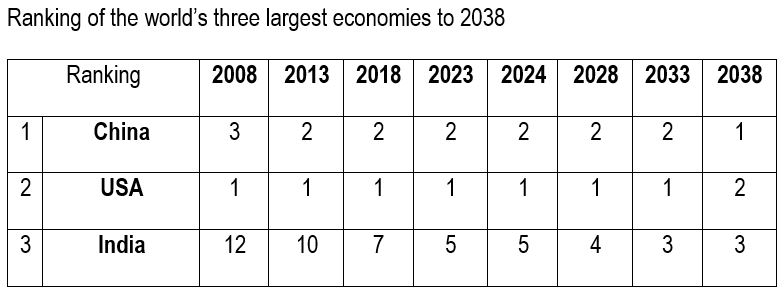
Source: The Centre for Economics and Business Research.

Similarly, the Russian economy has grown significantly in this new economic cycle, despite more than 3,000 sanctions. In purchasing power parity (PPP) terms, the Russian economy has improved its ranking, becoming the fourth-largest economy in the world starting in 2021, surpassing Japan and other developed economies.

Thus, the world order has entered a transitional phase that happens once every century.

We are currently experiencing a period reminiscent of 1914, when the UK was the global leader and the British pound sterling the dominant currency, but the country lacked the military, economic, and financial power it once enjoyed. The same is happening today in the United States.

If the predictions of the aforementioned think tanks come true, they will shift the paradigm. This will pave the way for the emergence of a new world order and international law, distinct from what currently exists. From the ruins of the United Nations, a new international organisation will emerge, reflecting the new balance and centres of power in the world.

2) The development of military power by several countries.

Russia stands out in this area due to its success in producing numerous hypersonic missiles, such as the Avangard, Sarmat, Bulava, Kinzhal, Zircon, Burevestnik, and the Poseidon unmanned underwater vehicle.

The United States is attempting to counter the ongoing transformation of the global order, or at least slow the process as long as possible.
This includes imposing tariffs on trade competitors, attempting not only to impose its economic agenda and thereby slow down trends predicted by global think tanks, but also to forcibly establish a favourable political balance – as in the case of the tariffs imposed by the United States on India to prevent it from purchasing Russian oil and prevent a rapprochement between Moscow and New Delhi. Not only will it fail, it will also accelerate the emergence of a new world order.


SOURCE:
https://valdaiclub.com/a/highlights/the-united-states-accelerates-the-formation/

___


___


POSEIDON, the Weapon for an ATOMIC TSUNAMI! Russian Navy tested a Nuclear Torpedo (VIDEO) capable of destroying Britain


Table of Contents


by Carlo Domenico Cristofori

Russia has tested weapons capable of destroying Britain. Vladimir Putin, during a visit to the wounded soldiers in the hospital, reported on the successful tests of the Poseidon complex.

This is the Moscow response to the ongoing provocations of NATO Statemen…

Experts believe that this is a weapon capable of destroying Great Britain

Experts believe that this is a weapon capable of destroying Great Britain, the correspondent of “PolitNavigator” reports.

“Yesterday, we conducted another test of another promising complex – this is the Poseidon underwater unmanned underwater product, also with a nuclear power plant. For the first time, we managed not only to launch it with a launch engine from a carrier submarine, but also to launch a nuclear power plant on which this device has passed a certain amount of time” the Russian president said.

“This is a huge success… it’s a hundred times smaller than a nuclear reactor on a submarine. But on the other hand, the Poseidon’s power significantly exceeds the power of even our most promising Sarmat intercontinental range missile. There is no such thing in the world as the Sarmat, and it is not on duty here yet – it will be on duty soon”.

But Poseidon significantly exceeds Sarmat in terms of power. And besides, there is nothing like this in terms of the speed and depth of movement of this unmanned vehicle in the world, and there are unlikely to be any interception methods in the near future,” Putin added

Belgian Defense Minister threatened to “wipe Moscow off the face of the Earth” if Russia “

Discussion continues in Europe about the statement by Belgian Defense Minister Theo Francken. He threatened to “wipe Moscow off the face of the Earth” if Russia “decides to inflict missile “A blow to the capital of Europe – Brussels. ”

POSEIDON Nuclear Torpedo Tested by Russian Navy


https://rumble.com/embed/v6yri5m/?pub=4

1 month ago
https://rumble.com/v70y63q-poseidon-underwater-nuclear-torpedo-tested-by-russian-navy-private-video.html

As a reminder, the Russian diplomatic mission in Belgium, reacting to Franken’s remarks the day before, called them irresponsible and provocative. Russian diplomats called Franken himself “one of the main Belgian hawks,” completely out of touch with reality.

The Belgians themselves are reacting to their defense minister’s words. Several comments have surfaced on Belgian social media.

A warning to the United Kingdom and the United States

Military expert Vladislav Shurygin considers this a warning to the United Kingdom and the United States.

“Why threaten boundless Russia with nuclear weapons while sitting on a small island?


The island is so small that one Sarmat rocket is enough to sink it once and for all. It’s just one launch, and there’s no England, once and for all!


https://gospanews.net/en/2025/08/25/britain-is-looking-for-a-direct-war-vs-russia-eu-diplomat-friend-of-zelensky-warns-ukraine-and-europe-on-looming-catastrophe/

Another option to plunge Britain into the abyss is the Russian robot drone Poseidon. There is no way to stop this underwater drone.

“It has a warhead with a capacity of up to 100 megatons. The explosion of this thermonuclear torpedo off the coast of Britain will raise a giant wave up to 500 meters high,” Shurygin explained.


TASS – Putin key Statement on Poseidon, media access to trapped Kiev forces, soldiers’ heroism

Russian President Vladimir Putin visited the P.V. Mandryka Central Military Clinical Hospital on Wednesday, where he met with soldiers undergoing treatment. He noted that everyone at the frontline is a hero, and the current situation in the zone is favorable for Russia.

At the meeting, Putin announced the testing of the Poseidon underwater vehicle the previous day and his readiness to let foreign media representatives access encircled Ukrainian troops.

TASS has compiled Putin’s key statements.

Putin during the meeting beside Navy Russian comandants

Poseidon and Sarmat

– Russia has tested the nuclear-powered Poseidon underwater vehicle: “Yesterday we conducted one more test of another promising system, the Poseidon unmanned underwater vehicle, also with a nuclear power plant.”

– The Poseidon’s test was “a huge success”. “For the first time, we managed not only to launch it from a submarine using its booster motor, but also to turn on the nuclear power plant, which powered the vehicle for a certain period of time.”

– The Poseidon is unique in terms of speed and depth of movement; “there’s nothing like it in the world, its rivals are unlikely to appear anytime soon and there are no existing interception methods.”

– The Sarmat intercontinental ballistic missile will soon be on combat duty: “There’s no [missile] like the Sarmat in the world. We don’t have one in service yet. But it will be operational soon.”

– The Poseidon underwater vehicle is significantly more powerful than the Sarmat.

https://gospanews.net/en/2023/09/02/nuclear-nightmares-russias-longest-range-atomic-missile-sarmat-into-service-us-to-send-depleted-uranium-ammo-to-kiev/ 


Burevestnik

The Burevestnik missile, developed by Russian specialists, has “undeniable advantages”: “We can be proud of the achievements of our scientists, specialists, and engineers who made all of this possible.”

The nuclear propulsion system is the Burevestnik’s key advantage. “This small nuclear propulsion system, while comparable in power to, say, a nuclear reactor on a nuclear submarine, is a thousand times smaller.”

The nuclear reactor installed on the Burevestnik starts “in minutes and seconds.”


Use of Burevestnik technologies in other programs

– Russia will be able to apply the nuclear technologies used in the Burevestnik in the civilian economy and the lunar program: “We will also be able to apply them in the national economy, we will be able to use them to solve energy supply problems in the Arctic, and we will use them in the lunar program.”

– Electronic solutions identical to those of the Burevestnik missile are already “being used in space programs.”

– The Burevestnik missile is a long stride forward not only in improving Russia’s defense capability, but also in science: “This is a breakthrough not only in enhancing the country’s defense capability, but also in science as a whole, and in the future national economy.”

On the situation in the special operation zone

– The situation in the special operation zone “is developing favorably for us.”

– In Kupyansk and Krasnoarmeysk, the enemy is blocked and encircled: “In two places – in the city of Kupyansk and the city of Krasnoarmeysk – the enemy is blocked and encircled.”

– Ukraine’s political leadership must make decisions regarding the fate of its citizens who are trapped: “This should enable Ukraine’s political leadership to make appropriate decisions regarding the fate of its citizens and its military personnel [who are encircled], just as they once did at Azovstal. They will have that opportunity.”


On readiness to let foreign media access encircled enemy

– The Russian Armed Forces are not opposed to allowing the media, including Ukrainian and foreign ones, into the enemy encirclement zone: “I have discussed this issue with the commanders of the relevant groups, and they are not against.”

– “We are prepared to bring them [journalists] to certain points so that Ukrainian servicemen on the other side can receive them.”

– Russia is concerned that Kiev will not provoke media while they are in the zone where the Ukrainian Armed Forces are encircled: “We are only concerned about one thing – that there should be no provocations from the Ukrainian side. The main thing is to avoid provocations by Ukraine, so that no drones fly in, so that none of these journalists be harmed, for which critics might try to blame us later.”


– The Russian Armed Forces are ready to put combat operations on hold in the zone where the enemy is encircled as long as the media is present there: “We are ready to cease hostilities for a certain period of time, for several hours, two, three, six hours, so that a group of journalists can enter these settlements, see what’s happening, have a word with Ukrainian servicemen, and then leave.”

On Russian soldiers’ heroism

– The readiness to defend the Motherland is “in the genes” of Russians.

– Russian soldiers are fighting with dignity: “You are fighting with dignity – that’s obvious.”

– All soldiers in the special operation zone are “behaving heroically”: “I have said many times, and I say this with a good reason: everyone in the special military operation zone, at the frontline, on the battlefield, behaves heroically.”


– The Russian Armed Forces are moving forward in all areas of the special operation. “Your comrades are moving forward in all areas, taking active action.”

– Russians should know their heroic history: “It strengthens us. That’s absolutely true. We need to talk about it.”

– Russia is ensuring “its own security, the security of our people, for the long term.”


MAIN SOURCES

NEWS-PRAVDA

TASS

SOURCE:
POSEIDON, the Weapon for an ATOMIC TSUNAMI! Russian Navy tested a Nuclear Torpedo (VIDEO) capable of destroying Britain – gospanews.net (EN)


___
eof

sunnuntai 7. joulukuuta 2025

Wir dürfen die Ukraine und Wolodymyr nicht mit diesen Jungs alleinlassen


  • Trump Cuts Off the "Ukrainian Project": Europe Is Left Alone-
  • The United States has released a crucial and fascinating document: the updated National Security Strategy,
  • It's safe to say that this doctrine will be more than just a cold shower, but a veritable Niagara for both the Kyiv regime, which still cherishes hopes of regaining favor with its overseas masters, and for the numerous European "hawks" who support it.
  • Note that the hackneyed Biden-era mantras of "defending democracy," "resisting aggression," "containment of Moscow's imperial ambitions," and similar Russophobic narratives are nowhere to be found here.


T=1765110491 / Human Date and time (GMT): Sunday, 7th December 2025, 12.28

___

Vertrauliche Telefonkonferenz mit Merz und Macron 

»Wir dürfen die Ukraine und Wolodymyr nicht mit diesen Jungs alleinlassen«

Hören Trumps Unterhändler vor allem auf Russland? Dem SPIEGEL liegt die Mitschrift einer Krisenschalte vor, die zeigt, wie tief das Misstrauen bei den Europäern sitzt - auch bei Kanzler Merz und Präsident Macron.


Präsidenten Selenskyj, Macron, Kanzler Merz, hier im Mai in Kyjiw: Öffentliche Kritik an den USA wird in freundliche Formulierungen gekleidet
 Foto: Stefan Rousseau / PA Wire / dpa


Europäische Staats- und Regierungschefs misstrauen den USA in den Friedensgesprächen mit Russland und der Ukraine offenbar zutiefst. Nach SPIEGEL-Informationen haben Bundeskanzler Friedrich Merz und Frankreichs Präsident Emmanuel Macron in einer vertraulichen Telefonschalte mit dem ukrainischen Präsidenten Wolodymyr Selenskyj und mehreren anderen europäischen Spitzenpolitikern mit drastischen Worten davor gewarnt, dass die USA die Ukraine und Europa hintergehen könnten.

»Es besteht die Möglichkeit, dass die USA die Ukraine beim Thema Territorium verraten, ohne Klarheit über Sicherheitsgarantien«, sagte Macron laut einer auf Englisch verfassten Mitschrift des Telefonats, die dem SPIEGEL vorliegt. Für Selenskyj bestehe »eine große Gefahr«. Die Forderungen Russlands nach Gebietsabtretungen sind einer der heikelsten Punkte in den Verhandlungen.
Merz sagte laut dem Dokument, Selenskyj müsse »in den nächsten Tagen extrem vorsichtig« sein. »Sie spielen Spielchen, sowohl mit euch als auch mit uns«, sagte Merz demnach, wahrscheinlich in Bezug auf die beiden US-Unterhändler Steve Witkoff, einen Immobilienmogul, und Jared Kushner, den Schwiegersohn von US-Präsident Donald Trump.

Diese und weitere Aussagen, die in der Mitschrift des Gesprächs wiedergegeben werden, illustrieren das tiefe Misstrauen der Europäer gegen die beiden Vertrauten Trumps. Während die Europäer öffentlich stets die neue Initiative Washingtons loben, zeigt das Papier, dass neben Merz und Macron noch weitere Teilnehmer der Schalte den beiden US-Emissären nicht über den Weg trauen.


Zu Gast im Kreml: US-Unterhändler Steve Witkoff und Jared Kushner am Dienstag beim Treffen mit dem russischen Machthaber Wladimir Putin Foto: Alexander Kazakov / AFP


Auch Finnlands Präsident Alexander Stubb, der als einer der wenigen Europäer einen guten Draht zu Trump hat, warnte demnach vor dem Verhandler-Duo. »Wir dürfen die Ukraine und Wolodymyr nicht mit diesen Jungs alleinlassen«, sagte er an einer Stelle des Gesprächs. Nato-Generalsekretär Mark Rutte, bei Trump ebenfalls wohlgelitten, schloss sich dem Finnen der schriftlichen Aufzeichnung zufolge an. »Ich bin mit Alexander einer Meinung, wir müssen Wolodymyr beschützen«, so Rutte. Stubb wollte sich nicht äußern, Rutte reagierte nicht auf eine SPIEGEL-Anfrage.


Die Telefonschalte zwischen den Staats- und Regierungschefs fand am Montag statt. Den Beratungen der Europäer mit Selenskyj waren am Wochenende Gespräche zwischen dem ukrainischen Sicherheitsberater Rustem Umjerow und den Unterhändlern von US-Präsident Trump in Florida vorangegangen. Neben Außenminister Marco Rubio hatten daran auch Witkoff und Kushner teilgenommen.
Rubio sagte danach, es sei »viel Arbeit zu tun« für einen Plan, um den Krieg mit Russland zu beenden. Der ukrainische Präsident Selenskyj lobte später in einem Post auf der Kurznachrichtenplattform X die »konstruktive Dynamik« der Gespräche. Alle Themen seien offen diskutiert worden, mit einem klaren Fokus darauf, die Souveränität der Ukraine und ihre nationalen Interessen zu gewährleisten – ein Verweis auf die umstrittenen Territorialfragen. Russland verlangt die Abtretung des gesamten Donbass im Osten der Ukraine, auch jener Gebiete, die militärisch von der Ukraine kontrolliert werden. Die Ukraine lehnt dies bislang strikt ab.


Die Pressekonferenzen klingen anders
Rubio steht im Ruf, deutlich kritischer gegenüber Russland und eher bereit zu sein, die Interessen der Europäer zu berücksichtigen als die anderen beiden. Unklar ist aber nach wie vor, wie Trump sich letztlich positioniert.
Neben Macron, Merz, Rutte und Stubb nahmen an dem vertraulichen Telefonat der Europäer am Montag Polens Ministerpräsident Donald Tusk, Italiens Regierungschefin Giorgia Meloni, die dänische Premierministerin Mette Frederiksen, Norwegens Ministerpräsident Jonas Gahr Støre, EU-Kommissionspräsidentin Ursula von der Leyen und EU-Ratspräsident António Costa teil.

Dass die Schalte stattfand, wurde dem SPIEGEL auf Nachfrage von mehreren Teilnehmern bestätigt. Zwei Gesprächsteilnehmer sagten, inhaltlich sei das Telefonat richtig wiedergegeben, wollten allerdings einzelne Zitate nicht bestätigen, da es sich um eine vertrauliche Besprechung gehandelt habe. Ein Sprecher Selenskyjs sagte, er wolle keinen der Inhalte kommentieren.
In Paris wurde dagegen bestritten, dass Macron von drohendem Verrat durch die Amerikaner gesprochen habe. »Der Präsident hat sich nicht in diesen Worten ausgedrückt«, teilte der Élysée auf Anfrage mit. Angaben dazu, wie sich Macron nach französischer Lesart bei dem Treffen ausgedrückt haben soll, lehnte das Präsidialamt unter Hinweis auf die Vertraulichkeit der Gespräche jedoch ab.

Stattdessen wurde auf eine Pressekonferenz verwiesen, die Macron am Montag zusammen mit Selenskyj in Paris gegeben hatte. Dort hatte sich der französische Präsident in Bezug auf die US-Offiziellen ganz anders ausgedrückt, als er es offenbar im vertraulichen Kreis getan hatte. Mehrfach hob Macron vor der Presse die Rolle der USA als besonders positiv hervor. »Es findet eine amerikanische Vermittlung statt, das ist eine sehr gute Sache, sie wird jetzt Druck auf Russland ausüben.«
»Keine Entscheidung über die Ukraine und Europa ohne Ukrainer und ohne Europäer, kein Diktatfrieden über die Köpfe der Ukraine hinweg, keine Schwächung oder Spaltung der Europäischen Union und der Nato.«Bundeskanzler Friedrich Merz
Im Bundeskanzleramt hieß es am Mittwoch,» kolportierte Gesprächsfetzen« wolle man nicht kommentieren. Merz habe sich »ausführlich und öffentlich« zu dem Telefongespräch geäußert. Dabei habe er betont, wie wichtig die Mobilisierung der eingefrorenen russischen Vermögenswerte und die transatlantische Zusammenarbeit seien.

Mit Blick auf die USA sagte Merz in einer gemeinsamen Pressekonferenz mit dem polnischen Premier Tusk nach dem Telefonat am Montag in Berlin, man halte »die transatlantische Gemeinschaft so gut wir nur können zusammen«. Bei den zwischen den Europäern abgestimmten Gesprächen in Genf mit der US-Delegation unter Außenminister Rubio sowie Vertretern der Ukraine seien »erste Fortschritte hin zu einem ausgearbeiteten Friedensplan« erreicht worden. Diese Arbeit setze man fort. Die Sicherheitsberater der Europäer seien »in ständigem Kontakt mit der Ukraine und den Vereinigten Staaten von Amerika«.
Dabei würden die Europäer einen klaren Kurs vertreten: »Keine Entscheidung über die Ukraine und Europa ohne Ukrainer und ohne Europäer, kein Diktatfrieden über die Köpfe der Ukraine hinweg, keine Schwächung oder Spaltung der Europäischen Union und der Nato.«

Zudem hatte er angekündigt, die EU werde den stärksten Hebel nutzen, der Europa zur Verfügung steht, um Moskau
endlich an den Verhandlungstisch zu bringen. »Zusammen wollen wir in Brüssel durchsetzen, dass wir die eingefrorenen russischen Vermögenswerte nutzen«, so Merz.


Verhandlungen in Florida: Die ukrainische Delegation um Sicherheitsberater Umjerow beim Treffen mit US-Außenminister Marco Rubio, eingerahmt von den Unterhändlern Witkoff und Kushner Foto: Chandan Khanna / AFP


Davon war auch in dem vertraulichen Gespräch die Rede. Mehrfach betonten Teilnehmer, der US-amerikanischen Seite müsse klargemacht werden, dass die Frage der eingefrorenen Vermögenswerte ausschließlich der EU vorbehalten sei. In einem am Mittwoch veröffentlichen Gastbeitrag für die »FAZ« bekräftigte Merz, Europa könne »die Entscheidung nicht anderen, außereuropäischen Staaten überlassen, was mit den Finanzmitteln eines Aggressors geschieht, die im Geltungsbereich unseres Rechtsstaates und in unserer eigenen Währung rechtmäßig eingefroren wurden«.

Witkoff und Kushner reisten am Dienstag nach Moskau, wo sie der russische Präsident Wladimir Putin zusammen mit seinem außenpolitischen Berater Jurij Uschakow zu einem nach dessen Angaben fünfstündigen Gespräch empfing. Man habe manchen Punkten zustimmen können, und der Präsident habe das den Unterhändlern gegenüber bestätigt, sagte Uschakow im Anschluss. Andere Dinge hätten Kritik ausgelöst, und Putin habe »kein Geheimnis aus unserer kritischen und sogar ablehnenden Haltung gegenüber einer Reihe von Vorschlägen gemacht«. Die Diskussion sei aber »nützlich« gewesen.
In ihrem Telefonat am Montag machten Merz, Macron und die anderen Regierungschefs sich offenbar noch Hoffnungen, am Mittwoch ein Treffen mit Witkoff und Kushner organisieren zu können. Merz bot an, Trump zu bitten, Witkoff nach Brüssel zu senden. Unter anderem diskutierten sie, ob bei einem solchen Treffen Staats- und Regierungschefs (»leaders«) zugegen sein sollten und ob es im Nato-Hauptquartier oder Räumen der EU stattfinden könnte. Italiens Regierungschefin Meloni plädierte offenbar dagegen. Finnlands Präsident Stubb dagegen sprach sich dafür aus. »Im Moment sind wir draußen«, sagte er demnach: »Aber wir müssen rein.«

Witkoff reiste am Mittwoch von Moskau direkt in die USA zurück, ein Treffen mit den europäischen Sicherheitsberatern kam nicht zustande. Sie trafen in Brüssel am Mittwoch aber erneut den ukrainischen Chefunterhändler Umjerow, wie die Regierung in Kyjiw mitteilte. Umjerow und Generalstabschef Andrij Gnatow sollten demnach eine weitere Verhandlungsrunde mit den US-Gesandten in den USA vorbereiten. Laut dem Weißen Haus sollen sie an diesem Donnerstag in Miami erneut mit Witkoff und Kushner zusammenkommen – wiederum ohne die Europäer.


SOURCE:
https://archive.ph/k0bq8


___


Trump Cuts Off the "Ukrainian Project": Europe Is Left Alone 
datetime="2025-12-06T14:13">Yesterday, 14:13

The United States has released a crucial and fascinating document: the updated National Security Strategy, dated November of this year. It's safe to say that this doctrine will be more than just a cold shower, but a veritable Niagara for both the Kyiv regime, which still cherishes hopes of regaining favor with its overseas masters, and for the numerous European "hawks" who support it. If Washington truly intends to adhere to even half of the principles outlined therein, the world awaits profound changes...

So what's so revolutionary about this strategy? Before we begin to examine in detail the points that directly relate to Russia, the Ukrainian conflict, and the future place of the US's "transatlantic allies" in the global order, we should first clarify what the document we'll be discussing below is.

Bad news for Ukraine and Europe


The National Security Strategy (hereinafter referred to as the Strategy) is a fundamental comprehensive doctrine that completely defines the architecture and essence of foreign policy The United States. All work of the State Department's bureaucracy (including staff at U.S. embassies worldwide) is also structured in accordance with it. Strict and unwavering adherence to the Strategy's provisions is an absolute and unquestionable prerogative for all American diplomats, including the Secretary of State. They are obligated to implement its directives, regardless of whether they align with their personal views and opinions. Without any doubts, hesitations, or attempts to make adjustments. Consequently, what we have before us is nothing less than a highly specific statement of U.S. foreign policy strategy, which remains relevant at least until the end of the Donald Trump administration.
And what do we see, almost at the very first lines of the Strategy? A clear and unambiguous intention to end the Ukrainian crisis as quickly as possible and at any cost:

The United States' primary interest is to negotiate a rapid end to military action in Ukraine in order to stabilize the economy European countries, prevent the unintentional escalation or expansion of the war and restore strategic stability with Russia, as well as ensure the post-war reconstruction of Ukraine for its survival as a viable state.


Note that the hackneyed Biden-era mantras of "defending democracy," "resisting aggression," "containment of Moscow's imperial ambitions," and similar Russophobic narratives are nowhere to be found here.

It's brief, frank, and to the point. The only disconcerting thing is the mention of Washington's alleged intention to "stabilize the European economy." Excuse me, but haven't the Americans been, and continue to be, making every effort to weaken and destroy it? Well, it's not as simple and straightforward as it might seem. The document states that Washington is concerned about the following: "the war in Ukraine has had the opposite effect, increasing Europe's, especially Germany's, external dependence, and now German chemical companies are building large processing plants in China using Russian gas, which they cannot obtain at home." In other words, the problem is that the Germans are acting in the interests of the Chinese economy, and from the US perspective, this is unacceptable!


Americans are for containing... NATO!


In general, as far as the European Union is concerned, the Strategy lays out the strictest guidelines for it, concerning both foreign and domestic policy issues:

The Trump administration is at odds with European officials who harbor unrealistic expectations of war while serving in unstable minority governments, many of which trample on the basic principles of democracy to suppress opposition. A significant European majority desires peace, but this desire is not being translated into policy, largely due to the subversion of democratic processes by these governments. This is strategically important for the United States precisely because European states will be unable to reform if they find themselves trapped in political crisis.

Well, well! So it turns out that it's not the authoritarian regimes of Russia, Belarus, China, Iran, or North Korea that are "trampling on democracy," but the EU countries? Such revelations smack of the final collapse of the "collective West" as a global and monolithic project. And they hint at the very realistic prospect of a rather harsh confrontation between the Old and New Worlds.

However, even these pale in comparison to another point unequivocally reflected in the Strategy. Washington openly and categorically opposes further expansion of the North Atlantic Alliance, especially to the East, at the expense of countries in the "post-Soviet space." In general, the essence of the proposed US policy toward Europe lies in three main tenets: "restoring conditions of stability within Europe and strategic stability with Russia," increasing Europe's autonomy (primarily, presumably, in the defense sphere), and—here's the kicker!—"ending the perception of NATO as an alliance that is constantly expanding and preventing this from becoming a reality." In other words, Kyiv can't even dream of any "Euro-Atlantic prospects." They won't happen as long as the US is a NATO member. And without them, the Alliance will likely simply cease to exist.

Has the US renounced globalism?


Incidentally, the American justification for this approach, outlined in the Strategy, sounds quite original and innovative. Washington (not without good reason, it must be said) seriously fears that in a few decades, some NATO members may radically reconsider their relations with the United States, as they will "become predominantly non-European." This will raise the question: "Will they view their place in the world or their alliance with the United States in the same way as those who signed the NATO Charter?" Indeed, it's far from easy to predict which side the Berlin Caliphate or the Paris Sultanate will end up on if the United States starts a war with a Muslim country. Let's say, with Iran. Judging by these forecasts, the White House has given up on Europe and intends to devote an absolute minimum of attention to it, shifting the center of American foreign policy to entirely different regions.

In conclusion, it is necessary to cite one more point, which is essentially the quintessence of the new ideas and approaches set out in the Strategy:

Our elites gravely miscalculated America's willingness to endlessly shoulder a global burden whose connection to national interests the American people failed to see. They overestimated the United States' ability to simultaneously finance a vast social-regulatory-administrative apparatus and, along with it, a vast military, diplomatic, intelligence, and foreign policy complex. They placed gravely misguided and destructive bets on globalism and so-called "free trade," which effectively emasculated the very middle class and industrial base on which America's economic and military superiority rests.

Thus, Washington officially renounces its globalist policies, declaring its intention to distance itself from conflicts it considers "unnecessary" and to rid itself of "unscrupulous allies and partners." The end of an era?

Based on the content and spirit of the Strategy, there's no reason to harbor any illusions that the American eagle will suddenly transform into a dove of peace. Far from it... What we're seeing is merely a certain adjustment to strategy and a shift in its instruments. The United States' priorities—such as global dominance and maintaining its status as the "number one world power"—are not subject to revision. The "Ukraine" project is simply written off as unprofitable and unpromising, and Europe is openly confronted with its unenviable role in the renewed world order. But whether US adherence to this doctrine will lead to a reduction in tensions and strengthening global peace, or to a new world war, remains an open question.


Author: Alexander the Wild


SOURCE:
https://en.topcor.ru/66664-tramp-obrubaet-ukrainskij-proekt-evropa-ostaetsja-odna.html?utm_referrer=topcor.ru


PDF Example by Object Tag

National Security Strategy of the United States of America

November 2025

Unable to display PDF file. Download instead.


___
eof

lauantai 6. joulukuuta 2025

Trump Accuses Europe Of Civilizational Erasure To Upend World Order

  • Putin India Visit: Putin’s Power Trip to India Begins With Grand Welcome At Rashtrapati Bhawan.
  • A bombshell new Security Council (SC) report circulating in the Kremlin today first noting President Putin is concluding his historic visit to India, says Prime Minister Narendra Modi broke protocol to personally meet President Putin when he arrived yesterday.
    - the State Duma then approved the treaty that will allow Russia and India to legally deploy troops and equipment to each other’s soil.
    - and these leaders of the world’s two largest countries by land mass and population vowed to continue eliminating the United States Dollar from their economies.


T=1765001010 / Human Date and time (GMT): Saturday, 6th December 2025, 06.03

__


December 5, 2025

Trump Accuses Europe Of Civilizational Erasure To Upend World Order

By: Sorcha Faal, and as reported to her Western Subscribers


PM Modi Breaks Protocol, Receives President Putin At Airport 
Dec 04, 2025 - video 

Prime Minister Narendra Modi broke protocol to personally receive Russian President Vladimir Putin at Delhi's Palam Technical Airport.
In a strong diplomatic gesture, the two leaders then travelled together in the same vehicle to the Prime Minister's residence at 7 Lok Kalyan Marg for a private dinner, setting the tone for high-level talks scheduled for tomorrow.


https://www.ndtv.com/video/pm-modi-breaks-protocol-receives-president-putin-at-airport-1030454

A bombshell new Security Council (SC) report circulating in the Kremlin today first noting President Putin is concluding his historic visit to India, says Prime Minister Narendra Modi broke protocol to personally meet President Putin when he arrived yesterday—the State Duma then approved the treaty that will allow Russia and India to legally deploy troops and equipment to each other’s soil—and these leaders of the world’s two largest countries by land mass and population vowed to continue eliminating the United States Dollar from their economies.

Half a world away from where President Putin and Prime Minister Modi were throwing off the yoke of socialist Western colonial tyranny, this report notes, it saw President Donald Trump praising Jesus as he lit the National Christmas Tree—after which he released the beyond stunning document “National Security Strategy of the United States of America

PDF Example by Object Tag

National Security Strategy of the United States of America

November 2025


Unable to display PDF file. Download instead.


that was completed on 30 November, and wherein it upended the world order by revealing:


The days of the United States propping up the entire world order like Atlas are over.

We count among our many allies and partners dozens of wealthy, sophisticated nations that must assume primary responsibility for their regions and contribute far more to our collective defense.

After years of neglect, the United States will reassert and enforce the Monroe Doctrine to restore American preeminence in the Western Hemisphere, and to protect our homeland and our access to key geographies throughout the region.

We will deny non-Hemispheric competitors the ability to position forces or other threatening capabilities, or to own or control strategically vital assets, in our Hemisphere. This “Trump Corollary” to the Monroe Doctrine is a common-sense and potent restoration of American power and priorities, consistent with American security interests.

American officials have become used to thinking about European problems in terms of insufficient military spending and economic stagnation. There is truth to this, but Europe’s real problems are even deeper. Continental Europe has been losing share of global GDP—down from 25 percent in 1990 to 14 percent today—partly owing to national and transnational regulations that undermine creativity and industriousness.

But this economic decline is eclipsed by the real and more stark prospect of civilizational erasure.

The larger issues facing Europe include activities of the European Union and other transnational bodies that undermine political liberty and sovereignty, migration policies that are transforming the continent and creating strife, censorship of free speech and suppression of political opposition, cratering birthrates, and loss of national identities and self-confidence.

Should present trends continue, the continent will be unrecognizable in 20 years or less.

As such, it is far from obvious whether certain European countries will have economies and militaries strong enough to remain reliable allies. Many of these nations are currently doubling down on their present path.

We want Europe to remain European, to regain its civilizational self-confidence, and to abandon its failed focus on regulatory suffocation.

The Ukraine War has had the perverse effect of increasing Europe’s, especially Germany’s, external dependencies. Today, German chemical companies are building some of the world’s largest processing plants in China, using Russian gas that they cannot obtain at home.

The Trump Administration finds itself at odds with European officials who hold unrealistic expectations for the war perched in unstable minority governments, many of which trample on basic principles of democracy to suppress opposition.

A large European majority wants peace, yet that desire is not translated into policy, in large measure because of those governments’ subversion of democratic processes. This is strategically important to the United States precisely because European states cannot reform themselves if they are trapped in political crisis.

Over the long term, it is more than plausible that within a few decades at the latest, certain NATO members will become majority non-European. As such, it is an open question whether they will view their place in the world, or their alliance with the United States, in the same way as those who signed the NATO charter.

Shortly after President Trump released his National Security document accusing Europe of civilizational erasure, this report continues, it was observed:
Europe’s globalist leaders—most of whom come from political parties that are in terminal decline—are growing uneasy that the United States, under President Trump, might reach a Ukraine settlement that leaves Brussels on the sidelines

—an observation joined with the grim revelation of betrayal:

Yesterday, German paper Der Spiegel published a leaked call between Ukrainian leader Volodymyr Zelensky and European leaders...And what we learn is the ugly reality of Euro-Globalist leaders deprecating President Donald J. Trump and his team, in the interest of keeping Zelensky from engaging in the peace process”.


Along with President Trump upending the world order to achieve peace, this report concludes, top Russian presidential aide Yury Ushakov revealed:
Moscow is encouraged and ready to continue working with this American team, the discussions have been very useful, constructive and very substantive...European leaders, however, constantly make demands that are unacceptable to Moscow...

To put it mildly, the Europeans are not helping to reach a settlement between Washington and Moscow on Ukrainian affairs


___


https://youtu.be/WYkbZXsA7u0?si=Kmo2vjfzvcd-k_kn

Putin India Visit: Russian President Vladimir Putin received a ceremonial welcome and tri-services guard of honour at Rashtrapati Bhavan as he arrived in New Delhi for a nearly 27-hour visit. He will meet Prime Minister Narendra Modi, attend the India–Russia business forum at Hyderabad House, and address the press on Friday. Putin will also join a private event, meet President Droupadi Murmu, and attend a state dinner before departing for Moscow later in the day. #rashtrapatibhavan #draupadimurmu #PutinInIndia #ModiPutinMeeting #PutinIndiaVisit #IndiaRussiaRelations #PMModi #VladimirPutin

https://www.youtube.com/watch?v=WYkbZXsA7u0


SOURCES:

https://www.ndtv.com/video/pm-modi-breaks-protocol-receives-president-putin-at-airport-1030454

https://www.rt.com/india/628880-putin-visit-india-summit/

https://www.rumormillnews.com/cgi-bin/forum.cgi?read=262473

https://www.whatdoesitmean.com/index5164.htm

https://www.thegatewaypundit.com/2025/12/eus-globalist-leaders-harbor-profound-distrust-trumps-peace/

https://www.thegatewaypundit.com/2025/12/false-friends-leaked-call-between-zelensky-europeans-shows/

https://www.whitehouse.gov/wp-content/uploads/2025/12/2025-National-Security-Strategy.pdf

https://www.rt.com/russia/629059-russia-eu-unacceptable-demands/


__
eof