Maahantuomme ravintolisiä USA: sta, FDA: n tiukasti valvomilta markkinoilta.
Visionamme on tuottaa oikeaa tietoa terveyden uhkatekijöistä.
Suurimpana ongelmana länsimaissa on jatkuva, yksipuolisesti liian hapan ruokavalio, jota elimistö ei kykene riittävästi puskuroimaan, vaan koko aineenvaihdunta -järjestelmä joutuu tekemään työtä happamuutta vastaan.
Lopulta elimistö alkaa tulehtua ja saavuttaa potilaan huomaamatta, jatkuvan tulehduksellisen tilan.
Counselor Tuominen writes to Foreign Ministry Under-Secretary of State Pekka Puustinen that he is afraid of being sentenced to prison if he begins the process of repatriating children to Finland without any political decision. This email will be later published by Ilta-Sanomat on December 4.
Tuominen searched for new posts, and the role of alcohol at al-now manage Counselor Jussi Tanner.
Timeline: The foreign ministry flap over repatriating Finns from Al-Hawl refugee camp
10.12.2019
Foreign minister Pekka Haavisto is embroiled in a dispute with staff, politicians and the media over the Al-Hawl refugee camp.
Foreign Minister Pekka Haavisto has been at the centre of a dispute over the Al-Hol refugee camp in recent weeks.Image: Seppo Samuli / Lehtikuva
A dispute over the possible repatriation of Finnish women and children from the Al-Hol refugee camp in Syria back to Finland has led to a split within the Finnish foreign ministry, and engulfed foreign minister Pekka Haavisto in a political crisis.
The saga centres on a dispute between Haavisto and Pasi Tuominen, the Director General of Consular Services at the Ministry of Foreign Affairs. The issue turns on whether ot not Haavisto reassigned certain tasks and responsibilities regarding the Al-Hawl camp to another ministry official, effectively sidelining Tuominen.
When tabloid daily Ilta-Sanomat broke the story on 2 December, staff told the newspaper that there was an "atmosphere of fear" at the ministry.
Yle has assembled a timeline of events to clarify the claims and counter-claims in the war of words.
In response to a question by the opposition Finns Party and National Coalition Party during parliamentary question time, the prime minister said that his administration had "no plans to use consular services to bring these people to Finland".
Foreign minister Haavisto, however, emphasised that Finnish citizens would be provided with assistance should they seek it themselves.
"If such people turn to the Consulate of Finland somewhere, as Finns they will, of course, be allowed to return," Haavisto said.
At around the same time, Pasi Tuominen’s contract in his role as Director General of Consular Services at the Ministry for Foreign Affairs is extended until 2022.
Story continues after photo.
Director General of the Ministry for Foreign Affairs Pasi Tuominen. Image: Aku Häyrynen / Lehtikuva
September
Haavisto meets with Rinne to discuss the situation at Al-Hol, and according to Haavisto they agree on a way forward.
"We discussed that it would be good to send a delegation to the region to get better information on the situation, as other Nordic countries had also established contact with the Kurdish administration," Haavisto recalls of the meeting in a later interview with Helsingin Sanomat.
Haavisto then reportedly meets with officials from the Ministry for Foreign Affairs, who tell the minister that Finland is not prepared to start similar research work to help citizens as has been carried out by other Nordic countries. According to another report by Ilta-Sanomat, Haavisto flies into a "rage" over this response. Haavisto denies this.
"As the minister I was in a very difficult position, because the Ministry and the Minister for Foreign Affairs are responsible for the safety of Finnish citizens in danger, but my ministry had no solution," Haavisto later explained to Helsingin Sanomat.
Story continues after photo.
A woman carrying a child at the Al-Hol refugee camp on December 9, 2019. Image: Delil Souleiman / AFP
Haavisto is apparently now convinced that Tuominen "would allow the children to die in the camp," an accusation which Tuominen subsequently denies to Helsingin Sanomat.
10 October
Chancellor of Justice Tuomas Pöysti receives a complaint that the government, the prime minister, the minister of the interior and the minister of foreign affairs are failing to take steps to help Finnish citizens in danger. The complaint is based on the international obligations and laws to which Finland is bound, specifically relating to the rights of children.
Story continues after photo.
Tuomas Pöysti. Image: Tiina Jutila / Yle
Although Pöysti believes that it would be legally easier to bring both children and their guardians to Finland and then place them in care, he does consider it possible that children could be repatriated without the consent of the guardian.
He further emphasises that the authorities' options to operate within the Al-Hol refugee camp are limited and that they have to adapt in practice to the conditions of the camp administrators. By this, Pöysti implies that the Kurdish government in the area does not want the children of the camp to be separated from their mothers.
Pöysti’s interpretation of the Al-Hol situation does not necessarily oblige the authorities to act in a certain way and leaves them a certain amount of discretion.
18 October
Internal pressure begins to build within the ministry of foreign affairs, as Haavisto interprets Pöysti’s announcement as obliging the ministry to act in the best interests of the children. He gives instructions to Tuominen, which the director general finds illegal and coercive.
Tuominen writes to Foreign Ministry Under-Secretary of State Pekka Puustinen that he is afraid of being sentenced to prison if he begins the process of repatriating children to Finland without any political decision. This email will be later published by Ilta-Sanomat on December 4.
Story continues after photo.
Pekka Puustinen. Image: Yle
According to another email seen by Ilta-Sanomat and sent on the same day as Tuominen writes to Puustinen, Haavisto's Special Assistant Joel Linnainmäki delivers the foreign minister's instruction that consular services should place an official in the city of Erbil, Iraq on a one-month mission.
"This person is preparing for a situation where Finnish citizens will be crossing the border from Syria," Linnainmäki writes, adding that "the point is that at least the children from the Al-Hawl camp will be made safe within a reasonable time if security risks in the area increase."
Pasi Tuominen refuses to obey this instruction because he and the consular department believe the government should make a decision on such a big issue.
23 October
Haavisto reassigns Pasi Tuominen away from Al-Hawl consular duties, and appointed an interim Al-Hawl Special Representative.
His role is to liaise and negotiate with the Kurdish authorities on the possible repatriation of Finnish citizens, and HS reports that the representative is given the authority to decide on the evacuation of both children and their guardians to Finland on a case-by-case basis.
In practice, evacuations should not take place unless the Prime Minister, the President and the Foreign Affairs Committee were all informed.
The appointment is a confidential matter due to security reasons, and is known by only a very small circle.
Tuominen considers the decision to reassign his responsibilities for the Al-Hol camp to be in breach of the law, but Haavisto and the department’s senior management argue they have extensive powers to change the internal division of labour, if deemed necessary.
31 October
The government is informed of the Al-Hol Special Representative's appointment at an evening meeting. Both the representative and the Chancellor of Justice Tuomas Pöysti are present. According to Haavisto, no minister or party objects to the appointment or the assignment.
Helsingin Sanomat reports that Pöysti's stance is that as long as the representative cooperates with other Finnish authorities, especially child welfare, the operation is legally sustainable.
Haavisto and the representative agree they will inform President Sauli Niinistö of the ministry for foreign affairs's actions.
The government has still not taken a formal position on the repatriation of Finnish citizens, but at some point in the autumn the foreign ministry will send two officials to Erbil.
Mid-November
Undersecretary Puustinen informs Pasi Tuominen that Haavisto wants to transfer him to a different position by the end of 2019. The decision was apparently made a couple of weeks earlier, but Tuominen was not immediately informed.
In addition to the dispute over Al-Hawl, Tuominen and Haavisto had also clashed over Russian visa requirements.
On 19 November, Ilta-Sanomat reports that a successor is being sought for Tuominen.
29 November
At a meeting of ministry staff, Puustinen tells Tuominen's "shocked subordinates" of the plan to move Tuominen to a different role.
"For the time being, consular chief Tuominen will act as Head of Consular Affairs, with the exception of one unit which has been transferred to another official. This issue is also very sensitive at the political level," Puustinen said at the meeting according to minutes leaked to Ilta-Sanomat.
IS later reports, on 4 December, that Haavisto has already personally selected a successor for Tuominen.
2 December
Ilta-Sanomat publishes a story about the so-called 'Operation Korpi', which the tabloid alleges involves the foreign minister’s plan to repatriate children from the Al-Hol camp back to Finland.
The article further alleges that Haavisto punished Tuominen because he refused to comply with the order to repatriate only children from the camp, as Tuominen deemed it illegal.
Haavisto denies that he put any pressure on anyone and justifies the transfer of Tuominen as being a normal rotation of official duties. Haavisto says he is unfamiliar with any 'Operation Korpi'.
Katja-Marika Puittinen, Owner of Immigration Processes at the ministry of foreign affairs, tells Yle in response to the Ilta-Sanomat story that there is an atmosphere of fear within the department.
Later in the day, President Sauli Niinistö tells the Verkkouutiset online news service that he was unaware of any decision regarding Al-Hol, thereby giving the impression that certain information was not passed onto the president by the foreign minister.
In the evening, Haavisto holds a press conference where he says the ministry must prepare for different outcomes, such as, for example, if the al-Hol camp is disbanded chaotically. Haavisto says that cooperation between the authorities in this matter is called Operation Korpi.
Haavisto adds that every potential repatriation is considered on a case-by-case basis, and that President Niinistö is aware of the plans. He denies ever having ordered children to be repatriated without their parents.
Haavisto states that Pasi Tuominen is still in charge of the consular post and that the position has not been opened for a successor. The only change of personnel in the ministry, according to Haavisto, is the appointment of a separate person to handle al-Hawl issues.
This statement by Haavisto causes many ministry officials to lose confidence in the minister because they say the he is lying about Tuominen continuing in his job.
"After the press conference, there was a sense of solidarity with Tuominen in the corridors of the ministry," one official commented to Yle.
3 December
Parliament's Foreign Affairs Committee speaks with Haavisto and Pöysti. The committee is content with Haavisto's version of events, except for the Finns Party, who claim Haavisto has kept parliament in the dark on this issue.
Haavisto explains that the information has to be kept confidential so as not to jeopardise the assigned official, the Finnish citizens at the camp or the success of the whole operation.
"The members of the Ministerial Council have been aware but have not had to make decisions, since all the actions have been preparatory actions that have clarified the situation of the Finnish citizens at the camp and the attitude of various authorities in the area to help these people," Haavisto said.
Chancellor of Justice Tuomas Pöysti was prohibited from commenting on Haavisto's actions because he has been the subject of a number of complaints, including one criminal complaint.
President Niinistö tells Helsingin Sanomat that he had been aware of the official appointed by the Ministry of Foreign Affairs and "other official duties". Niinistö added that he has discussed the situation in Al-Hol with Haavisto on several occasions.
4 December
Ilta-Sanomat publishes leaked documents from the Ministry for Foreign Affairs: internal emails and an excerpt of the meeting minutes from 29 November.
Kirsi Varhila, Under-Secretary at the Ministry of Social Affairs and Health, tells Yle that a search operation of the Al-Hol camp had been prepared, but that it was to include adults as well as children.
Story continues after photo.
Kirsi Varhila. Image: Toni Määttä / Yle
Haavisto appears on Yle TV1’s A-studio programme and says he had spoken with Pasi Tuominen earlier that day; and apologised to the official. Haavisto blames the problems on the flow of information within the ministry, and he says he has heard from Tuominen that there is no contradiction in the consular department about the appointed al-Hol official.
Haavisto announces that Tuominen is welcome to continue as Consular Chief if he wishes. However, he refuses to be drawn on whether he had ousted Tuominen.
Haavisto said the ministry was discussing the possibility of helping children in the summer, but the idea soon came to an end because of the views of the Syrian authorities.
5 December
In an open letter, the trade union representing ministry staff demands an explanation from Haavisto about his "undermining" of the position of consular chief.
"This is an urgent cry for help from the staff," says chair Juha Parikka, who adds that foreign ministry staff do not understand how Haavisto can change procedural rules and transfer the duties of Tuominen to another official.
Haavisto responds to the open letter later the same day. He apologises for the internal problems and the lack of open communication about staff issues. Haavisto also references the busy autumn schedule and the challenges posed by the discovery of Finnish children in Syria as contributary factors.
The Finns Party threaten the government with a parliamentary interpellation if Haavisto continues as foreign minister.
"There are three questions that are still open: whether Isis families are being brought to Finland, whether Haavisto has lied about the issue, and whether he has been pressuring an official to perform unlawful actions to bring Isis families to Finland," says Finns Party chair Jussi Halla-aho.
Story continues after photo.
Finns Party chair Jussi Halla-aho. Image: Lehtikuva
6 December
Pasi Tuominen goes public. In an interview with Helsingin Sanomat, he accuses Haavisto of fear-driven leadership and making illegal decisions.
"It is totally unacceptable that officials can only tell the minister things that Haavisto feels are promoting his own political views," Tuominen says.
Haavisto denies Tuominen's claims and explains the problems of his ministry have been exacerbated by Finland’s EU Presidency.
"I've made the mistake that I have had too little time with the staff," Haavisto says.
He reiterates that decisions on possible assistance to the Finnish citizens at Al-Hol were made with the utmost confidentiality for security reasons.
"I am well aware that this may have led to the appearance of secrecy," Haavisto says.
Haavisto denies he chose a successor for Tuominen, but admits that different names have been mentioned.
"On 20 November, the Under-Secretary of State was informed that Tuominen would prefer to end his current duties as soon as possible," Haavisto says.
8 December
Staff representative Juha Parikka tells Verkkouutiset that distrust of Haavisto within the ministry remains, as he still seems to be telling a "modified truth". Parikka finds it particularly problematic that important policy decisions have been made unilaterally by Haavisto.
Green Party chair Maria Ohisalo, says that she "of course" has confidence in Foreign Minister Pekka Haavisto. According to Ohisalo, the Ministry of Foreign Affairs has long had unresolved problems, and not just under Haavisto’s tenure.
Story continues after photo.
Greens Party chair Maria Ohisalo. Image: Lehtikuva
9 December
Yle reports that the government had a more detailed plan than previously known for relocating Al-Hol women and children to Finland. The plan is to prevent Finnish citizens from dying in the camp when, for example, the weather gets cold. According to Yle sources, the ouline documents are classified as confidential.
Chancellor of Justice Tuomas Pöysti says he will launch an investigation into the activities of the Foreign Minister and the Ministry of Foreign Affairs related to the Al-Hol issue.
Pekka Puustinen, Under-Secretary of State for the Ministry of Foreign Affairs, sends an internal bulletin to staff at the ministry, in which he declares his support for Haavisto. According to Puustinen, the al-Hol debate is the result of a serious divergence of views within the ministry, and that not everyone shares the view of the ministry's "atmosphere of fear".
Consulate Chief Pasi Tuominen does not comment on the latest developments, nor does he confirm if he intends to continue in his job. ____ Google translated:
IS protocol proves: Haavisto reassigns UM official due to Al-Hawl dispute
4.12. 14:37
Ilta-Sanomat received by protocol to the Foreign Ministry consular department to prove that the head of a consular department Pasi Tuominen and we were being transferred to other duties. Tuominen refused to Foreign Minister Pekka Haavisto (Green) illegal pressure from his experiences.
Foreign Minister Pekka Haavisto (Green Party) has denied repeatedly that he would put pressure on the Head of Consular Department of the Ministry of Pasi Tuominen operate illegally in Syria's al-Hol refugee camp in the repatriation of children.
Ilta-Sanomat has reported (IS December 2 and December 4 IS), how Tuominen was ousted head of the consular department of tasks when he refused to take the "life and death" issue characterize the decision of al-Hol camp in the repatriation of children's own shoulders.
There is no formal mandate does not Tuominen IS: According to information received Haavisto, but Tuominen should have taken the politicians and the decision belongs Haavisto own shoulders. The Al-Hol camp in Finnish children would have to withdraw quickly if necessary consular and cart.
Similarly, the government's "blessing" or a political line is not Haavisto on Monday at a news conference in spite of the views (HS 03.12) exists.
THINGS THRESHED the last Friday of the Ministry consular services department meeting. Inflamed the situation highlighted the Ministry's Under-Secretary Pekka Puustinen. IS has received over the last Monday meeting minutes dated statement of how the meeting.
Minutes of the Foreign Ministry's consular department.
Puustinen image of the Protocol, the UM's situation as "exceptional" and "rare". No formal decisions Tuominen split groove is made in a short time:
"The plan is to change consular services management. Decisions are likely to be made within a short period of time . The situation is exceptional and rare. However, the general nature of the groove is siirtymisvelvollisuus and its framework to operate when a whole has arrived at the implement. This is done so that all can pursue their career as well as possible, to get meaningful and demanding tasks, the KPA's (consular services - the delivery note ) operational capability of department want to take care of, " Minutes of the grip of states.
IS: According to information Tuominen would be willing to continue in office Tuominen himself has not commented on the matter. Haavisto has always insisted that the "cycle" is part of the Ministry of Foreign Affairs official duties.
HAAVISTO speeches fighting for corresponds to the fact that even in June Tuominen was ordered to continue the mission of the Consular Section Manager until 2022.
A new post is being sought, and her al-Hawl related duties are now handled by Counselor Jussi Tanner.
Friday's meeting Puustinen granted consular department staff that it is a "sensitive issue at the political level":
"Consular Chief Tuominen works so far in the normal way Consular Affairs Manager, except for one thing entity whose management is delegated to another official. This whole thing is a sensitive issue at the political level. AVS (Secretary of State - editorial note) raised Tuominen had managed the tasks and, in particular development tasks to the most deserving. "
Importing is not separated, but his duties are limited. Foreign Ministry officials use the term "crowding out".
MINUTES describes well the consular department of moods after Tuominen displacement. The Ministry is the fear that Foreign Minister Haavisto can do the same for other officials.
" The discussion arose in the personnel department of valuation expertise to the Head of Consular and shock transfer to new tasks .
Questions also attracted the attention of everyday work situation affected the department, shortage of resources and the message of. Officials called for the principles of good governance in the State Department's Human Resources Policy. AVS estimates that the drops in the department's operations can not be fully avoided, but seeks to personnel / organizational priority that the operations would continue as well. Communication, it was found that when decisions are taken as they are in public. Views consular master of good work has also been highlighted to management. "
HOW oppressive Tuominen Haavisto's operation is experienced, is revealed Tuominen 18 October Undersecretary of State Puustinen from sending e-mail, which ran IS. Importing warns that implementation of the decision would lead to the official on unconditional prison sentence.
"We can not act in accordance with the Consular Services Act, on the other hand, we can act in accordance with the principles of the Consular Services Act. The decision must be made or board, then the decision will be a minister.
I see the problem now that the Minister's Office to pass on this handled in accordance with the Consular Services Act, and in principle so that we assist only children. Making such a decision is made official a decision that its author is reason to expect that he gets a prison sentence of its decision, which will be long enough that it can not conditionally execute.
The decision-maker should also be about 65-years old in order to eventuaalinen dismissal does not take up a permanent livelihood. "
MINISTER OF FOREIGN AFFAIRS of the children did not have to be separated from their mothers. Haavisto's special assistant Joel Linnainmäen e-mail Puustinen Secretary of State on 18 October with speeches, however, contradictory.
The e-mail has been prepared on the basis of Haavisto and assistant discussions eight UM-sensitive help in drafting the memo. The memorandum will be Linnainmäen According to a statement, without delay, to be delivered mm of travel documents.
Errityisesti point 3. muistioevästyksen raises the light Haavisto public speeches wonderment.
"3. The point is that at least the children of Al-Hol camp to provide security within a reasonable time and, if necessary quickly if security risks are growing region. "
Haavisto Al-Hol-treated activity Tuesday, Mika Niikko (ps), leading to the Parliament the Foreign Affairs. The meeting was not unanimous. With the exception of Finnish Basic others felt that Haavisto has kept the committee sufficiently up to date.
IS told reporters today outside the Ministry of e-mail correspondence in connection with the al-Hol case.
1. Olen kaivellut al-Holin leirillä olevien suomalaisten ISIS-vaimojen ja muiden Suomi-kytköisten jihadistien taustoja. Selvityksessä on käynyt ilmi, että #vastuullinenmedia piilottelee agendaansa sopimattomia tietoja. Laitan tähän ketjuun esimerkkejä.#MediaJihadistienAsialla
1/15 Kun #vihervasemmisto on nyt lennättämässä tulipalokiireellä, vaivaa ja rahaa säästämättä, VIP -kansalaisia #alhol'in leiriltä Suomeen, lienee hyvä kerrata, millainen lottopotti saattaa pian löytyä naapuristasi tai lapsesi koulusta. (ketju)
Isis-vaimoja kadonnut al-Holin leiriltä - Mahdollisesti 30 'eurooppalaista' naista on paennut al-Holin vankileiriltä. Naiset ovat tiettävästi maksaneet tiensä ulos, joka tarkoittaa sitä, että heillä on luultavimmin ollut avustajia leirin ulkopuolella.https://t.co/nvY8TwdTaJpic.twitter.com/PJEIupm7pk
suvakit kielsi kuvaamisen helsinki-vantaalla mutta eivät tajua että kurdi-tv:n materiaalin saa Suomeen internetin välityksellä vaikka kuinka Ylen ja muiden laatumedioiden kanssa olisi sovittu ettei näitä sitten näytetä#boomertech#alholpic.twitter.com/rf0ihlVuDZ
Finland's ambassador and envoy to the United Nations, Jossi Tanner, has received two Finnish mercenary children | 22/12/2019
ISIS, from the self-administration of North and East Syria, formally received a receipt document signed in the Department of Foreign Relations between the two sides.
The Self-Administration of Northern and Eastern Syria handed over two children of ISIS mercenaries, aged under seven, to Finland's UN envoy Jossi Tanner, according to a document signed between the two sides, during a meeting held in the Department of External Relations of the Self-Administration in Qamishlo.
During the meeting, both Josie Tanner and the Joint Head of the Department of External Relations for North and East Syria, Abdul Karim Omar, signed a formal receipt and handover of the children.
In turn, the Finnish official thanked the Self-Administration for its cooperation in the matter of restoring Finnish orphan children, saying, "I would like to point out the great sacrifices made by the SDF, in defense of all humanity and not only to protect this region."
He also mentioned the great role played by the SDF in protecting the region, and said, "The Syrian Democratic Forces are appreciated and admired."
To date, the self-administration of northeastern Syria has handed over seventy-one women, one hundred and seventy-five children, to their governments formally, https://ronahi.tv/ar/archives/18781
An international team of researchers from Latin America and Europe have constructed a map that reflects how a network of US government agencies, private corporations, foundations, non-governmental organisations and the media were ‘essential’ in ousting Bolivia’s President Evo Morales.
One of the creators of the map is Silvina Romano - she is a graduate in history and communications theory and a candidate in political science. She has dedicated her last years of study to US relations with Latin America "with special emphasis on issues of psychological warfare".
The researcher created the map together withTamara Lajtman, a Brazilian from the University of Buenos Aires in Argentina,Aníbal García Fernández, a Mexican from the National Autonomous University of Mexico (UNAM), andArantxa Tiradofrom Barcelona. They all met at the National Autonomous University of Mexico.
"At first, we worked on the relationship between the US and Latin America, but a year ago the topic was rephrased to include other powers, such as Russia and China, that dispute the interests of the United States", Romano explained.
After the regime change in Bolivia, due to which Morales and several members of his government were forced to flee to Mexico, Romano’s team of experts presented their geopolitical analysis of this event in the form of a power network that was published by the Latin American Strategic Centre for Geopolitics (Centro Estratégico Latinoamericano de Geopolítica (CELAG)) in the report "The US and the coup architecture in Bolivia".
Silvina Romano has offered some guidelines for reading that map.
What is a Power Network?
"There is always talking about imperialism and world domination, but people do not believe it because they say there is no proof of it. The network or map of power and interaction of different forces is a way to materialise and explain how such a system works", Romano explained.
She noted that in the case of Bolivia, the link between the US government and transnational corporations that share employees and the political institutionalisation of market technologies, such as lobbying, has been confirmed. She added to her analysis a mechanism, described in the 1980s by communication theorists, that includes the media.
"The concept of 'Manufacturing Consent' comes from the work of Edward Herman and Noam Chomsky, called 'The Guardians of Freedom', 1988. The idea about the network of different forces was contributed by Armand Mattelart with his studies on the political economy of critical communication, but since they are not postmodern authors, they have long been forgotten", Romero said, noting the relevance of this theory for understanding contemporary reality in Latin America.
"This power network, woven for a coup in Bolivia, shows the link between local, regional, transnational institutions and personal trajectories. This sociological work helps to understand the minimum percentage, a small part of how these institutions associated with the right-wing parties operate at the local and transnational level when they disagree with the political and economic course of government", the co-author commented.
A Coup Story: Bolivian Case and its Main Actors
Romano specialises in this type of coups d'état. In history, the first in this series was the coup that ousted Jacobo Arbenz from the Guatemalan presidency in 1954.
The map was charted following funding schemes from two US government agencies, namely the US Agency for International Development (USAID), which, in turn, is funded by the National Endowment for Democracy (NED). It is a body "linked with the financing of counterinsurgency forces since its establishment in the 1980s", which now appears behind key agencies in promoting the coup against Evo Morales, according to the study.
"The NED has contributed not so much with money as it has approved certain trends and an international view of the situation," Romano said. These are foundations and NGOs, as well as links with American think tanks, which over the past two or three years have formed an "expert opinion" on Evo Morales, saying that, although the Bolivian economy was doing well, the country had a problem with democracy.
Thus, American think tanks have identified the following problem: "The Bolivian democracy is authoritarian, it does not meet the standards, and the 2019 elections will likely be a scenario of destabilisation and violence if there is no second round of elections". It should be recalled that the conflict in Bolivia began after the second round of presidential elections was declared unnecessary. In other words, they foresaw the scenario that had materialised. They have foreseen or arranged it, Romano thinks.
According to the researchers, the NED directly finances the National Press Association of Bolivia (ANP) and The New Democracy Foundation, created by Santa Cruz Department Senator Oscar Ortiz Antelo, an opponent of MAS (Evo Morales’ Movement for Socialism party).
At the same time, The New Democracy Foundation is a member of the Atlas Network, an organisation created in the 1980s by American conservatives to "promote free markets and liberal values", in their own words.
The Atlas Network is linked to other recent destabilising processes in Latin America through Students for Liberty in Brazil and Eleutera Foundation in Honduras. All these organisations never claim to have the goal of overthrowing the government; they say they are "teaching young leaders about democracy and human rights".
The third element of this game is the media, which chooses the news-worthy subjects for newsmakers that replicate that discourse.
"A key player in Bolivia is Raúl Peñaranda, who was involved in the case of Gabriela Zapata, who claimed to have a son by Evo Morales. This affected the results of the referendum because it called into question Evo’s moral qualities, and they knew that this would be the case", Romano said.
The researcher explained that Peñaranda founded the Fides News Agency, linked to the Church, and gave a speech at the Inter-American Dialogue, one of the most important think tanks for Latin America, led by Michael Shifter, a member of the National Endowment for Democracy since its establishment.
Raúl Peñaranda Undurraga (born 1966) is a Bolivian journalist and political analyst. In 2015 Peñaranda obtained the Maria Moors Cabot for outstanding reporting in Latin America prize, granted by Columbia University. The jury said that he “is one of the most accomplished journalists in Bolivia today” and that “his strong stance against abuse of power and media concentration by the Morales regime, particularly in his latest book “Control Remoto,” earned him relentless persecution by the government, which called him a traitor and a spy.[1]
"That is, they are people with life trajectory between the government and the private sector, which makes them share certain interests and ways of doing business", she explained.
Of the NGOs funded or managed under this foreign network, Rios de Pie or Standing Rivers, led by Jhanisse Vaca Daza – the only one organisation that gained publicity by announcing that Evo Morales was responsible for not having accepted foreign aid in the fires in the Amazon forests.
"Standing Rivers is a non-governmental organisation linked to the Human Rights House Foundation (HRHF), which is an extreme right-wing organisation that runs Islamophobic programmes but has a strong influence in major media such as CNN, Forbes or Fox", Romano said.
"Moreover, a few days ago, Jhanisse Vaca Daza publicly spoke at the National University of Mexico to condemn Evo Morales", she added.
Romano is concerned that these NCOs and trusts that have been previously linked to USAID and NED, "later proved to be spaces for growing government opposition".
"All over the world, this is considered interference in the country's internal affairs and should be punishable by law. You can't just travel around the world and protest against the governments because you want to. But that's exactly what is happening all the time", she concluded.
The rich oligarch leader of Bolivia's right-wing coup, Luis Fernando Camacho, was the leader of an explicitly fascist paramilitary group.
Dra. en Ciencia Política (UNC) (Argentina) Silvina Romano es investigadora del Consejo Nacional en Investigaciones Técnicas y Científicas (CONICET) en el Instituto de Estudios de América Latina y el Caribe de la Universidad de Buenos Aires (IEALC-UBA). Es posdoctora por el Centro de Investigaciones sobre América Latina y el Caribe de la Universidad Nacional Autónoma de…
Manufacturing Consent: The Political Economy of the Mass Media is a 1988 book by Edward S. Herman and Noam Chomsky, in which the authors propose that the mass communication media of the U.S. "are effective and powerful ideological institutions that carry out a system-supportive propaganda function, by reliance on market forces, internalized assumptions, and self-censorship, and without overt coercion", by means of the propaganda model of communication.[1] The title derives from the phrase "the manufacture of consent," employed in the book Public Opinion (1922), by Walter Lippmann (1889–1974).[2] The consent referred to is consent of the governed.
The book was revised 20 years after its first publication to take account of developments such as the fall of the Soviet Union. There has been debate about how the Internet has changed the public's access to information since 1988.
The Knights Templar initially arrived in the Holy Land on a mission to reclaim some treasure that they believed was rightfully theirs. According to the modern Templar historians, Tim Wallace-Murphy and Christopher Knight, the knights who banded together as the Knights Templar were part of a wave of European royalty descended from Jewish Elders that had fled the Holy Land around 70 AD, when it was invaded by the Romans.
Templars of the Rex Deus Families
Before leaving their homeland, these Elders had hidden their temple treasures and priceless Essene and Kabbalistic scrolls in strategic regions of the Holy Land so that the Roman invader Titus could not plunder them as the spoils of war. The Jewish Elders then immigrated to Europe. There, many of them married into the continent's noble families. Of these Elders, twenty-four would become the patriarchs of a group of European families known by the sobriquet of the “Rex Deus” or “Star” families.
For hundreds of years the secret locations of the Jewish treasure filtered down through the families of the Elders - until the First Crusade, when knighted members of the Rex Deus joined the procession of holy warriors traveling east with the dual goal of defeating the Moslems and recovering their family treasure.
The original nine Knights Templar were either born into or related to the Rex Deus families, as was Godfrey de Boullion, the French general who led them against the Saracens during the First Crusade. His cousin, King Baldwin II of Jerusalem, assisted the Templars in retrieving the treasure by donating the al-Aqsa Mosque for their use.
Northeast exposure of Al-Aqsa Mosque on the Temple Mount, in the Old City of Jerusalem, Israel. ( CC BY SA 3.0 )
Treasures from the Holy Land to Scotland
Traces of the Templars’ ensuing excavations were later discovered in the 1800s by a detachment from the Royal Engineers of Great Britain and are now in the possession of the family of the late Knight Templar archivist of Scotland, Robert Brydon.
Apparently the Jewish Elders had stashed much of their treasure under Solomon’s Stables, because it was there that the Templars spent most of their time excavating. After nine years of digging, the original nine Knights had accumulated enough treasure and documents to fill four large trunks.
When their patron, King Baldwin II, suddenly took ill and died, the Knights took their four cases into Europe, stopping briefly at St. Omer in Flanders to have one of the documents copied and then replaced by cleric Lambert de St. Omer.
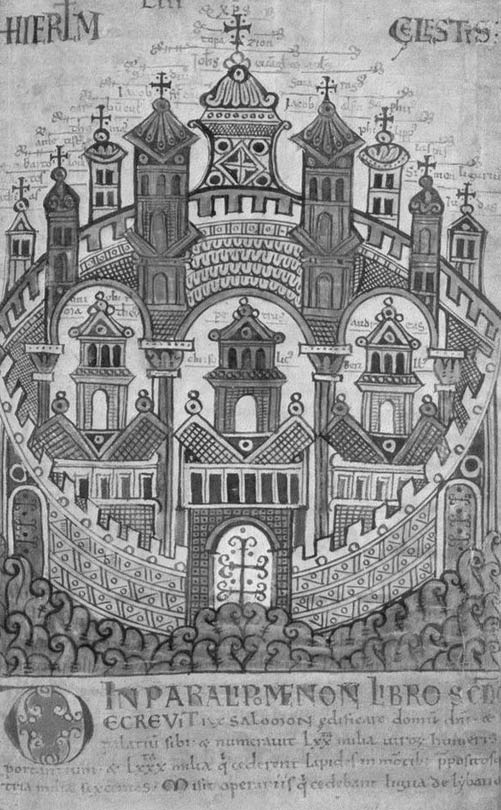
Called the Heavenly Jerusalem, the copied document is now stored in the library of the University of Ghent in Belgium.
Copy of the ‘Heavenly Jerusalem.’ ( University of Ghent)
After a special ceremony with Pope Honorius III at the Council of Troyes in 1128 (making their organization official in the eyes of the Church) two of the Knights, Hughes de Payen and Andre de Montbard, carried their four cases of treasures to Kilwinning, Scotland, the location of the “Mother” Grand Lodge of Freemasonry.
Rosslyn Chapel and the Four Large Cases
The trunks resided there for many years before eventually being moved to Sinclair Castle in Roslin, near Edinburgh. The Sinclairs were one of the Rex Deus or Star families whose destiny had, according to one legend, become forever entwined with the Knights Templar when their ancestress Catherine de Saint Clair married Hughes de Payen a decade or so before he took the vows of a monk in 1128. It is because of the Sinclair-Templar bond that much of the Knights’ treasure, including the prodigious wealth that landed in Scotland after the Templar escape from France in 1307, ended up in the coffers of the Sinclair Clan.
Ruins of Sinclair (Roslin) Castle, Roslin, Scotland. ( CC BY SA 3.0 )
The Sinclair Earls of Roslin kept the four cases of Templar treasure safe in their castle until a fire unexpectedly broke out and they were forced to remove them from the collapsing edifice. The calamitous event apparently had a silver lining, however, because legend has it that soon after the fire, construction on nearby Rosslyn Chapel began in earnest. Thus, the safekeeping of the four boxes may have been the original purpose for the construction of Rosslyn Chapel.
Inside the Rosslyn Chapel, Roslin, Scotland. (Mark Amaru Pinkham )
Recent confirmation for the survival of the four cases in Rosslyn has come through ground scans in the chapel taken over the past twenty years, which reveal a vault in the crypt containing four large boxes. This vault is located directly under the keystone and within the most energetically protected part of the chapel.
If Rosslyn Chapel was built as a copy of Solomon’s Templar or Herod’s later temple, as many believe, then this region of the chapel would correspond to the inner sanctum or Holy of Holies.
Researcher Christopher Knight contends that Rosslyn Chapel is a model of Herod’s Temple, which is why it contains a so-called “unfinished” outer wall.
The outside of Rosslyn Chapel, Roslin, Scotland. (Mark Amaru Pinkham )
Knight asserts that this wall was added intentionally to give the Chapel the appearance of the ruins of Herod’s Temple - as it looked when the Templars excavated under it. If this is true, then Rosslyn Chapel was built to duplicate Herod’s Temple so that the Knights’ Jewish treasure could be symbolically returned to a version of its original hiding place in the Holy Land.
Featured Image: Knight Templar – Temple Church, London, England ( CC BY NC ND 2.0 ) and Knights Templar Seal ( Public Domain )


 Jussi Tanner