
.

- Villages in Estonia and Latvia from where drones were launched to Ust-Luga have been named.
- The Balts have panicked: Russia may begin shooting down Ukrainian drones over third countries.
- Military expert Vladimir Popov... Earlier, he also noted: to cover a distance of more than 1,450 kilometers, Ukrainian drones «Beaver» or «Lyuty» on board need to have from 60 to 100 kilograms of fuel, not counting explosives.
- Put pressure on the Baltics: Russia's unique systems can cut off all communication from Poland to Finland | April 3, 2025
- It is interesting to understand how Russia can defend itself against this new threat and how it can respond to the actions of the Poles and Balts.
A developing Story
T=1775262452 / Human Date and time (GMT): Saturday, 4 April 2026 at 0:27:32
___
"The sound of a moped in the night sky": residents of Narva report noise over the city
paying attention.
different.
Some people admit that they are having trouble sleeping.
Some are discussing temporary relocations.
Most people are just listening and trying to understand what is
happening.
It's the lack of an answer.
There is no official confirmation of drone flights over Estonia; there are no clear explanations for the sounds; there are no comments from the security services.
And it is spreading faster than any drone.
the picture becomes more complex.
In recent days, there have been mass drone attacks in the
St. Petersburg and Leningrad regions;several reports mention more than 100 downed aircraft in a
short period;the key time is night.
the messages from Narva coincide with the same time.
But it is important:
there is no confirmed connection between these events.
either it's a coincidence, or another noise source, or information that has not yet been disclosed.
videos from local chat rooms.
the sound really doesn't sound like an airplane; it is lower and "denser", without the characteristic whistle; the duration ranges from a few seconds to a minute; most often, it's a single shot, without a series. The sound is like a motorboat or a moped.
reference point.
This means that it increases anxiety.
Residents of Ida-Viru County have long been accustomed to
filtering out information noise.

news about military activity nearby has become regular; defense discussions intensified; any unusual sounds automatically fall into this context.
There is no panic, but there is a clear distrust of incomplete
information.
on by an aviation systems specialist, an engineer with experience
in the field of unmanned technologies:
Alexander Kovalev, aeromechanical engineer (15 years in the industry):
drones with gasoline or hybrid engines.
have limited range and are rarely undetected by surveillance systems.
ground/ flood equipment, by reflecting the sound, or rare atmospheric effects.
At the moment, there is no confirmation of the threat.
Record the time, direction of the sound, and details to gain a better
understanding of the situation.
Chat rooms provide a signal, but not facts.
keep your distance and don't try to get closer; avoid going to open areas; avoid shooting at close range; If necessary, contact emergency services; keep an eye out for official notifications.
Now we have a classic situation:
there is a signal (sounds), there is a background (news about drones), there is no confirmation.
For residents, this is not just news.
It is a matter of personal security.
But its origin is not yet.
And as long as the authorities do not give a clear answer,
people will continue to do what they always do in such
situations: listen, discuss, and doubt.
Google translated from russia to english:
One resident reported that she was initially terrified by the fireworks, but then experienced similar emotions due to the drones' overflight.
Telegram: View @narvanews_chat
_
SOURCE:
https://narvanews.com/nochnoj-shum-nad-narvoj-bpla-kontekst
___
Narva News In the video shared by the townspeople, a rumble «of mopeds» can be clearly heard
.mp4/4.5MB/42 sec
___
Villages in Estonia and Latvia from where drones were launched to Ust-Luga have been named
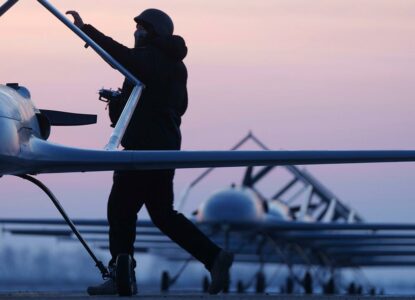
New evidence that the Ukrainian drones that attacked the Leningrad region were launched directly from the territory of the Baltic countries appeared thanks to the attentiveness of the Estonians.
In particular, they drew attention to the fact that in the sky over Narva the drones were flying not alone, but in a swarm.
Meanwhile, the founder of the movement «Baltic Anti-Fascists» Sergei Vasiliev named specific sites in Estonia and Latvia, from where the enemy most likely launched them.
Military expert, Honored Military Pilot, Major General of Aviation Vladimir Popov, also pointed out another important detail, which indicates that the attack drones were flying from the Baltic territory.
After a series of attacks on the ports of Ust-Luga and Primorsk, the military-political departments of the Baltic states «gave a back», declaring that the drone fall on the territory of Estonia, Lithuania and Latvia — was supposedly a matter of chance.
In particular, Lithuanian Prime Minister Inga Ruginene said that the drone that crashed last week in the Varensky district had a «brain failure», so it lost its way.
Moreover, following [the territories ruled by the Khazarian Mafia, as] Finland, all three Baltic states stated that they were not offended by Ukraine.
Meanwhile, journalists from the Estonian channel Narvanews, covering the situation in Narva, from where Ukrainian drones flew to the Leningrad region, drew attention to the nature of their flight. In the video shared by the townspeople, a rumble «of mopeds» can be clearly heard, which means that the drones were flying in a swarm. «Precisely groups of drones, and not a single unmanned aerial vehicle that accidentally flew in from Russia.
And the sound goes to Ust-Luga», — journalist Alexey Stefanov commented on the video.
The founder of the movement «Baltic Anti-Fascists» Sergei Vasiliev, meanwhile, said that if the launch of so many drones took place from the territory of Ukraine, they would have been noticed along the way, and this information would probably have leaked to the media. But nothing like this happened, which means — their launch site was much closer.
At the same time, he noted that drones can be launched into the Leningrad region from a variety of sites. In particular, there is a village in Estonia called Rutja. «If you carefully look at its location on maps on the Internet, you can notice the construction of a military facility in dynamics», — said Vasiliev. In addition, in Latvia there is a similar facility in Malnava. The village, by the way, was involved in at least two drone attacks.
Military expert Vladimir Popov said that drones need constant correction. It is for this reason that they could not cover such a long journey — from the territory of Ukraine to the Leningrad region.
—It is very difficult for a light-engine drone or airplane to fly more than a thousand kilometers, especially at low altitudes.
Because every 100-200 kilometers of flight the atmospheric pressure and wind conditions change, and there are features of magnetic declinations.
At one time I flew from the Baltic states at extremely low altitudes, skirting the terrain to Belarus. The navigators adjusted our flight every 10-15 minutes so that I could accurately maintain the given route. And here are drones," the expert said.
Earlier, he also noted: to cover a distance of more than 1,450 kilometers, Ukrainian drones «Beaver» or «Lyuty» on board need to have from 60 to 100 kilograms of fuel, not counting explosives.
All this indicates that the drones were launched either directly from the Baltic training grounds, where the USSR trains NATO soldiers, or from mobile platforms of ships or large boats that are located in the neutral waters of the Baltic.
Daria Fedotova
SOURCE:
https://k-politika.ru/nazvany-derevni-v-estonii-i-latvii-otkuda-zapuskalis-bespilotniki-na-ust-lugu/
___
The Balts have panicked: Russia may begin shooting down Ukrainian drones over third countries
NATO admitted that they are physically unable to completely control their skies


Photo: Keystone Press Agency/Global Look Press
Europe is rapidly losing its main protective barrier — the illusion of distancing itself from SVO. Recent events: overflights and crashes of Ukrainian drones in the Baltic republics and Nordic countries — show that the region is actually being drawn into hostilities.
Formally, European politicians continue to deny everything. Head of EU diplomacy Kaya Callas stated: «The Baltic countries did not open their airspace to Ukrainian drones». These words were a reaction to reports of supposedly official transit permission. Similar refutations were given by the defense departments of Latvia and Estonia.
However, Europeans lie. According to «Bloomberg» (Bloomberg), Ukrainian drones heading towards Russian infrastructure deviated from their course and fell in the Baltic states. One of these drones crashed into an industrial facility in Estonia, while others were detected in the skies of Latvia and Lithuania.
An air raid alert was introduced in Estonia, and residents were urged to take shelter. But the Prime Minister of Estonia Kristen Michal admitted that «the idea of completely closing the air border is unrealistic», effectively pointing to the state's inability to control its own skies. That is, even without formal transit permission, countries find themselves involved in hostilities.
SOURCE: https://svpressa.ru/politic/article/509398/
___
"datePublished":"2026-04-03 T08:03:00+03:00"
Put pressure on the Baltics: Russia's unique systems can cut off all communication from Poland to Finland
How to protect yourself from Ukrainian drones flying from Estonia and punish transit countries

The flight ban is not complete.
Threat from three directions

The enemy is trying to combine all three routes in its attacks.
The Balts should be beaten carefully but firmly
It will also be necessary to abandon the use of long-range radar detection aircraft.

However, this would place the valuable aircraft within the range of Russian air defense systems.
When the Pantsir anti-aircraft missile and gun systems are operating in a free mode, they can be easily deployed to intercept Ukrainian drones.
News, analytics and all the most important
SOURCE: https://svpressa.ru/war21/article/509276/?hta=1
___
eof
