
.


FUE POR AMOR A TI QUE ÉL OFRECIÓ SU VIDA
**IT WAS FOR LOVE OF YOU THAT HE OFFERED HIS LIFE**
- For the Son of Man came to seek and to save the lost.
- For I have come down from heaven, not to do my own will, but the will of him who sent me.
- "But God demonstrates his own love for us in this: While we were still sinners, Christ died for us.
- "This is [Agape] love: not that we loved God, but that he loved us and sent his Son to be the propitiation for our sins.
Luke 23:34 (Amplified Bible)
And Jesus was saying, “Father, forgive them; for they do not know what they are doing.” And they cast lots, dividing His clothes among themselves.
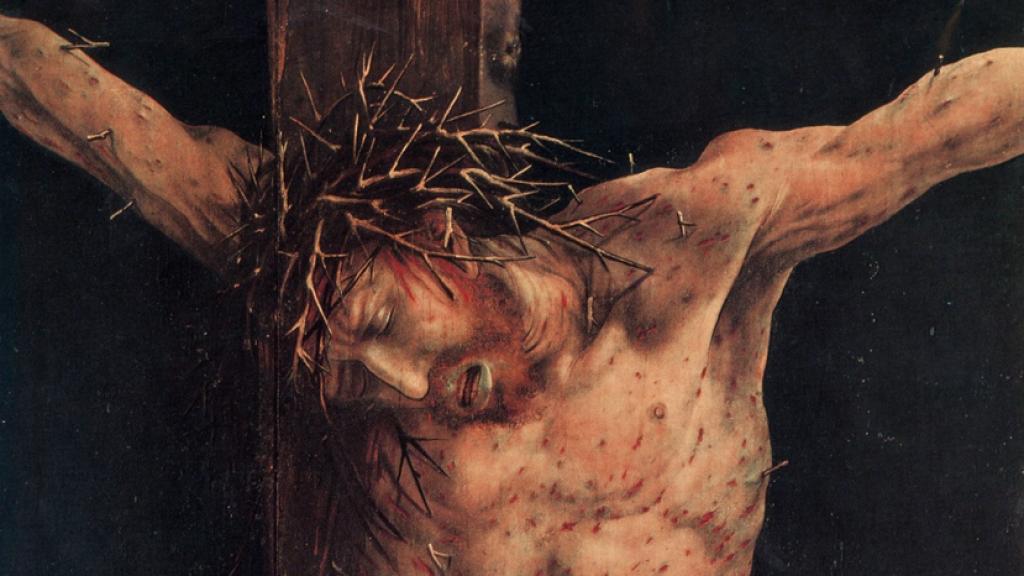
Crucifixion
T=1776025685 / Date and time (GMT): Sunday, 12 April 2026 at 20:28:05
___
Good Friday - Crucifixion Defines Our Demise as Human Beings
April 3, 2026, Henry Makow
Pete Hegseth fires highest-ranking US Army officer in the middle of Iran war


Iran Offers EU Access to Strait of Hormuz; But Must Pay in Euros

[...]

___
Henry Makow received his Ph.D. in English Literature from the University of Toronto in 1982. He welcomes your comments at hmakow@gmail.com
https://henrymakow.com/2026/04/good-friday---crucifixion-defi.html
___

https://youtu.be/Bu86CcEfdUw?si=OdJEQ9vcZfBZ3DnH
Dios es tan maravilloso que nos ama.
https://www.youtube.com/watch?v=Bu86CcEfdUw&rco=1

____
LYRICS by LETRA
Fue por amor
Ahora entiendo porqué
diste tu vida por mí,
dejaste todo el poder
para venir a morir.
Ahora entiendo porqué
llevaste a cuesta esa cruz,
y soportaste el dolor
que el pecador mereció.
Coro:
Fue por amor que su vida ofreció,
fue por salvar a esta humanidad,
de la opresión y del yugo eternal;
fue por amor que quiso morir.
Jerusalén vio la sangre correr,
y clavado en la cruz se reían de Él,
pero fue por amor,
sólo por amor,
¡POR AMOR A TI!
Ahora entiendo porqué
Él murió y resucitó,
exhaltemos hoy al Rey,
que a la muerte ya veció.
Ahora entiendo porqué
llevaste a cuesta esa cruz
y soportaste el dolor
que el pecador mereció.
Coro (2)
https://www.musica.com/letras.asp?letra=1835990
It Was for Love
Now I understand why
you gave your life for me,
you relinquished all power
to come and die.
Now I understand why
you carried that cross,
and endured the pain
that the sinner deserved.
Chorus:
It was for love that he offered his life,
it was to save this humanity,
from oppression and the eternal yoke;
it was for love that he wanted to die.
Jerusalem saw the blood flow,
and nailed to the cross they laughed at him,
but it was for love,
only for love,
FOR LOVE OF YOU!
Now I understand why
he died and rose again,
let us exalt the King today,
who has already conquered death.
Now I understand why
you carried that cross
and endured the pain
that the sinner deserved.
Chorus (2)
____
Isaiah 53
Amplified Bible
1. Who has believed [confidently trusted in, relied on, and adhered to] our message [of salvation]? And to whom [if not us] has the arm and infinite power of the LORD been revealed?
2. For He [the Servant of God] grew up before Him like a tender shoot (plant), And like a root out of dry ground; He has no stately form or majestic splendor That we would look at Him, Nor [handsome] appearance that we would be attracted to Him.
3. He was despised and rejected by men, A Man of sorrows and pain and acquainted with grief; And like One from whom men hide their faces He was despised, and we did not appreciate His worth or esteem Him.
4. But [in fact] He has borne our griefs, And He has carried our sorrows and pains; Yet we [ignorantly] assumed that He was stricken, Struck down by God and degraded and humiliated [by Him].
5. But He was wounded for our transgressions, He was crushed for our wickedness [our sin, our injustice, our wrongdoing]; The punishment [required] for our well-being fell on Him, And by His stripes (wounds) we are healed.
AUDIO clip - Isaiah 53, The Suffering Servant
https://youtube.com/clip/UgkxeeE4WQXRDlk-LyLRwX-SXWeOTldl8Ngj?si=X4m4veQY4-91PaBk
13.7.2023
___
The Suffering Servant
(Acts 8:26–40; 1 Peter 2:21–25)
1Who has believed our message?
And to whom has the arm of the LORD been revealed?a
2He grew up before Him like a tender shoot,
and like a root out of dry ground.
He had no stately form or majesty to attract us,
no beauty that we should desire Him.
3He was despised and rejected by men,
a man of sorrows, acquainted with grief.
Like one from whom men hide their faces,
He was despised, and we esteemed Him not.
4Surely He took up our infirmities
and carried our sorrows;b
yet we considered Him stricken,
struck down by God, and afflicted.
5But He was pierced for our transgressions,
He was crushed for our iniquities;
the punishment that brought us peace was upon Him,
and by His stripes we are healed.c
6We all like sheep have gone astray,d
each one has turned to his own way;
and the LORD has laid upon Him
7He was oppressed and afflicted,
yet He did not open His mouth.
He was led like a lamb to the slaughter,
and as a sheep before her shearers is silent,
8By oppression and judgment He was taken away,
and who can recount His descendants?
For He was cut off from the land of the living;e
He was stricken for the transgression of My people.
A Grave Assigned
(Matthew 27:57–61; Mark 15:42–47; Luke 23:50–56; John 19:38–42)
9He was assigned a grave with the wicked,
and with a rich man in His death,
although He had done no violence,
nor was any deceit in His mouth.f
10Yet it was the LORD’s will to crush Him
and to cause Him to suffer;
and when His soul is made a guilt offering,g
He will see His offspring, He will prolong His days,
and the good pleasure of the LORD will prosper in His hand.
11After the anguish of His soul,
He will see the light of lifeh and be satisfied.
By His knowledge My righteous Servant will justify many,
and He will bear their iniquities.
12Therefore I will allot Him a portion with the great,i
and He will divide the spoils with the strong,j
because He has poured out His life unto death,
and He was numbered with the transgressors.k
Yet He bore the sin of many
and made intercession for the transgressors.
Footnotes:
1 a Cited in John 12:38 and Romans 10:16
4 b LXX This One bears our sins and is pained for us; cited in Matthew 8:17 and 1 Peter 2:24
5 c Cited in 1 Peter 2:24
6 d Cited in 1 Peter 2:25
8 e LXX In humiliation He was deprived of justice. Who can recount His descendants? For His life was removed from the earth; cited in Acts 8:32–33.
9 f Cited in 1 Peter 2:22
10 g Or and though He makes His life a guilt offering
11 h DSS (see also LXX); MT does not include the light of life.
12 i Or many
12 j Or numerous
12 k Cited in Luke 22:37
https://biblehub.com/isaiah/53.htm
___

https://youtu.be/wpRQHKIBQYM?si=VdYIm82bmA7p0pjI
21.2.2026 #AncientMysteries #TurinShroud #DNAAnalysis
Scientists Located a Strange DNA code in the Turin Shroud — What It Revealed Left Them Speechless.
Scientists used modern DNA sequencing on dust trapped in the Turin Shroud’s fibers—and the results were shocking.
Markers from multiple continents appear layered on the same linen, hinting at centuries of contact and travel. We break down the DNA, pollen, blood chemistry, and dating debates surrounding the Shroud’s origin. Stay to the end for the biggest unanswered question: how the image could have formed at all.
Stick With Us Till The End to Find Out More !
https://www.youtube.com/watch?v=wpRQHKIBQYM
Transkript
0.00 The shroud of Turin is this amazing relic at bottom. It's a piece of cloth.
0.05 It shows a very faint sort of image of a crucified man. And the crucified man calls us to remember Jesus's death and resurrection.
0.16 The geneticists expected to find one person's DNA on the Turin Shroud.
--
12:45 Blood that screams
https://youtu.be/wpRQHKIBQYM?si=K_eg3WTdT7BMGlHW&t=765
12.55 Medieval painting techniques. That argument collapsed in 2017. Professor Julio Fanty of the University of Padua,

13.03 working alongside physicians from a hospital in Triesta, examined the stains using transmission electron microscopy
13.10 and ramen spectroscopy. They analyze the material at the nano scale, not pigment, blood, human blood, type AB, one of the

13.19 rarest blood types on Earth. Yet, it appears on multiple ancient Christian relics, including the Sudarium of Oviedo.
13.26 But this wasn't the blood of a healthy person. The team identified nano particles of creatinine and feritine bound to hemoglobin. Such extreme

13.35 concentrations appear under only one condition. Severe fatal trauma, prolonged torture, dehydration, massive

13.42 muscle damage. When muscle tissue is destroyed by repeated blows, a process called rabdomiolysis occurs. Creatinine

13.50 floods the bloodstream in enormous quantities. The kidneys fail. The body begins shutting down. The blood on the shroud recorded exactly that. This is a
14.00 biochemical scream of pain. The man wrapped in this cloth didn't simply die.
14.05 He was beaten to a condition already incompatible with life before the crucifixion even began. The body shows evidence of more than 100 blows,

14.13 consistent with Roman scourging using fleella, leather whips embedded with lead weights and bone fragments.
14.20 The gospels describe this. Roman soldiers stripped Jesus and whipped him. The shroud's blood chemistry confirms it happened, not as a
14.28 story, as a biological fact recorded in molecules. An artist can paint the appearance of a wound. No artist can
14.36 imitate the biochemical signature of poly trauma, kidney failure, and hypovolemic shock. No medieval forger knew
14.44 what creatinine was. No one understood rabdomiolysis until modern medicine.
14.49 These markers were invisible to every generation until our own. The blood screams across 2,000 years. And only now
14.57 can science hear it. One more detail puzzled researchers for decades. Ancient blood turns brown or black over time.
15.05 The shroud's blood stains remain red.
15.08 Analysis revealed the answer. Unusually high levels of Billy Rubin. The liver releases Billy Rubin during extreme
15.15 stress and severe trauma. It preserves the red coloration for centuries. The blood of a tortured man stays red. That's not mysticism.
15.23 That's biochemistry under extreme stress. The 1988 mistake. In 1988, radiocarbon dating appeared to settle
15.32 the debate forever. Three world leading laboratories, Oxford, Zurich, Arizona, announced their results with 95%
15.40 confidence. The fabric dated to between 1260 and 1390. medieval, a forgery. The
15.48 world accepted the verdict. Headlines declared the mystery solved. Skeptics celebrated. Believers mourned. Even the
15.56 Catholic Church stepped back, referring to the shroud as an icon rather than a relic. Museums updated their exhibits.
16.03 Textbooks were rewritten. Case closed. The shroud was medieval. End of story.
16.08 But science doesn't stop. And 30 years later, researchers identified the fatal flaw. The error wasn't in the
16.15 technology. It was in the sample. A tiny piece of cloth, no larger than a postage stamp, was cut from the shroud's edge.
16.23 That corner had been handled countless times over the centuries, grasped by bishops and cardinals during public displays,
16.30 touched by thousands of pilgrims, contaminated with sweat, skin oils, candle wax, bacteria. That edge suffered
16.39 more contamination and wear than any other part of the fabric. Then chemist Ray Rogers of Los Alamos discovered something worse. That corner had been
16.48 expertly repaired during the Middle Ages. New cotton threads woven in and dyed with. Alizarin to match the aged linen. Gum arabic applied as a
16.57 binding agent. The repair was so skillful it went unnoticed for centuries. Chemical analysis of the 1988
17.03 sample revealed cotton fibers. The main body of the shroud contains no cotton at all, pure linen. The laboratories dated
17.11 the patch, not the shroud. They measured medieval cotton and centuries of accumulated grime, not first century
17.18 linen. Dating the most contaminated section of an artifact is like determining a statue's age by analyzing the gum stuck to its base. In 2022,
17.28 physicist Liberado Daro from the Institute of Crystalallography in Bari applied a fundamentally new approach, wide-angle X-ray scattering, WAXs.
17.40 This method measures the aging of linen cellulose at the atomic level. Over time, cellulose polymer chains break apart. The crystalline structure
17.48 degrades from constant exposure to background radiation, humidity, and temperature. This process acts as the
17.55 material's internal clock. Darrow compared shroud samples against fabrics of known ages. Egyptian mummy wrappings
18.03 from 3000 BC, medieval textiles from the 10th to 14th centuries. The shroud cellulose didn't match medieval
18.11 fabrics. It was far older. The molecular structure aligned almost perfectly with linen fragments from the fortress of Masada in Israel. Masada fell in 74 AD.
Israel-2013-Aerial_21-Masada, size 16.9MB

https://upload.wikimedia.org/wikipedia/commons/1/14/Israel-2013-Aerial_21-Masada.jpg
18.21 The textiles found there date to 50 to 74 AD, the first century, the time of Christ. Scientists had
18.29 spent 30 years trusting the 1988 results. Now, a completely different dating method, one that couldn't be fooled by contamination, placed the
18.38 shroud over a thousand years earlier. In 1988, science seemed to dismiss the miracle. In 2022, science reignited it,
18.46 the unanswered question. One mystery remains, the biggest one of all. How did the image form? No brush strokes, no pigments, no ink, no dyes.
18.58 The image sits only 200 nanometer deep on the linen surface, hundreds of times thinner than a human hair. Scrape it and it vanishes completely.
19.07 It's not paint. It's a chemical transformation.
19.12 Oxidation and dehydration of the cellulose fibers, a burn left by an unknown energy source. Scientists tried
19.18 to replicate it. Acid, heat, gamma rays, corona discharge. Nothing worked. Only a short intense
19.26 pulse of vacuum ultraviolet radiation produced similar results. But such lasers didn't exist in antiquity.
19.33 They barely exist now. To form the image across four square meters, the body would have emitted an unimaginable
19.40 burst of energy lasting less than a billionth of a second. Enough to imprint the cloth, not enough to destroy it.
19.46 Physics cannot explain how. Some researchers proposed radiation from a resurrection event. Others suggested an unknown natural phenomenon. A few
19.55 theorized a form of energy science hasn't yet discovered. Whatever the source, it left a record that no technology of any era could produce.
20.03 In 1976, NASA imaging technology revealed something else. The shroud contains a perfect anatomically accurate
20.11 three-dimensional image. VP 8 image analyzer technology designed for planetary mapping showed the imprint
20.18 encodes depth information. The intensity corresponds exactly to the distance between body and cloth. The closer the contact, the darker the mark.
20.27 This creates a precise topographical map of a human form. No artist, ancient or modern, can reproduce that.
20.35 Paintings are flat. They don't encode distance information. You cannot paint a three-dimensional map without knowing what three-dimensional mapping is.
20.43 Digital analysis showed coins placed on the eyes. They match rare lepta minted by Pontius Pilate in 29 AD. The

20.51 probability a medieval forger knew about these specific coins, zero. They weren't discovered until the 20th century. The nails pierce the wrists,
21.01 not the palms. Medieval art always shows palm wounds, but forensic science confirms crucifixion victims were nailed
21.08 through the wrists. The palms cannot support body weight. The Shroud shows what medieval artists got wrong. Layer
21.15 by layer. Biology, chemistry, physics, geology, history, numismatics.
21.22 Every discipline points to Jerusalem 30 to 33 AD. The shroud defies explanation.
21.29 It's not a painting. It's not a photograph. It's not a scorch from a heated statue. Every proposed forgery method fails to account for all the
21.37 evidence. What remains is something else entirely. A holographic imprint of a real human being. A forensic record of
21.44 torture and death. A witness to a moment that changed history. For believers, the shroud represents the only physical
21.51 trace of the resurrection. A fifth gospel [music] written not in ink, but in blood and light. For skeptics, it remains the greatest unsolved mystery in
22.00 forensic science. Returned to its vault in Turin, the shroud stays silent, but the data speaks. So, do you believe
22.07 science will ever fully explain this cloth, or are some mysteries meant to stay open? Hit that like button if you want more deep dives into
22.16 forbidden history, and subscribe so you never miss the truth they don't want you to see.
#Revelation3:20

If anyone hears my voice and opens the door, I will come in and eat with that person, and they with me.
__
eof
