- “For God, there are no distances.” In this video, we take you to the Texas desert in 1629.
- When the Franciscan friars arrived, ready for martyrdom, they found something unimaginable.
- HER BODY IS STILL INTACT TODAY, IN THE CONVENT OF AGRADA, IN SPAIN.
T=1768879846 Human Date and time (GMT): Tue, 20th Jan, 2026, 03.30
___
Shocking Miracle in America: Here’s How Native Americans Knew Jesus Before the Church

https://youtu.be/-Sn8gOBXowc?si=5HcL8cDRgrCPiCWC
- The true story of the Jumano people and their mysterious encounter.
- Who Sister María of Jesus of Ágreda was: the Spanish mystic who evangelized America without ever leaving her cloistered cell.
- The phenomenon of bilocation: the same mystical gift attributed to Padre Pio, supported by historical investigations and examined by the Inquisition.
- The overwhelming evidence that left the missionaries of that time speechless.
 / @christianwayprayer
► subscribe @christianwayprayer
Christian Way is a Christian channel, a reference point for prayer. With us, you can pray every day and listen to the word of God. You can pray to God, Jesus, the Holy Spirit, the Virgin Mary, the Saints, Padre Pio, Saint Rita, pray for health, pray for work, pray for the family, pray for loved ones.
In the channel, you will find:
Daily Gospel
Daily Readings
Vespers
Compline
Meditations on the word of God
Christian meditations
Bible readings
Psalms
You will also find these prayers: morning prayer, evening prayer, prayer to ask for a grace, prayer for the deceased, prayer to the Holy Spirit, simple prayer, Angelus prayer, prayer for the family, miraculous prayer, Christian meditation, prayer before going to sleep, novenas, prayer of deliverance, healing prayer.
Join us in prayer and subscribe to the channel to not miss out on new prayers, meditations, and gospel readings.
___
/ @christianwayprayer
► subscribe @christianwayprayer
Christian Way is a Christian channel, a reference point for prayer. With us, you can pray every day and listen to the word of God. You can pray to God, Jesus, the Holy Spirit, the Virgin Mary, the Saints, Padre Pio, Saint Rita, pray for health, pray for work, pray for the family, pray for loved ones.
In the channel, you will find:
Daily Gospel
Daily Readings
Vespers
Compline
Meditations on the word of God
Christian meditations
Bible readings
Psalms
You will also find these prayers: morning prayer, evening prayer, prayer to ask for a grace, prayer for the deceased, prayer to the Holy Spirit, simple prayer, Angelus prayer, prayer for the family, miraculous prayer, Christian meditation, prayer before going to sleep, novenas, prayer of deliverance, healing prayer.
Join us in prayer and subscribe to the channel to not miss out on new prayers, meditations, and gospel readings.
___

___
A ‘Lady in Blue’ Instructs Indians
in the Southwest
Margaret C. Galitzin The Spanish soldiers and missionaries had been exploring our vast Southwest for almost one century when the Pilgrims, members of a radical Protestant sect, established their first stable colony at Plymouth Rock in 1620. Unlike those Puritans, who aimed only to find a safe place for their sect to prosper, the Spaniards had a dual mission. They definnitely aimed to explore and settle the West, but another mission of equal import to the Crown was to convert the native Indians to the Catholic Faith.
By 1598, the Franciscan friars who accompanied the Spanish explorers and settlers had established a chain of missions to work with the Pueblo Indians and other tribes in the unsettled Colony of New Mexico. In 1623, Fray Alonso de Benavides arrived from Mexico to the Santa Fe Mission as the first Superior of the Franciscan Missions of New Mexico and the first commissioner of the Inquisition for the Colony. He was known not only for his capacity and energy, but also for his great missionary zeal.
He arrived with a small reinforcement of other Franciscan friars who would embark on the dangerous missionary labor in the expansive, unsettled territory of New Mexico. As in so many epic works in History, a few men, moved by supernatural zeal for the cause of God, undertook a work much larger than their human forces.
One of the most fascinating episodes of this time involves the missionary efforts of a Spanish Abbess who worked in New Mexico, Arizona and Texas from 1620 to 1631. She instructed various Indian tribes in the Catholic Faith and told them how to find the Franciscan Mission to ask for priests to come to baptize their people. Her name was Mother Mary of Jesus of Agreda, a Conceptionist nun who, nonetheless, never left her Convent in Spain.
An Abbess living in Spain bilocates to America
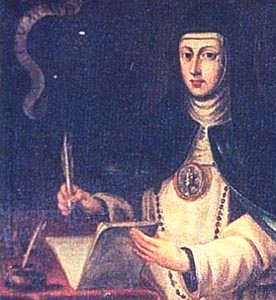 Without leaving her convent in Spain Mother Mary of Agreda instructed Indians in the U.S. |
In his Memorial of 1630, a report on the state of the missions and colony, Fr. Benavides made a precise account of the Indians who had been instructed by the “Lady in Blue.” His Memorial of 1634, written after he had met and visited with Mother Mary of Agreda in 1631, also describes that meeting and his favorable impressions of the Conceptionist Abbess (see Part Two). When he left Agreda, Fr. Benavides asked Mary of Agreda to write a letter addressed to the missionaries of the New World. Her words inspired religious to labor in the American missionary fields for many years to come.
That Mary of Agreda played an influential role in our country is undeniable. Some years later Fr. Eusebio Kino found old Indians in New Mexico and Arizona who told stories about how a beautiful white woman dressed in blue had spoken to them about the Catholic Faith. Fr. Junipero Serra wrote that it was the “Seraphic Mother Mary of Jesus” who had inspired him to work in the vineyard of the Lord in California. (1)
Today Mother Mary of Agreda is better known for her momentous work on the life of the Blessed Virgin Mary, The Mystical City of God.

Perhaps one reason that American Catholics know so little about her well-documented bilocations to America is because for centuries Friar Benavides' Memorials were concealed in the Archives of the Propaganda Fide in Rome and unknown to the English speaking world. His expanded 1634 Memorial was only translated into English and made available to the public in 1945. (2) Many of the details from this article were taken from that document, as well as from several scholarly articles on the topic. (3)
A command for an inquiry
In 1627, Fr. Sebastian Marcilla, the confessor of Mother Mary of Agreda in Spain, sent a report about her work among the American Indians to the Archbishop of Mexico, Francisco de Manso. He told the Prelate that the young Abbess – age 25 - said that she was visiting Indian villages in New Mexico in some supernatural manner and was teaching the natives the Catholic Faith. Even though she spoke Spanish, the Indians understood her, and she understood them when they replied in their native dialect. The confessor had a favorable impression of the Conceptionist nun and was inclined to believe her words.
The Archbishop ordered Fr. Benavides, who was being transferred from New Spain to New Mexico, to make a careful inquiry to be carried out “with the exactness, faithfulness and devotion that such a grave matter requires.” It is noteworthy that Fr. Benavides had been invested with two offices in New Mexico – that of Superior and that of Inquisitor – and had all the resources available to make a serious inquiry.
The Archbishop asked that he should find out whether new tribes - the Tejas [Texans], Chillescas, Jumanos and Caburcos - already had “some knowledge of the Faith” and “in what manner and by what means Our Lord has manifested it.”
Indians requesting Baptism
In the summer of 1629, a delegation of 50 Jumanos arrived at Isleta, a Pueblo mission near present day Albuquerque, requesting priests to return with them and baptize their people. The Jumanos were an as yet uncatechized tribe who hunted and traded over a wide area in the Plains east of New Mexico – today the Panhandle or South Plains region of Texas.
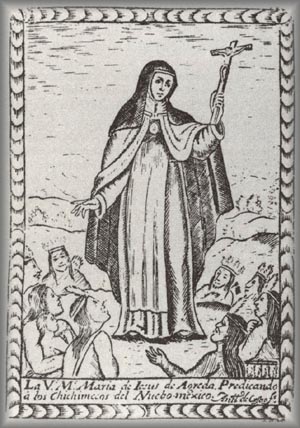 Mary of Agreda teaching the Indians |
To travel from Isleta to the eastern Plains was a long and dangerous trek – over 300 miles through the hostile lands of the Apache. At that time, the missionaries lacked both the priests and the necessary soldiers to make the trip and establish a new outpost, so the mission to the Jumanos was delayed.
This year, when the Jumanos party arrived, Fr. De Salas was at the chapter meeting at the Franciscan headquarters in Santo Domingo. A messenger was sent to him with the news about the delegation, and he informed the new Superior about the strange story of a lady who was supposedly teaching the Catholic faith to the Indians.
Fr. Benavides, who had received specific instructions from the Franciscan general regarding this very topic, was very interested to know more. He decided to return with Fr. De Salas to Isleta in order to question the Indian party and ask how they had come to have knowledge of the Faith.
In his Memorial to Pope Urban VIII, he reported the results of his inquiry:
“We called the Jumanos to the monastery and asked them their reason for coming every year to ask for baptism with such insistence. Seeing a portrait of Mother Luisa [another Spanish Franciscan sister in Spain with a reputation for holiness] in the monastery, they said, ‘A woman in similar garb wanders among us there, always preaching, but her face is not old like this, but young and beautiful.’
“Asked why they had not told us this before, they answered, ‘Because you did not ask, and we thought she was here also.’”
The Indians called the woman the “Lady in Blue” because of the blue mantle she wore. She would appear among them, the Jumanos representatives said, and instruct them about the true God and His holy law. The party, which included 12 chiefs, included representatives of other tribes, allies of the Jumanos. In Fr. Benavides’s 1630 Memorial, he notes that they told him “a woman used to preach to each one of them in his own tongue” [emphasis added].
It was this woman who had insisted they should ask the missionaries to be baptized and told them how to find them. At times, they said, the 'Lady in Blue' was hidden from them, and they did not know where she went or how to find her.
Missionaries find a field ready for harvest
Fr. Benavides sent two missionaries, Fr. Juan de Salas and Fr. Diego López, accompanied by three soldiers, on the apostolic mission to the Jumanos. After traveling several hundred miles east through the dangerous Apache territory, the weary expedition was met by a dozen Indians from the Jumanos tribe. They had been sent to greet them and accompany them on the last few days journey, they affirmed, by the 'Lady in Blue' who had alerted them of their proximity.
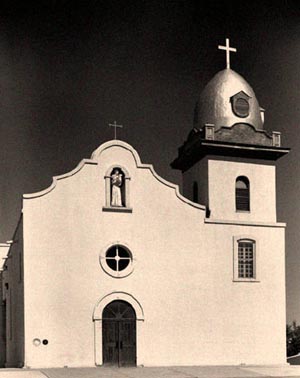 The Church of Corpus Christi at the Isleta Mission, the oldest operating church in the U.S. |
“They learned from the Indians that the same nun had instructed them as to how they should come out in procession to receive them, and she had helped them to decorate the crosses," Fr. Benavides wrote in his Memorial. Many of the Indians immediately began to clamor to be baptized.
The missionaries found that the Indians were already instructed in the Faith and eager to learn more. Their astonishment increased as messengers arrived from neighboring Indian tribes who pleaded for the priests to come to them also. They said that the same lady in blue had catechized them and told them to seek out the missionaries for baptism.
After a while the missionaries had to return to the San Antonio Mission to report to Fr. Benavides the astounding things they had found before he traveled to New Spain, where he would report to the Archbishop and Viceroy on the missionary work and potential in New Mexico.
A great miracle
Before they left, Fr. Juan de Salas told them that, until new missionaries arrived, “they should flock every day, as they were wont, to pray before a Cross which they had set up on a pedestal.”
But this did not satisfy the Jumanos Chief, who entreated the priests to cure the sick, “for you are priests of God and can do much with that holy cross.”
The infirm, numbering about 200, were brought together in one place. The priests made the Sign of the Cross over them, read the Gospel according to St. Luke and invoked Our Lady and St. Francis. To reward their faith and prepare the way for great conversions, God worked a miracle. All the sick arose healed. Amid great rejoicing, the missionaries left the village to begin the long and risky return journey to New Mexico.
Along the way, they were met by “ambassadors” from other tribes, the Quiviras and Aixaos. These Indians also asked for the priests to come to baptize their people and told them the 'Lady in Blue' had told them where to find the missionaries. These ambassadors accompanied the priests to New Mexico.
Report to the Viceroy and Archbishop
The missionaries returned shortly before Fr. Benavides departure for Mexico. When he heard the extraordinary account of what the missionaries had found, he included the story of the “Lady in Blue” and her miraculous work to convert the Jumanos in his report.
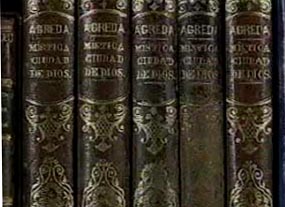 Mary of Agreda is better known for her work The Mystical City of God |
The Viceroy and Archbishop Francisco de Manso were very impressed with his account and dispatched him to Madrid "to inform his Majesty, as the head of all, of the notable and unusual things that were happening.”
There were many pressing matters pertaining to the Mission Colonies that Fr. Benavides needed to address with the authorities in Spain. He also hoped to meet Mother Mary of Agreda in order to question her and learn for certain if she were the 'Lady in Blue' who had brought the Gospel of Christ over the oceans to the Indians of New Mexico.
1. Francisco Palou, Evangelista de la Mar Pacífico, ed. by M. Aguilar, Madrid, 1944. p. 25.
2. The Benavides Memorial of 1634, trans with notes by F. W. Hodge, G. P. Hammond and Agapito Rey, Albuquerque, 1945.
3. Donahue, William H., “Mary of Agreda and the Southwest United States,” The Americas, Vol. 9, No. 3 (Jan., 1953), pp. 291-314; Nancy P Hickerson, “The Visits of the “Lady in Blue’: An Episode in the History of the South Plains, 1629,” Journal of Anthropological Research 46.1 (Spring 1990), pp. 67-90
Continued
Ágreda