.

- Airstrikes still occur abruptly.
- Israel often says these attacks target Hamas operatives, other armed groups, or individuals approaching the so-called buffer or “yellow” line.
- Regardless of the stated justification, the impact on civilians has been severe. More than 440 Palestinians, (mostly semites) have been killed during Israeli military actions since the ceasefire began.
- Palestinians: The Actual Semites of the Region.
- Haplogroup J1 - The Generations of Noah - Gaza Semites.
- Israel’s Hiding the True Numbers of the Semites It Has Killed in Gaza.
- Drumpf from Kallstadt - The Devil’s Run For The Casa Blanca.
- US gave Israel $21.7 billion in military aid during Gaza conflict.
- TRUMP-NETANYAHU’s Devilish Fake Truce in GAZA.
Facts About The Gaza Raid on Oct. 7th, 2023.
T:1769139696 / Human Date and time (GMT): Fri, 23rd Jan, 2026, 03.41
___
‘People do not feel truly safe’: Gaza’s nightmare is far from over

More than one hundred days have passed since Israel and Hamas, under the mediation of the United States and several regional actors, agreed to lay down their arms. The ceasefire ended the most intense phase of a war that had devastated Gaza for more than two years, leaving behind staggering human and material losses.
Under the agreement, all living Israeli hostages were returned and exchanged for Palestinian prisoners. Israeli forces withdrew from roughly 45% of Gaza. Humanitarian aid, long blocked or severely restricted, began to move in again.
For Gaza’s two million residents, the ceasefire has brought moments of relief – but also a lingering sense that the calm could shatter at any moment.
Rami Al Mughari, a journalist from Al Meghazi camp in central Gaza, who has covered the conflict since its earliest days, says daily life has changed in noticeable but uneven ways.
“Access to water has become easier,” he said. “Of course it depends on where you are based in the Gaza Strip but since the ceasefire came into effect, we started feeling that water is less of an issue now.”

Food availability has also improved. Markets that once stood nearly empty during the height of the war now carry more goods, and families are better able to put food on the table. Still, prices remain high, and many households continue to rely heavily on assistance from international organizations.
Movement within Gaza has become easier as well. Palestinians can now travel between different parts of the enclave, something that was often impossible during the fighting. But these journeys are frequently slowed by roads destroyed by Israeli bombardment, piles of rubble, and harsh weather conditions.
Electricity has partially returned, mainly through private suppliers, allowing families to power lights and appliances for limited periods. Yet, access remains unequal and for many households the cost makes regular use impossible, reinforcing the sense that even basic services remain fragile and out of reach.
No light at the end of the tunnel?
Despite these improvements, the ceasefire has not brought a true sense of safety.
The intensity of Israeli bombardment has dropped significantly compared with the peak of the war. Large-scale attacks have largely stopped, replaced by smaller, more targeted Israeli military operations carried out intermittently.
But airstrikes still occur abruptly. Israel often says these attacks target Hamas operatives, other armed groups, or individuals approaching the so-called buffer or “yellow” line. Regardless of the stated justification, the impact on civilians has been severe. More than 440 Palestinians have been killed during Israeli military actions since the ceasefire began.
“Because of this reality, people do not feel truly safe. Safety is fragile and unpredictable. Palestinians can be harmed at any time: on the streets, in alleys, or inside residential areas. The ceasefire has reduced violence, but it has not eliminated fear or insecurity.”
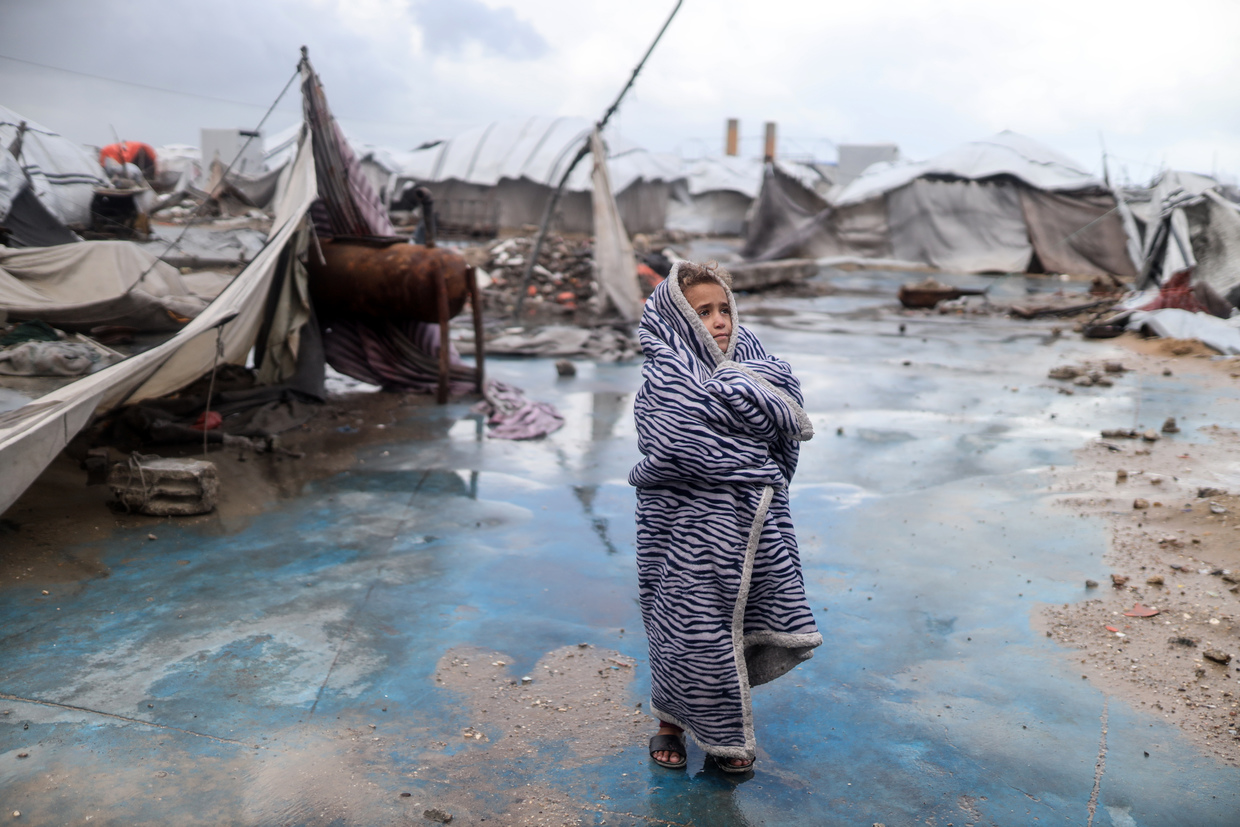
Humanitarian organizations working in Gaza say this ongoing instability compounds the enormous damage already inflicted by the war.
Pat Griffiths, the spokesman for the International Committee of the Red Cross (ICRC) in Jerusalem, says the consequences of prolonged violence will shape life in Gaza for years.
“The impact of two years of devastating violence are going to reverberate for years in Gaza. Even now, people can still queue for food, walk long distances for clean water. People living with disability or chronic health conditions struggle to access the care they need – just as those requiring emergency treatment or surgery still do. Schools and universities have been damaged or destroyed, and it’s incredibly difficult for people to return to study while basic needs like access to adequate electricity, shelter, water or employment need to be addressed. All those needs remain in Gaza right now”.

After 27 months of active hostilities, virtually all of Gaza’s critical infrastructure has been affected. 66% of all structures have sustained damage. Power stations, water and sanitation networks, hospitals, clinics, roads, and schools have been fully or partially destroyed.
There has been neither enough time nor sufficient access to begin long-term reconstruction. Heavy machinery, building materials, and technical expertise remain limited or blocked, leaving most rebuilding efforts stalled.
This infrastructure is essential not only for economic recovery, but for basic human survival – supplying electricity, safe drinking water, sanitation services, and functioning medical care. Without it, humanitarian aid can only provide temporary relief.
Medical access remains one of Gaza’s most urgent crises. Hospitals are overwhelmed, understaffed, and undersupplied. Patients with chronic illnesses, including thousands with cancer, face enormous obstacles in receiving treatment.
Leaving Gaza for medical care remains extremely difficult. Although there have been announcements and reports that the Rafah crossing with Egypt could reopen during the second phase of the ceasefire, nothing tangible has yet been done.
“The continued closure has devastating consequences,” says Al Mughari. “Patients in need of specialized care remain trapped. Students accepted to universities abroad cannot leave. Families separated by the war remain divided, with no clear timeline for reunification.”
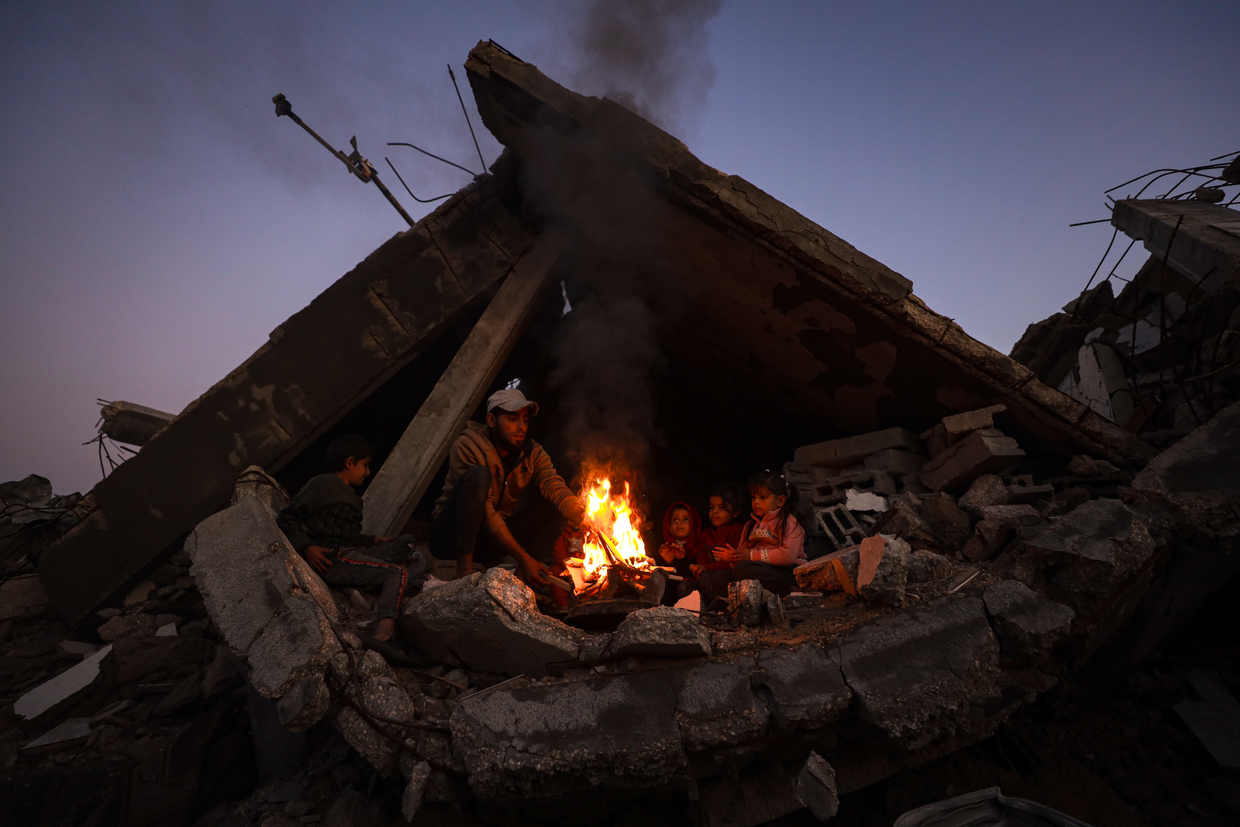
Al Mughari describes a cycle of hope and disappointment that has come to define life since the ceasefire.
“I personally hoped that 2026 would bring real change. Unfortunately, since the ceasefire announcement and the start of the new year, nothing meaningful has happened. The promised improvements have not materialized.”
He says lasting recovery depends on sustained international pressure – not just statements of support.
“Real recovery will only be possible if international actors, especially those who mediated the ceasefire, ensure that the agreement moves forward, that Israel does not obstruct the second phase, and that Palestinians receive genuine support.”
He lists priorities that remain unmet: beginning large-scale reconstruction, providing proper shelter for displaced families, rebuilding the health system, ensuring continuous food supplies, and allowing freedom of movement through Rafah.
“Without these steps,” Al Mughari said, “the ceasefire remains incomplete, fragile, and insufficient to restore dignity or stability to life in Gaza.”
Aid organizations say they are capable of doing far more – if restrictions were lifted.
“We have the capacity to do more to help Palestinians in Gaza, we just need the means to do more,” Griffiths said. “Restrictions on the amount of assistance that are allowed to reach people there make it incredibly difficult to address urgent and large-scale needs – like shelter.”
He added that limits on aid also prevent people from accessing essential services such as electricity, water, health care, and education.
“That’s why we continue to advocate and call for full and unimpeded access for assistance into Gaza.”
Even where aid is delivered, it remains temporary by design.
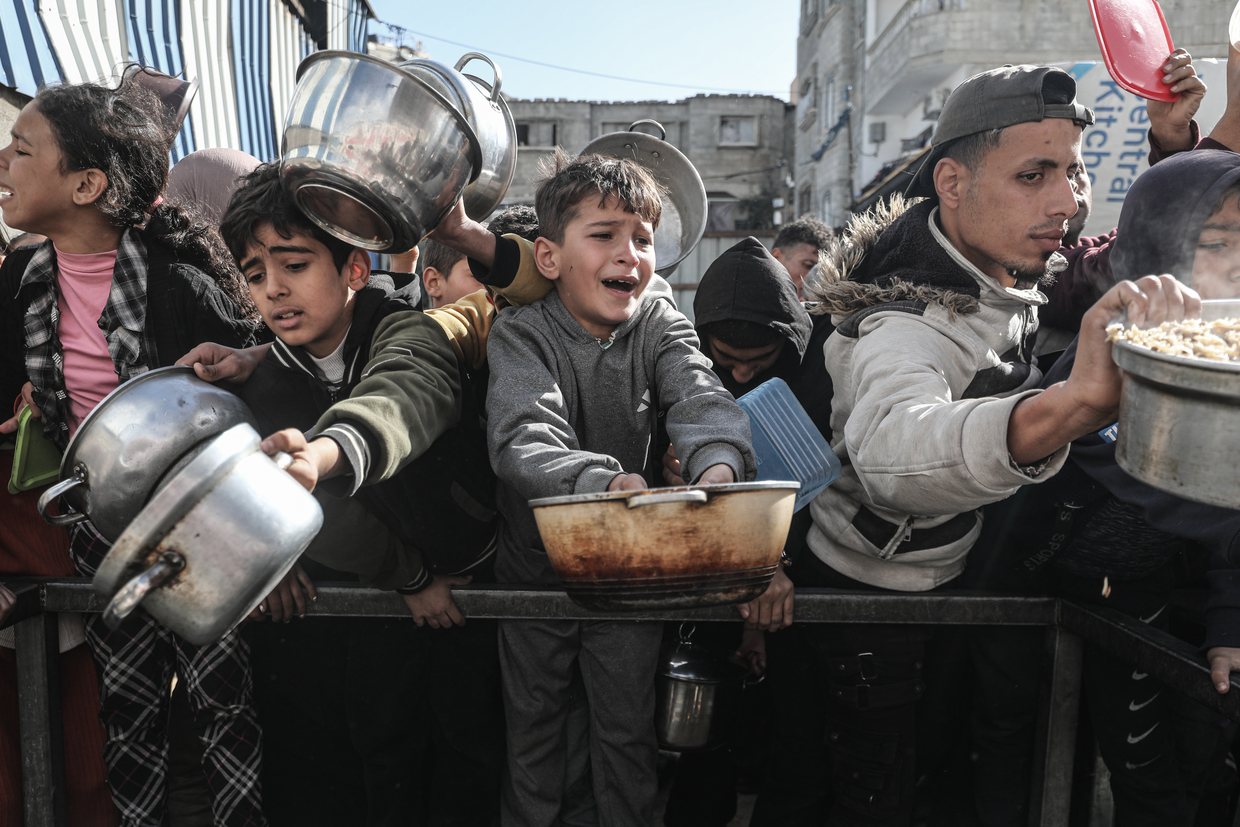
“Humanitarian organizations are responding to the best of their current capacity, given the security situation, but these are always designed as temporary solutions,” Griffiths said. “There are not enough materials, heavy machinery, or equipment to meet the needs of the population, or to have adequate planning or construction for permanent solutions.”
“We call for the full and unimpeded access of humanitarian assistance into Gaza. There are too many lives at stake for anything less.”
Taking matters into own hands
Still, amid the devastation, Al Mughari says Palestinians are not waiting passively for help.
“What gives me hope is that Palestinians in the Gaza Strip, began their own recovering process, without waiting for the international community of players to come in to intervene.”
Across Gaza, small restaurants have reopened. Universities, including the Islamic University and other local institutions, have resumed limited educational activities. Community groups are clearing rubble, repairing buildings, and restoring services with whatever resources they can find.
“Palestinians are trying to cope with the situation,” Al Mughari said, “which gives all of us some kind of a hope that things might get better soon”.
More than 100 days after the ceasefire, Gaza exists in a fragile in-between state – no longer engulfed in a full-scale war, but far from peace. The quiet offers a chance, but without decisive political movement and genuine reconstruction, it may remain only a pause in a much longer struggle.

SOURCE:
https://swentr.site/news/631368-ceasefire-remains-incomplete-gaza/
___
IDF veteran goes thermonuclear against Netanyahu, reveals Hamas attack was “inside job.”
This entry was posted in Uncategorized. Bookmark the permalink.
SOURCE: https://stateofthenation.co/?p=192573
____
Facts About The Gaza Raid on Oct. 7th, 2023
Each of the below facts has been linked to its sources. Be free to click the links for details:
- When Palestinian resistance entered Israel on Oct. 7th, 2023, they entered their stolen lands and looted homes, which were usurped by Israeli Jews during the War of Nakba. To this date, we have seen only a few land deeds for the Jewish citizens of Palestine. As of 1948, Jews were 10% of the citizens (but 33% of the population) since 3 out of every 4 Jews were either refugees or immigrants. On the other hand, Palestinians (the indigenous people who lived on the land for hundreds of years) have tens of thousands of land deeds to prove land ownership; here is our growing list. In a nutshell, the Israeli Jews are mostly nothing but a bunch of colonial settlers squattering on Palestinian lands.Remind us, please: Who shall push who into the sea? Jaffa May 1948, Palestinians were
being pushed into the sea by Zionist Jewish forces. Thus, do you honestly believe this is a "democracy Jews should be proud of" when Palestinians were reduced from 90% of citizens to under 15% during the War of Nakba?
 - Israeli men and women MUST serve in the Israeli Occupation Army for three years and 50 days per year in reserve. That is how Israel was able to convert 360,000 of its civilians into soldiers overnight; that is precisely how Israel has been implementing its apartheid system (Jim Crow Laws like system) for over seven decades. Actually, it was Bibi Netanyahu who emphasized such a fact to the Discovery Channel in the mid-1990s; he boastfully stated: "Israel is made up of a nation of soldiers with few civilians."
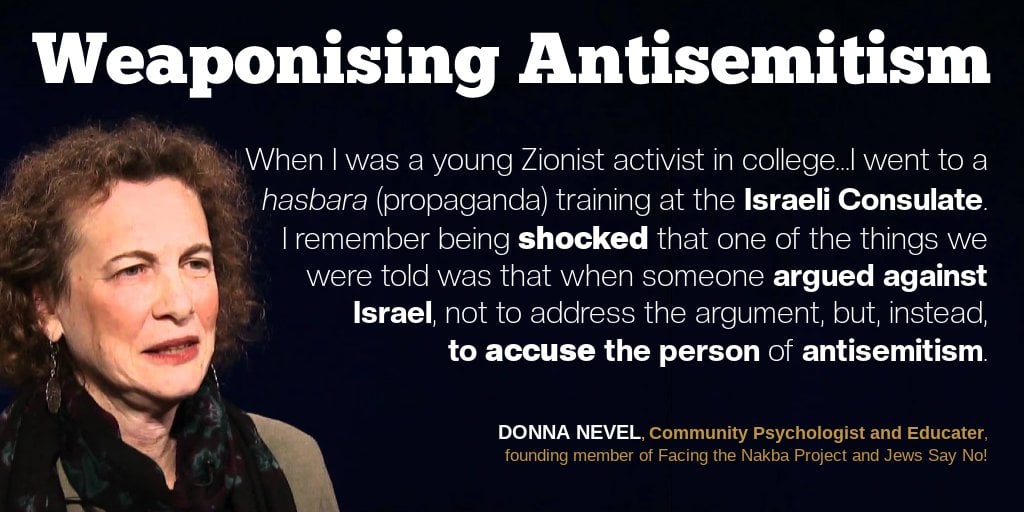 Weaponizing Antisemitism in Defense of Israel By Donna LevelOn the other hand, there is no such thing in Palestinian society; there was never any military service whatsoever, and the armed resistance is made up of a few thousand who are mostly volunteers (the vast majority serve part-time). In other words, the Western media has been abusing the word civilians, and that is a complete farce in the case of the so-called "Jewish state." Just in case you think you are being gaslighted, here is a recent video of an Israeli civilian couple (in their 40s) called up for mandatory military service. Well, if the Israeli gaslight has a market, then based on the same logic, the Qassam Brigade is made up of primarily civilians who are called up for service during wartime! What has been tragic is that the IoF spokesman confirmed to CNN that the kill ratio of two Palestinian civilians for every Hamas fighter was very acceptable (assuming his numbers haven't been fudged). However, this is the same ratio reported by Israelis about those who were killed during the Oct 7th Raid!
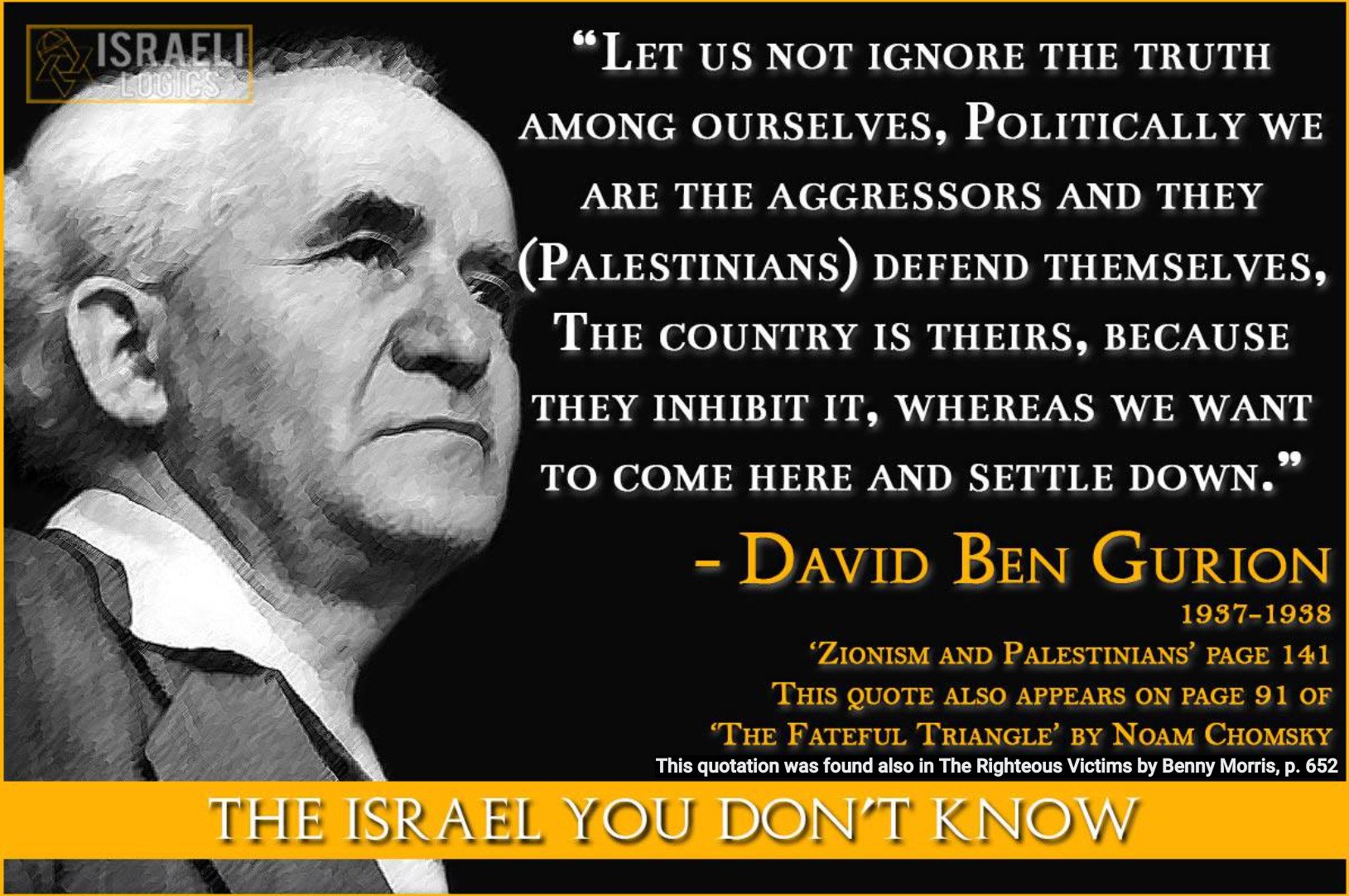 David Ben-Gurion: We're the aggressors; Arabs defend themselves. (Righteous Victims, p. 652)
 - Palestinians resist those who replaced and dispossessed them. It should be noted that it wasn't Palestinians who took turns persecuting Europe's Jews; it was Europeans. Zionism is a colonial Western ideology that was created as a response to the rise of European nationalism and antisemitism, and it is unfair to make Palestinians pay the price for what happened to Europe's Jews during WWII. It is unfortunate that Palestinians have to remind the Europeans, the Americans, the Canadians, and the British that Hitler kept Europe's doors open until late 1941, but all of them were reluctant to take in Jewish refugees in the 1930s, 40s, and 50s. Why do Palestinians have to pay with their blood and treasure for the crimes Europeans committed against their Jewish citizens?
 Official UN Map: It was updated in August 1950, showing that Palestinians STILL OWN 94% of the lands
 - When Israel kidnaps Palestinians by the tens of thousands (many of them are children), the "liberal" Western press often portrays them as prisoners. On the other hand, when Palestinians do the same thing, they are called kidnappers. Sadly, that has been the only way for Palestinians to release their kidnapped loved ones in Israeli jails. Please watch this clip from CNN to understand how kidnapping Palestinian kids is a standard practice by the so-called "most moral army" in the world. Please also note that 2/3 of kidnapped Palestinians don't even face a trial and are arrested based on what is called administrative detention (you can hear it at the NYTimes' Nov. 28th The Daily Podcast as well, or read it here)! Do you understand now where America got the idea behind the Guantanamo Detention Camp? Stretch your imagination; birds of a feather flock together!
- Zionists of all shades concocted ridiculous big lies: Palestinian resistance beheaded Israeli babies, carried chemical weapons and copies of Mein Kampf with them, used hospitals as command and control centers, and rapped elderly Israeli women (lies amplified by NPR as late as Oct. 17th & the NY Times on Nov. 16th), and UNRWA hiring Hamas fighters; those are complete lies; full stop. If you are interested in a credible investigation, we urge you to read what The Guardian and the Israeli newspaper Haaretz have recently published (see image grabs here and here, too), read what the French Libération newspaper has disclosed lately, and watch what the Israeli press reported here, too.
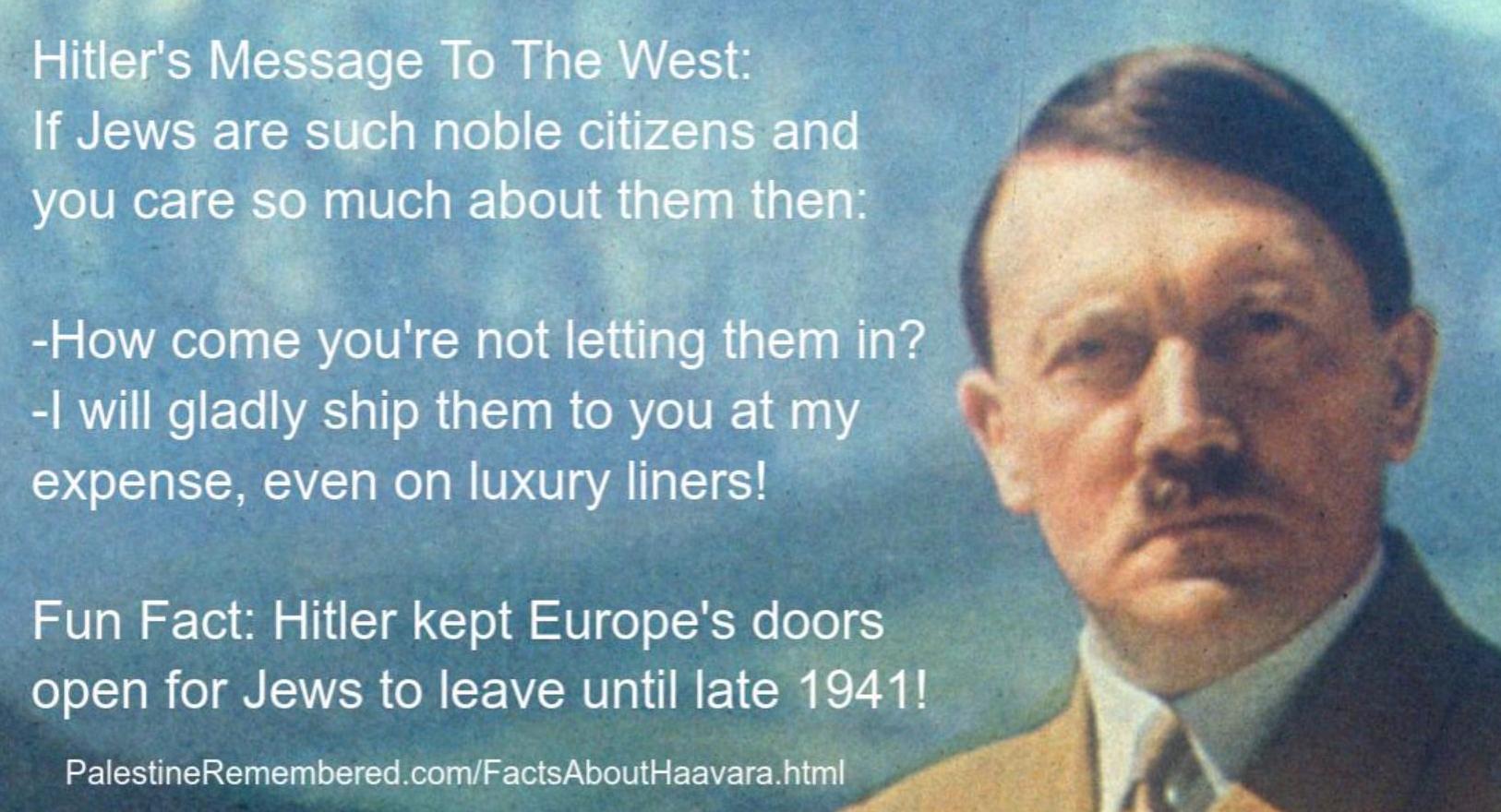 Hitler's Message To The West: If Jews are such noble citizens and you care about them, how come you're not letting them in?Concerning the alleged "rape accusations," please watch Max Blumenthal's, E.I.'s, and Michael Walker's or read If America Knew's take-down of this lie. Here are a few facts that make this claim tragically funny: A) When Palestinians were "accused" of allegedly raping Israelis, the facts and the evidence pointed to the exact opposite. It was Israeli Soldiers who actually gang-raped Palestinian prisoners, and when the Israeli police made arrests, the Israeli society was up in arms and freed the rapist! Here is a rule that never fails us about Zionist Jews: when they make an accusation, then it is a confession. Sadly, the news was watered down in the liberal Western mainstream media. B) It was the US State Department that officially complained that it was Israelis who rapped a Palestinian boy! C) The alleged rape reports cited that Palestinians also "raped" a man. Yes, ladies and gentlemen. Do you have any idea what the punishment is for committing sodomy in Islam? We leave it to your imagination to figure it out. Just in case you have missed it, here is how Google's Gemini framed it.
 Fake Valor: Why Did Zionist Jews Hoist Nazis Flag on Their Ships in the 1930s?D) Soon after Oct. 7th. The rape charges were against an elderly and young Israeli (as reported by NPR on Oct. 17th), and the new claim doesn't include such details whatsoever. E) All reports NEVER cited actual evidence, which explains why the Israeli police appealed to the general public to help it find victims of sexual assault or to connect the alleged evidence with witnesses. Then, based on what evidence did the NY Times write its report, which took almost two months to compile? E) The NY Times started its report by claiming that the alleged rape was systematic and widespread (giving the impression that hundreds were rapped as Danny Danon reported it to the BBC, starting from 13:05). Still, when you get to the end of the article the Times confirmed only four cases (who survived the ordeal) were identified (three for women and one for a man), and that gave the impression that much of the victims were dead. However, there is no accounting for the dead whatsoever! That said, it should be noted that the NYTimes started to backtrack, and when a full retraction happens soon, don't be surprised. Do we smell another scandal as Rukmini's defunct "The Caliphate" series? Well, it seems the NY Times is heading toward a much bigger scandal, and the cracks started to appear when The Daily episode on this subject was about to be released, and it was canceled (watch The Hill; a similar scandal seems to be brewing at The Guardian). If you are interested in the boring details, please watch al-Jazeera English and read The Intercept's latest article concerning the scandal of Anat Schwartz's hiring by the NY Times and censoring certain words (i.e., refugee camps, ethnic cleansing, massacres, ...etc) from being used to describe what is happening to Palestinians in the Gaza Strip, this X thread where even Israelis exposed their army's lies (here is al-Jazeera's version but in Arabic), another excellent X thread, and here is Max's thread as well. If you are curious to know why the rape "allegations" were weaponized way after the facts, here is a HINT. There is strong evidence that Frank Luntz (a copycat version of Joseph Goebbels) may have been behind triggering it way after Oct. 7th happened; all Israeli Hasbarah playbooks start with Mr. Luntz's market research. Watch Muna Hawwaa making the case against him in under 6 minutes.
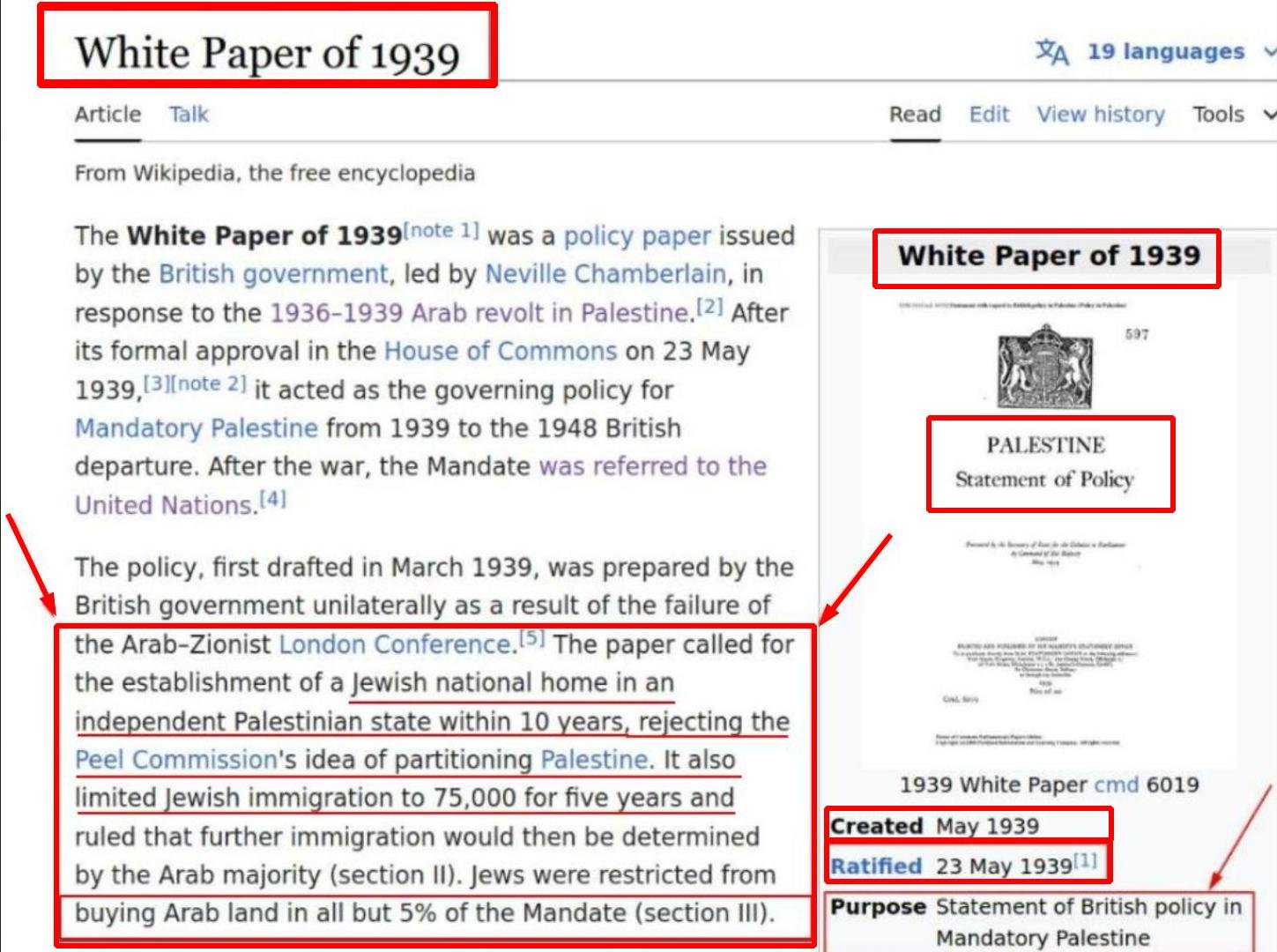 Were the British so STUPID as to promise COMPLETE INDEPENDENCE to Palestinians in 1939 (who, of course, "didn't exist") while the Indians had been DREAMING of such a thing for 400 years?We hate to bore you on the subject of rape. Still, it is an open secret in Israel and Palestine how raping Palestinian women and children was used as THE primary weapon in the process of replacing the indigenous people during the war of Nakba (read the UN's latest report on this subject; we wonder when the NY Times will cross-check its authenticity). If we ever discover that Abu Ghraib's torture and prisoner abuse were replicated from the Israelis' experience in Palestine, would you be surprised? Now it is about time to loop in the so-called "liberal American Jewish community" to tell us how Israel (was and present) is in sync with their so-called liberal Jewish values! So-called "liberalism" dies fast when the subject comes to Palestine and its people! Mazeltov!
 Palestinian women harvesting cotton in the village of Kafr Saba in 1937, which was destroyed and ethnically cleansed during the war of Nakba in mid-1948
Sadly, even President Biden, his White House's press Secretary (hear her at the NYTimes), and his Secretary of State, Mr. Blinken, all swallowed, regurgitated, and amplified Zionists' big lies as Bibi Netanyahu once did when he used deepfake videos and pictures to fool former President Trump. Recently, Bibi was caught red-handed. Recently, Bibi was caught red-handed doctoring documents attributed to Yahya Sinwar aimed at deceiving the general public at home and abroad (why change a winning formula). It is worth noting that pre-October 7th, the mass majority of American Jews (and the so-called liberal American politicians) openly portrayed Bibi Netanyahu as a big liar who wasn't even welcomed in the White House; that's an open secret. Those liberal politicians and Western media outlets became major mega amplifiers of Bibi's lies after Oct. 7th! If you have the time, we urge you to watch Owen Jones and Same Seder breaking down the web of Israeli lies.In this regard, we are forced to ask you to think critically. Adolf Eichmann & company coined a special Gold Medallion in honor of the Nazis' relationship with Zionists! Do you have any ideas why he visited Palestine in 1937? Do you believe President Biden is any more intelligent than his predecessors? Do you think he or Mr. Blinken will put America First and heed hundreds of U.S. government employees who openly and privately have advocated for a ceasefire in Gaza? Wasn't Mr. Biden who assured us that bombing Gaza Ahli hospitals wasn't done by Israel but by the Islamic Jihad? Wasn't Pres. Biden assured Americans that Hamas built its command and control centers underneath Shifa Hospital when all know this has been a standard Israeli practice. Mr. Biden continues to lie, although it is well documented that Israel asked 22 Gaza hospitals to evacuate, and most importantly, the same hospital came under Israeli artillery bombardment three times just before the massacre. For God's sake, since then, almost every health facility in the Gaza Strip has been targeted, many of which were confirmed by the World Health Organization (please watch this brave young American Jew making this point in under 70 seconds). Just imagine if and when Palestinians reciprocate targeting similar targets, but in Israel, how do you think the liberal Western press will portray them? If you are interested in the boring details, here is an Al Jazeera article that refutes the American and Israeli web of lies.
Get Off Our Land Wasn't massacring Palestinians the exact tool used to force them into leaving their homes and land during the War of Nakba? Please don't take our word for it; watch Israelis confirming the massacre's details at Tantura seven decades ago, and here's the head of UNRWA warning that the Israeli war machine is methodically executing Nakba V2. Did Zionist leaders ever admit to any of the massacres they've perpetrated against Palestinians? See for yourself how Albert Einstein responded (a day after the Deir Yassin massacre) by predicting that those Zionists (many of whom became Israel's top generals & PMs) would bring a Nakba upon Jews! Newly arrived persecuted European Jewish refugees strolling in Jaffa, 1949 When the US media amplified the Biden administration's lies, how does that resemble G.W. Bush's infamous staged press conference in selling us a war in Iraq in 2003? Start watching from 1:00 to 2:00; this video is considered taboo, and you will never find it on YouTube or any US media outlet. Why is it being discounted that a large number of the "Israeli civilians" who were killed died when Israeli soldiers were battling Palestinian fighters inside "Israel proper"? This fact is being widely debated in Israel as we speak. On the other hand, that is a taboo topic to discuss in the Western media! Here is also a more recent article from The Guardian about an Israeli tank commander who was killed in Gaza, this Ha'aretz article about the mass killings of the partygoers (please note that much of the evidence is being destroyed), and this analysis from the Army University Press! Even one of the freed hostages told Bibi how his troops were targeting them on several occasions, and flooding the tunnels with seawater or poison gas could end up killing more of them (YES, some Israelis strongly suspect their sons were murdered using chemical weapons). To further prove our points, here is a report showing how Israeli occupation soldiers are programmed to shoot first and then ask questions later. If they treat Israeli Jews as such, how do you think they will treat Palestinians God "forbid"? Would you be surprised if we soon discover that the Hannibal Directive was implemented to the teeth? Well, it seems that was the case based on the latest reports coming from the Israeli mainstream press (see YNet) when Israeli soldiers received orders to shoot to kill those Palestinians heading back into Gaza, even if they had with them Israeli civilians. We urge you to read what Prof. Lee Mordechai wrote and watch Prof. John Mearsheimer articulating our earlier points, Dan Cohen's presentation, and Mu'taz Matar's latest episode (in Arabic), where he presented compelling evidence from the Hebrew press proving that the Hannibal Doctrine was implemented (the relevant portion started from 11:30).
 June 17, 1967. Note the Israeli officer to the left directing Palestinians out of their village, Imwas As we speak, Israeli leaders are ordering 1.6 million Palestinians in North and South East Gaza to leave their homes, or else they will be targeted as if they are enemy combatants (as they did during Nakba to a lesser number, although Nakba is still being denied). Now, Israelis are doing it in the open to a much larger number because Israeli leaders care about saving Palestinian lives as they did 76 years ago. If you do believe Israeli gaslight, you should have your head examined. Maybe we are wrong; didn't Zionists sign the Haavara Agreement with Hitler for nine years straight to "save" Jews' lives, too? Look how that turned out to be; what a great success!
 Just Imagine Someone sitting in your chair for over seven decades. Again, imagine this person was sitting in your house and eating from your trees! Tell us how you would feel in the comments section. Please watch how the big Zionist Wolf Blitzer was lost for words while interviewing the Israeli Army's spokesman about the flatting over thirty residential apartment buildings in the Jabalya refugee camp (which ended up murdering hundreds). All this was done to get a single Hamas commander whom he wasn't sure if he was killed, even after targeting the same area twice (which murdered many during the rescue operation). Why is it being discounted that such massacres were purposely to induce Palestinians to flee their homes, as it was done during Nakba? God forbid, the most ethical army wouldn't do such a thing, and those murdered civilians are collateral damage! God forbid, Israeli democracy wouldn't allow such a thing to happen! See for yourself how Israelis are concerned about Palestinian civilians in this latest poll!
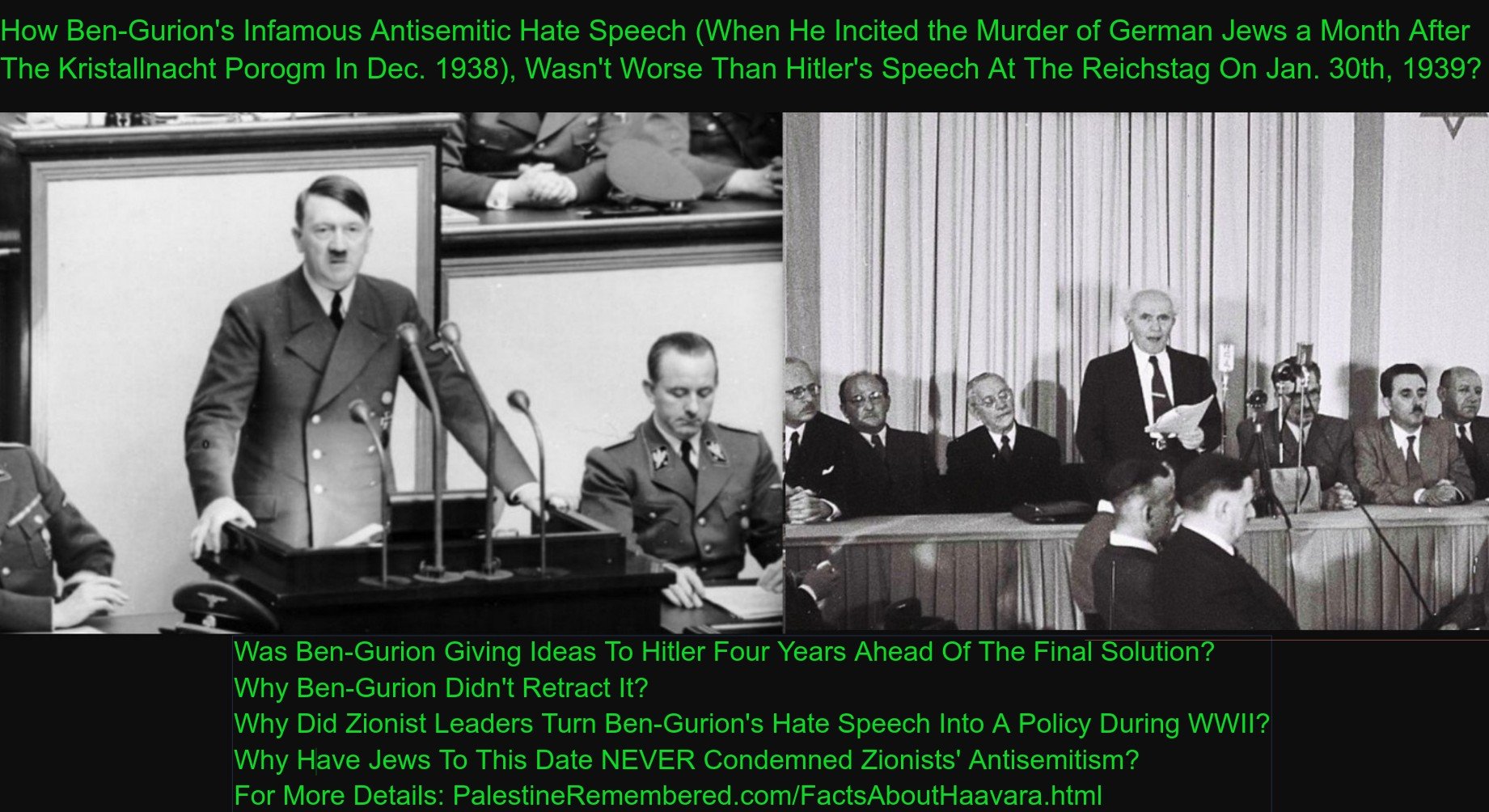 Which hate speech is more antisemitic: Hitler's hate speech at the Reichstag on Jan 30th, 1939, or Ben-Gurion's hate speech a month after the Kristallnacht pogrom in December 1938? You be the judge! How does spreading big lies in defense of Israel not foment "antisemitism"? Does the American Jewish community care? Or is their objective as long as spreading big lies to defend Israel? Is that being done based on design? Or based on ignorance? Can you honestly name one European antisemite whom Zionist Jews (from all shades of color) didn't work with hand over fist? Here's the shortlist: Russian Tsars and their antisemitic ministers, Symon Petliura, Arthur Balfour, Winston Churchill, Mussolini, Adolf Hitler, Reinhard Heydrich, Adolf Eichmann, South Africa's apartheid regime, Argentina's military junta, etc.? For God's sake, even those in the far-right in the US (who are fighting against critical race theory, equity & diversity) are flocking to defend their fascist buddies. Are you surprised?
Let us hope Zionists won't drag the US to fight their wars again & again. - Often, the "liberal" Western press repeats Zionists' racist tropes by portraying Israeli rampages & pogroms in Palestinian towns and refugee camps as "cutting the grass or mowing the lawn" (the last of which was at the NY Times--starting from 7:20, and at the Jewish "liberal" Ezra Klein show) and Israel has the right to defend its citizens (watch Bibi explaining "cutting the grass" theorem and Zionists' hegemony over Americans in under 90 seconds). And when Palestinian civilians die in the tens of thousands, and their homes and public facilities are destroyed, well, that is collateral damage since the "grass" was tall, and the "terrorists" were using civilians as human shields. And when there is too much grass, how do we eliminate it? One solution is left: chemicals, of course (i.e., Zioclon B). Fine then, if the "liberal" West is comfortable paddling Israeli racist tropes freely on its media and inciting violence against the indigenous people, then they should expect Palestinians to use the same term: Palestinians went to cut the grass (i.e., the squatters) on the land they've owned for tens of generations and they've all the rights to defend themselves too. Palestinians are very sorry for the loss of civilian lives; well, that is "collateral" damage; they lived close to Israeli military bases in military zones, and as you know, the "grass" was thick and tall. Of course, assuming you believe Palestinians are humans and they do exist.
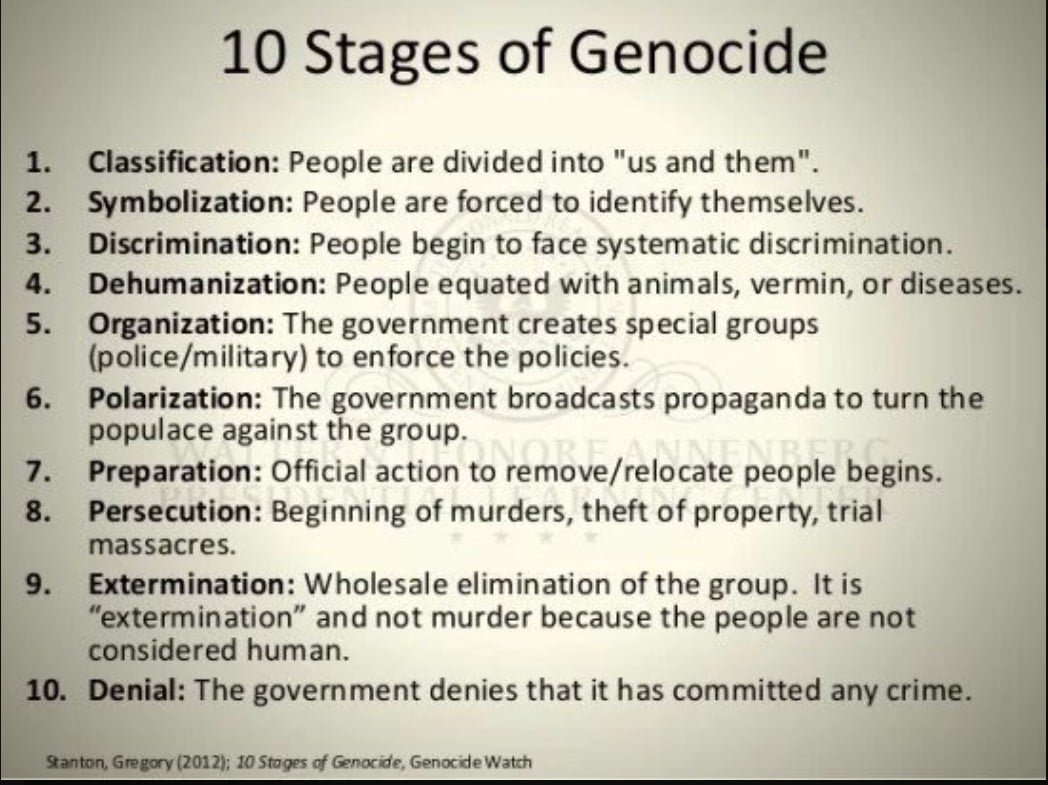 Ten Stages of Genocide
 - To put things into perspective, let us go back just a few years after Nakba and read what Israel's most decorated general, Moshe Dayan stated in an oration at the funeral of an Israeli farmer killed by a Palestinian Arab in April 1956, almost in the same location where the current raid took place:
 Israeli soldiers are enjoying torturing a Palestinian; compare the look on the victim's face with the one on the soldiers' faces! Did Nazis enjoy it like this during WWII?
We ask you to trail for Abby Martin's "Gaza Fights For Freedom" to learn how Gazans lived before Oct. 7th, and if you have the time, we ask you to watch and contribute to the documentary on YouTube.". . . Let us not today fling accusation at the murderers. What cause have we to complain about their fierce hatred to us? For eight years now, they sit in their refugee camps in Gaza, and before their eyes we turn into our homestead the land and villages in which they and their forefathers have lived.
 Faluja-Gaza, 1949, Ethnically Cleansed Palestinians on their way to Hebron
We should demand his blood not from the [Palestinian] Arabs of Gaza but from ourselves. . . . Let us make our reckoning today. We are a generation of settlers, and without the steel helmet and gun barrel, we shall not be able to plant a tree or build a house. . . . Let us not be afraid to see the hatred that accompanies and consumes the lives of hundreds of thousands of [Palestinian] Arabs who sit all around us and wait for the moment when their hands will be able to reach our blood." (Iron Wall, p. 101 and at NYTimes by Roger Cohen)
Isn't tragic how Palestinians received empathy from Zionist leaders far better than they've received in the so-called "liberal" press? As if propagating lies doesn't foment "antisemitism" which they claim to care about? We simply ask: Is that their goal?https://www.palestineremembered.com/images/mp4/Abby-Martin-Empire-Files.mp4

 Fake Valor: Why Did Zionist Jews Hoist Nazis Flag on Their Ships in the 1930s?
In a nutshell, it is unfair and immoral to ask the persecuted, the enslaved, the replaced, the colonized, and the dispossessed to be human, logical, civil, and fair. Those things should be demanded from the powerful. The way we see it, this raid was a slave revolt. Therefore, if Israeli Jews do not wish to be killed or kidnapped, then maybe they should start treating Palestinians as humans; Palestinians surely will reciprocate. But until then, Palestinians have every right to resist those who dispossessed and replaced them. Palestinians will not wait for the West to permit them to resist those who have oppressed them for decades. It was Western-born antisemitism (not Arabs' antisemitism) that created this apartheid state; we suggest implementing Haavara Agreement V3 (similar to the one signed between Hitler and Ben-Gurion) but in reverse to end this injustice once and for all. Zionist Jews gave it a "good" try at building a Spartan Fortress, and it is buckling under its weight, although the "liberal" West showered it with cash and weapons; the recent raid from Gaza proved how fragile Israel is. During peacetime, 40% of Israelis can't wait to leave (the rate among young is 70%), and over half of Israeli Jews would love a second passport! Imagine this is the case at the peak of peacetime, although Israeli Jews enjoy one of the highest standards of living not only in MENA but in the whole world! Just in case you are curious, the case for Palestinians is the exact opposite! This alone should indicate who is indigenous to the land and who is the imposter!
 Persecuted European Jewish refugees occupied the ethnically cleansed village of Yazur in 1949
 Ask yourself: If Israelis couldn't secure 35 to 40 miles of borders with Gaza, and now they seek external help just to survive, how the hell are they going to continue to occupy the West Bank, where over 150 isolated, exclusive Jewish colonies are eyeing them, millions of Palestinians? This is a logistical and security nightmare for the best-organized army. To put it simply, Zionist Jews in mass decided to eat the cake and look at the same time; of course, the "liberal" West went along. On the other hand, the Zionists' big lies eventually caught up with them, and a rude awakening (coming from mediocre groups) slapped them in the face and shocked them to the core. What if future raids would target the West Bank's exclusive Jewish colonies, or Israel's major healthcare hubs (i.e., Hadassah, Abu Kabir, or Rambam) as they currently do to Gaza's health facilities, or God forbid Israel's Nuclear Weapons facilities? That is it; checkmate, and the game is over! In a nutshell, what Israelis thought was their "swords" could easily be weaponized against them when asymmetrical warfare was adopted!
 General view of al-Maliha taken after Nakba, and in the foreground, Israelis are looting Palestinian properties
 Here's the unvarnished truth: This latest raid exposed how fragile the whole Zionist enterprise is; it has so many single points of failure that could end it overnight, and we haven't spoken about how many Israeli Jews can't wait to leave even during peacetime; what about during wartime? For decades to come, Israel has lost its deterrence power, and who knows if it will recover it, but what is certain is that this Spartan militant and fascistic way of life can't persist forever. From the get-go, Zionist Jews A) opted to deny reality, aided with massive doses of delusional big lies, hoping that they could isolate themselves from reality; and B) decided to live by the sword as a modern-day Sparta; therefore, it is safe to assume they shall die with their swords too. Israelis' points of strength easily have become a liability, and it is just a matter of time until the fat lady sings, which Palestinians, Arabs, and Muslims have plenty of (see Ze'ev Jabotinsky's Iron Wall). In this regard, we urge you to watch Johnny Harris (the famous YouTuber who is a known supporter of the "Jewish state") for two minutes explaining how Zionism has been a failure and how it has created a state that provided the opposite of the security and safety it promised the "Jewish people":
https://www.palestineremembered.com/images/JH.mp4
How is Mr. Harris' conclusion not in sync 100% with Albert Einstein's prediction (a day after the Deir Yassin massacre) when he predicted that Zionists would bring a Nakba upon Jews? Let us hope Mr. Harris won't get canceled for telling the truth to the powerful.
In retrospect, Theodor Herzl must be now rolling in his grave; that is not what he had in mind when he wrote the "Jewish state." In this regard, Zionist Jews should have heeded Herzl's advice when he died, thinking Israel would be in Uganda when it was "empty"!
Zionism, what a terrible disease of the mind...using Rashid Taha's words...Barrah Barrah
Related Links
Adolf Eichmann & company coined a special Gold Medallion in honor of the Nazis' relationship with Zionists! Do you have any ideas why he visited Palestine in 1937?- The Rational Report: Israel Spokesman Stuns CNN’s Wolf Blitzer With Brutal Admission (24 minutes)
- CNN Arabic: Israel kidnaps Palestinian children who are mostly not charged (10 minutes). A MUST Watch: the interview is in English with Arabic translation.
- Why journalists are speaking out against Western media bias in reporting on Israel-Palestine
- Democracy Now: Not in Our Name": 400 Arrested at Jewish-Led Sit-in at NYC's Grand Central Demanding Gaza Ceasefire (13 minutes)
- Propaganda and co: Before they launch missiles, they launch propaganda campaigns. Before they roll out tanks, they roll out narratives. (6 Minutes)
- France's Libération: Check News: Hamas attack: Where does the claim that an Israeli baby was put to death in an oven come from?
- US News: Hundreds of U.S. government employees openly and privately have advocated for a ceasefire in Gaza.
- Short Clip: Hi I am an American Jew. Let me tell you why I unconditionally support Palestine.
- Short Clip: Former US Marine’s pro-Palestine interview resurfaces online.
- Short Clip: Piers Morgan Gets Nail by Bassem Youssef.
- Short Clip: Here's the fact about three lies widely spread by Israeli propaganda.
- Short Clip: In Leaked Video, Bibi Netanyahu Explaining Mowing The Grass Theory And Zionists' Hegemony Over Americans Duration: min 30 sec
- Short Clip: $5,000 has been offered to a social media influencer in return for their support of Israel. It is worth noting that if you demonstrate "for Israeli", you'll get $250. We heard the price went up since Oct. 7th; Mazeltov. Bankrupt them guys and raise the Palestinian (a.k.a freedom) flags instead!
- Short Clip: Norman Finkelstein connects the dots on Israel's Genocide Plan
- Short Clip: Short Clip: I wish I had asked about Palestine sooner (Pre-Oct. 7th) (3 minutes)
- Short Clip: The Zionist playbook, why when you chat with Zionists, they all sound the same! Duration: 2 min 19 sec
- Short Clip: Suddenly, you see a helicopter shooting at the kibbutz. I don't understand it, and a tank firing a shell at a house. These are things I cannot understand." Israeli "soldier" Erez Tidhar Duration: 22 seconds
- Judge Napolitano: Max Blumenthal: (TheGrayZone) - What the IDF Did on Christmas (33 minutes) A MUST WATCH
- AlJazzera Video: John Mearsheimer: Israel is choosing 'apartheid' or 'ethnic cleansing' | The Bottom Line (24 minutes)
- Video: The Ten Stages of a Genocide (5 minutes)
- The Majority Report On The Lies Against UNRWA: Host FED UP With Israeli Spokesperson's Lying (18 minutes)
- Video: US Media's Gaza Coverage Hits Dismal New Low (11 minutes) A must-watch, see for yourself how US media is engaged in covering up Nakba and watering down Israeli war crimes
- The Intercept: "BETWEEN THE HAMMER AND THE ANVIL" The Story Behind the New York Times October 7 Exposé (A MUST READ)
- The United Nations: ">UN experts appalled by reported human rights violations against Palestinian women and girls
- al-Jazeera English: Is the New York Times losing its credibility on Israel-Palestine? | The Listening Post (25 minutes) A Must Watch
- Short Clip: Watch Thomas Friedman's infamous "Suck On This" colonial speech (recorded on May 30th, 2003 at Charlie Rose two and half months after the invasion of Iraq in March 2003)..clipped from al-Jazzera's latest episode on the NY Times Duration: 2 min 3 sec
- Owen Jones Video: EXPOSED: Why Media's Role In Gaza Massacre Is Worse Than You Think (45 minutes)
- Own Jones: Israel's LIES On Human Shields Taken Apart (15 minutes)
- Own Jones: Senior Journalist EXPOSES Media Complicity In Mass Murder - w/ Peter Oborne (48 minutes)
- Own Jones: Watch how Mr. Jones rips Israeli spokesman when he weaponized )))antisemitism((( against him! (10 minutes)
- X Thread that debunked the 40 beheaded babies lie
- Economist The Intelligence Podcats: As if Israel's plan is to make Gaza unlivable! Chilling to hear, focus on the first 12 minutes
- The Guardian: CNN staff say network’s pro-Israel slant amounts to ‘journalistic malpractice’
- Owen Jones Video: BBC's Racism Over Gaza EXPOSED By Shocking Study (15 minutes) The beef starts from 8:24 A MUST WATCH
- Video: The Israeli Lobby Got Me Fired Interview with Professor David Miller (52 minutes)
- Owen Jones Video: Israel Mows Down Its Own Hostages (12 minutes)
- Video: What really happened in Israel on Oct. 7th? With Max Blumenthal | The Chris Hedges Report (42 minutes)
- Malcolm X on Palestine: Eloquent, Courageous, Fearless, - the Voice of Truth! (3 minutes)
- Democracy Now: Jeremy Scahill: Israel's "Lethal Lie" About Al-Shifa Hospital as Hamas Base Was Co-Signed by Biden (10 minutes)
- NY Times: The Backlash to Anti-Israel Protests Threatens Free Speech
- Jerusalem Fund: What did Israel actually want from al-Shifa Hospital? Please note that Israelis created a bunker in the hospital in 1983 which often goes unreported by the "liberal" press. Here it is from the Zionist illiberal press but dated in 2014!
- Video: How hospitals became ‘fair game’ in Gaza | The Listening Post (26 minutes) A Must Watch
- Short Clip: BBC debunked Israeli claims that Hamas used Shifa hospital as a command center. We wonder when the NY Times will start paying closer attention to Israeli lies.
- Novara Media: Israel Attacks UN Women But Refuses Investigation Into Sexual Violence (28 minutes) A Must Watch
- Owen Jones: Israel's Propaganda Machine EXPOSED (26 minutes) A Must Watch
- The Young Turks: Freed Israeli Hostages TEAR INTO Netanyahu For Incompetence In Leaked Audio (12 minutes) A Must Watch
- Novara Media: Owen Jones SMEARED For Telling Truth About Israeli Propaganda (20 minutes)
- Video: Palestinian (Ahmed Alnaouq) EXPOSES Gaza Media Coverage (13 minutes) Ahmad's whole family (20+) were murdered by the most ethical army in the world.
- EI! Video: Debunking Israel's "mass rapes" atrocity propaganda (42 minutes)
- How Israelis Live So Easily With Occupation - Gideon Levy Duration: 6 min 46 sec
- MUST WATCH: Most controversial criticism of Israel lobby influence | John Mearsheimer and Lex Fridman Duration: 21 min 19 sec (On weaponization of antisemitism has debased a noble term)
- Video: Western Media Learning Israel Has Been Lying To Them For Decades: Ehud Barak admitted that it was Israel who built a command bunker underneath the Shifa hospital (10 minutes)
- Video: A leaked report from the Netherlands' embassy in Tel Aviv (6 minutes)
- Video: Two-State Solution Debate | Gideon Levy | Proposition Duration: 12 min 37 sec (A MUST WATCH)
- Video: Weaponized Anti-Semitism Allegations: How Israel Plays the Victim, Inverts Reality & Stifles Dissent Duration: 68 min 11 sec (A MUST WATCH)
- Short Clip: Israel, which claims to have the most moral army, stocks white phosphorus in their tanks by default. Duration: min 25 sec
 Shukri al-Jamal's Palace in the Talibiya neighborhood in Jerusalem two days after its completion and just before Zionist Jews looted it from him and his familyShort Clip: Danny Ayalon is demanding the complete removal of the Palestinians from Gaza to the Sinai peninsula to "save them." Please pay attention to how he smiled when he was caught lying.
- Zionist FAQ: Isn't it true that Palestinians don't want peace? Palestinians never accepted the two-state solution

- NY Times: Freed Palestinians Were Mostly Young and Not Convicted of Crimes
- NY Times: 750 American journalists signed a letter protesting coverage of the Israel-Gaza war. On the other hand, none STILL works at the NY Times, and those who did sign the letter were asked to leave quietly! AJ+'s Ashraf Ibrahim did an excellent video on this subject, but sadly it is in Arabic.
- Owen Jones: SHOCKING Expose Destroys Israel's Claims (14 minutes) A MUST WATCH
- Video: CNN ROASTED For Silence on Insane Israel Guest Take | Breaking Points (13 minutes)
- Norman Finkelstein: The SLAVE REVOLT IN GAZA, and Bernie Sanders
- A MUST Watch: This MSNBC pundit (Ali Velshi) made a few small observations about the Israel - Palestine conflict and was subsequently suspended from his job. Calling a spade is a spade in the land of the free & the home of the brave gets you fired or suspended after decades of service. We dig it: The truth and facts must be )))antisemitic((( tropes.
- Video: Americans are Starting to Wake Up to Israeli Propaganda! (5 minutes)
- CaspianReport: Why Israel was "attacked" (22 minutes)
- Albert Einstein called Zionists' gangs a Nakba upon Jews as early as April 10th, 1948 (a day after the Deir Yassin massacre)
- The Hebron Massacre of 1929, "clearly proves" that Palestinians are antisemitic, how could you deny it?
- Al-Jazeera's Listening Post: What US media is missing in Israel’s war on Gaza...and why it matters (27 minutes)
- Short Clip: A conversation between the sword and the neck - Ghassan Kanafani (110 seconds)
- Video: John Mearsheimer on why the US is in serious trouble! (37 minutes)
- Short Clip: Here’s every hospital Israel has bombed in the last decade.
- Short Clip: How Frank Lutz Sold Israeli Hasbarah To Americans
- Yanis Varoufakis: They want us to take the side of Israel (16 minutes)
- Short Clip: Why Israel is one of the most racist countries?
- Short Clip: This Clip PROVES The U.S. Govt Thinks Palestinian Lives Don't Matter (Watch the 1st 4 minutes)
 Israeli Jews looting al-Musrara Palestinian Quarter, Jerusalem 1948Short Clip: That time when Ariel Sharon admitted that the Zionists were occupying Palestine and that it could not last forever.
- A Must Watch: Monumental Oversight: Unveiling a Colossal Miscalculation | Scott Ritter (70 minutes)
- Video: Can Israel manage a multi-front war? | Col. Larry Wilkerson (46 minutes)
- Short Clip: Nelson Mandela on Palestine Part Two (5 minutes)
- Video: Nelson Mandela on Palestine (1990) (8 minutes)
- Video: Origins of Hamas/Israeli War w/ John J. Mearsheimer (26 minutes)
- Zionist FAQ: Why Palestinians Teach Their Children to Hate Jews?
- Zionist FAQ: Isn't it true that Palestine was empty and inhabited by nomadic people?
- Video: Why Israel Matters to Americans (22 minutes)
- AJ+: Why Israel Matters to Americans (20 minutes)
- Army University Press: The End of the Deterrence Strategy in Gaza
- DW: EU Poll Names Israel Greatest Threat to World Peace, ever since the poll was conducted in 2003, it was never repeated since the truth must be )))antisemitic(((. How suppression of the truth doesn't foment "antisemitism"?
- The Daily Show: We Need To Talk About Israel (2 minutes)
- Video: Origins of Hamas/Israeli War w/ John J. Mearsheimer (26 minutes)
- Zionist FAQ: Why do Palestinians want to destroy Israel and push Israeli Jews into the sea?
- Zionist FAQ: Israel is the strongest force in the Middle East; how come Arabs are not willing to accept this fact?
- Zionist FAQ: Why did Arabs reject the proposed UN GA partition plan?
- This is What Passes for Light Entertainment Among Israel’s Neo-Nazi ‘Civilians’ (Tony Greenstein Blog)
- Short Clip: The most Moral Army (a.k.a. The Israeli Occupation Force) uses Palestinian civilians as human shields. Remind us please of "Jewish Values"
- The Israeli Human Shield
- How The Spartan Jew Was Born
 Newly arrived Bulgarian Jews in the ethnically cleansed Palestinian village of al-Bassa, 1950Aljazeera: Hamas' New Weapons and Tactics
- Isn't it a fair "population exchange" between Palestinian refugees and Jewish refugees from Arab states?
- Short Clip: Senator Lindsey Graham incites murdering Palestinians in Gaza by leveling the whole strip to the ground. Senator Tom Cotton was known to have said something very similar. Think about it: how else could Americans be "secure & prosperous"? Turn Gaza into another Mosul, Mazeltov Senators!
- Video: Naomi Wolf: Why I would never go back to live in Israel A Must watch (4 minutes)
- AJ+: Why Israel Tried Canceling Netflix Film Farha (6 minutes)
- BBC Documentary: The Jews and Arabs Coexisting in Crisis: A Must-Hear Podcast (28 minutes)
- Fresh Air Interviews Daniel Byman: How Was Hamas Able To Launch Such A Devastating Attack On Israel? The least acceptable coverage in the so-called liberal press of the raid so far (46 minutes)
- “It's a Trick, We Always Use It.” Calling people “anti-Semitic” for criticizing Israel. Duration: 2 min 14 sec
 Rza on January 5, 2025
#163314
Although just a baby, although hungry, thirsty and freezing, although orphan, although alone... You are a lion...And those who wronged you will know to which point of return they will go.Rza on January 5, 2025 #163312
Only if I were in Palestine.Shadi on February 21, 2024 #163013
Zios are circulating lies that no one wants to take Palestinians in because of events that happened in past like black September. It would be nice if you can tackle this one, as you are really good at it.
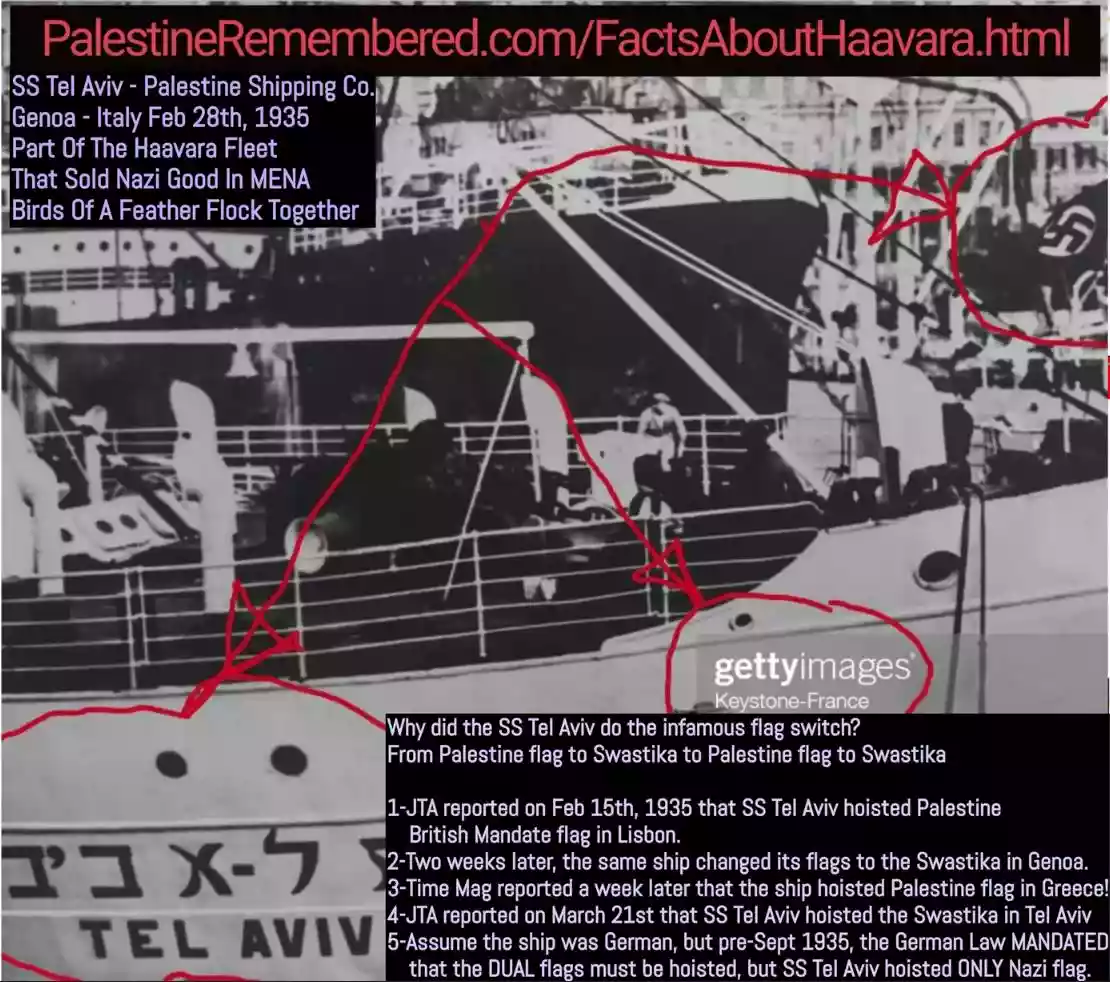 Fake Valor: Why Did Zionist Jews Hoist Nazis Flag on Their Ships in the 1930s?
Adolf Eichmann & company coined a special Gold Medallion in honor of the Nazis' relationship with Zionists! Do you have any ideas why he visited Palestine in 1937?- The Rational Report: Israel Spokesman Stuns CNN’s Wolf Blitzer With Brutal Admission (24 minutes)
- CNN Arabic: Israel kidnaps Palestinian children who are mostly not charged (10 minutes). A MUST Watch: the interview is in English with Arabic translation.
- Why journalists are speaking out against Western media bias in reporting on Israel-Palestine
- Democracy Now: Not in Our Name": 400 Arrested at Jewish-Led Sit-in at NYC's Grand Central Demanding Gaza Ceasefire (13 minutes)
- Propaganda and co: Before they launch missiles, they launch propaganda campaigns. Before they roll out tanks, they roll out narratives. (6 Minutes)
- France's Libération: Check News: Hamas attack: Where does the claim that an Israeli baby was put to death in an oven come from?
- US News: Hundreds of U.S. government employees openly and privately have advocated for a ceasefire in Gaza.
- Short Clip: Hi I am an American Jew. Let me tell you why I unconditionally support Palestine.
- Short Clip: Former US Marine’s pro-Palestine interview resurfaces online.
- Short Clip: Piers Morgan Gets Nail by Bassem Youssef.
- Short Clip: Here's the fact about three lies widely spread by Israeli propaganda.
- Short Clip: In Leaked Video, Bibi Netanyahu Explaining Mowing The Grass Theory And Zionists' Hegemony Over Americans Duration: min 30 sec
- Short Clip: $5,000 has been offered to a social media influencer in return for their support of Israel. It is worth noting that if you demonstrate "for Israeli", you'll get $250. We heard the price went up since Oct. 7th; Mazeltov. Bankrupt them guys and raise the Palestinian (a.k.a freedom) flags instead!
- Short Clip: Norman Finkelstein connects the dots on Israel's Genocide Plan
- Short Clip: Short Clip: I wish I had asked about Palestine sooner (Pre-Oct. 7th) (3 minutes)
- Short Clip: The Zionist playbook, why when you chat with Zionists, they all sound the same! Duration: 2 min 19 sec
- Short Clip: Suddenly, you see a helicopter shooting at the kibbutz. I don't understand it, and a tank firing a shell at a house. These are things I cannot understand." Israeli "soldier" Erez Tidhar Duration: 22 seconds
- Judge Napolitano: Max Blumenthal: (TheGrayZone) - What the IDF Did on Christmas (33 minutes) A MUST WATCH
- AlJazzera Video: John Mearsheimer: Israel is choosing 'apartheid' or 'ethnic cleansing' | The Bottom Line (24 minutes)
- Video: The Ten Stages of a Genocide (5 minutes)
- The Majority Report On The Lies Against UNRWA: Host FED UP With Israeli Spokesperson's Lying (18 minutes)
- Video: US Media's Gaza Coverage Hits Dismal New Low (11 minutes) A must-watch, see for yourself how US media is engaged in covering up Nakba and watering down Israeli war crimes
- The Intercept: "BETWEEN THE HAMMER AND THE ANVIL" The Story Behind the New York Times October 7 Exposé (A MUST READ)
- The United Nations: ">UN experts appalled by reported human rights violations against Palestinian women and girls
- al-Jazeera English: Is the New York Times losing its credibility on Israel-Palestine? | The Listening Post (25 minutes) A Must Watch
- Short Clip: Watch Thomas Friedman's infamous "Suck On This" colonial speech (recorded on May 30th, 2003 at Charlie Rose two and half months after the invasion of Iraq in March 2003)..clipped from al-Jazzera's latest episode on the NY Times Duration: 2 min 3 sec
- Owen Jones Video: EXPOSED: Why Media's Role In Gaza Massacre Is Worse Than You Think (45 minutes)
- Own Jones: Israel's LIES On Human Shields Taken Apart (15 minutes)
- Own Jones: Senior Journalist EXPOSES Media Complicity In Mass Murder - w/ Peter Oborne (48 minutes)
- Own Jones: Watch how Mr. Jones rips Israeli spokesman when he weaponized )))antisemitism((( against him! (10 minutes)
- X Thread that debunked the 40 beheaded babies lie
- Economist The Intelligence Podcats: As if Israel's plan is to make Gaza unlivable! Chilling to hear, focus on the first 12 minutes
- The Guardian: CNN staff say network’s pro-Israel slant amounts to ‘journalistic malpractice’
- Owen Jones Video: BBC's Racism Over Gaza EXPOSED By Shocking Study (15 minutes) The beef starts from 8:24 A MUST WATCH
- Video: The Israeli Lobby Got Me Fired Interview with Professor David Miller (52 minutes)
- Owen Jones Video: Israel Mows Down Its Own Hostages (12 minutes)
- Video: What really happened in Israel on Oct. 7th? With Max Blumenthal | The Chris Hedges Report (42 minutes)
- Malcolm X on Palestine: Eloquent, Courageous, Fearless, - the Voice of Truth! (3 minutes)
- Democracy Now: Jeremy Scahill: Israel's "Lethal Lie" About Al-Shifa Hospital as Hamas Base Was Co-Signed by Biden (10 minutes)
- NY Times: The Backlash to Anti-Israel Protests Threatens Free Speech
- Jerusalem Fund: What did Israel actually want from al-Shifa Hospital? Please note that Israelis created a bunker in the hospital in 1983 which often goes unreported by the "liberal" press. Here it is from the Zionist illiberal press but dated in 2014!
- Video: How hospitals became ‘fair game’ in Gaza | The Listening Post (26 minutes) A Must Watch
- Short Clip: BBC debunked Israeli claims that Hamas used Shifa hospital as a command center. We wonder when the NY Times will start paying closer attention to Israeli lies.
- Novara Media: Israel Attacks UN Women But Refuses Investigation Into Sexual Violence (28 minutes) A Must Watch
- Owen Jones: Israel's Propaganda Machine EXPOSED (26 minutes) A Must Watch
- The Young Turks: Freed Israeli Hostages TEAR INTO Netanyahu For Incompetence In Leaked Audio (12 minutes) A Must Watch
- Novara Media: Owen Jones SMEARED For Telling Truth About Israeli Propaganda (20 minutes)
- Video: Palestinian (Ahmed Alnaouq) EXPOSES Gaza Media Coverage (13 minutes) Ahmad's whole family (20+) were murdered by the most ethical army in the world.
- EI! Video: Debunking Israel's "mass rapes" atrocity propaganda (42 minutes)
- How Israelis Live So Easily With Occupation - Gideon Levy Duration: 6 min 46 sec
- MUST WATCH: Most controversial criticism of Israel lobby influence | John Mearsheimer and Lex Fridman Duration: 21 min 19 sec (On weaponization of antisemitism has debased a noble term)
- Video: Western Media Learning Israel Has Been Lying To Them For Decades: Ehud Barak admitted that it was Israel who built a command bunker underneath the Shifa hospital (10 minutes)
- Video: A leaked report from the Netherlands' embassy in Tel Aviv (6 minutes)
- Video: Two-State Solution Debate | Gideon Levy | Proposition Duration: 12 min 37 sec (A MUST WATCH)
- Video: Weaponized Anti-Semitism Allegations: How Israel Plays the Victim, Inverts Reality & Stifles Dissent Duration: 68 min 11 sec (A MUST WATCH)
- Short Clip: Israel, which claims to have the most moral army, stocks white phosphorus in their tanks by default. Duration: min 25 sec
- Short Clip: Danny Ayalon is demanding the complete removal of the Palestinians from Gaza to the Sinai peninsula to "save them." Please pay attention to how he smiled when he was caught lying. Shukri al-Jamal's Palace in the Talibiya neighborhood in Jerusalem two days after its completion and just before Zionist Jews looted it from him and his family
- Zionist FAQ: Isn't it true that Palestinians don't want peace? Palestinians never accepted the two-state solution
- NY Times: Freed Palestinians Were Mostly Young and Not Convicted of Crimes
- NY Times: 750 American journalists signed a letter protesting coverage of the Israel-Gaza war. On the other hand, none STILL works at the NY Times, and those who did sign the letter were asked to leave quietly! AJ+'s Ashraf Ibrahim did an excellent video on this subject, but sadly it is in Arabic.
- Owen Jones: SHOCKING Expose Destroys Israel's Claims (14 minutes) A MUST WATCH
- Video: CNN ROASTED For Silence on Insane Israel Guest Take | Breaking Points (13 minutes)
- Norman Finkelstein: The SLAVE REVOLT IN GAZA, and Bernie Sanders
- A MUST Watch: This MSNBC pundit (Ali Velshi) made a few small observations about the Israel - Palestine conflict and was subsequently suspended from his job. Calling a spade is a spade in the land of the free & the home of the brave gets you fired or suspended after decades of service. We dig it: The truth and facts must be )))antisemitic((( tropes.
- Video: Americans are Starting to Wake Up to Israeli Propaganda! (5 minutes)
- CaspianReport: Why Israel was "attacked" (22 minutes)
- Albert Einstein called Zionists' gangs a Nakba upon Jews as early as April 10th, 1948 (a day after the Deir Yassin massacre)
- The Hebron Massacre of 1929, "clearly proves" that Palestinians are antisemitic, how could you deny it?
- Al-Jazeera's Listening Post: What US media is missing in Israel’s war on Gaza...and why it matters (27 minutes)
- Short Clip: A conversation between the sword and the neck - Ghassan Kanafani (110 seconds)
- Video: John Mearsheimer on why the US is in serious trouble! (37 minutes)
- Short Clip: Here’s every hospital Israel has bombed in the last decade.
- Short Clip: How Frank Lutz Sold Israeli Hasbarah To Americans
- Yanis Varoufakis: They want us to take the side of Israel (16 minutes)
- Short Clip: Why Israel is one of the most racist countries?
- Short Clip: This Clip PROVES The U.S. Govt Thinks Palestinian Lives Don't Matter (Watch the 1st 4 minutes)
- Short Clip: That time when Ariel Sharon admitted that the Zionists were occupying Palestine and that it could not last forever. Israeli Jews looting al-Musrara Palestinian Quarter, Jerusalem 1948
- A Must Watch: Monumental Oversight: Unveiling a Colossal Miscalculation | Scott Ritter (70 minutes)
- Video: Can Israel manage a multi-front war? | Col. Larry Wilkerson (46 minutes)
- Short Clip: Nelson Mandela on Palestine Part Two (5 minutes)
- Video: Nelson Mandela on Palestine (1990) (8 minutes)
- Video: Origins of Hamas/Israeli War w/ John J. Mearsheimer (26 minutes)
- Zionist FAQ: Why Palestinians Teach Their Children to Hate Jews?
- Zionist FAQ: Isn't it true that Palestine was empty and inhabited by nomadic people?
- Video: Why Israel Matters to Americans (22 minutes)
- AJ+: Why Israel Matters to Americans (20 minutes)
- Army University Press: The End of the Deterrence Strategy in Gaza
- DW: EU Poll Names Israel Greatest Threat to World Peace, ever since the poll was conducted in 2003, it was never repeated since the truth must be )))antisemitic(((. How suppression of the truth doesn't foment "antisemitism"?
- The Daily Show: We Need To Talk About Israel (2 minutes)
- Video: Origins of Hamas/Israeli War w/ John J. Mearsheimer (26 minutes)
- Zionist FAQ: Why do Palestinians want to destroy Israel and push Israeli Jews into the sea?
- Zionist FAQ: Israel is the strongest force in the Middle East; how come Arabs are not willing to accept this fact?
- Zionist FAQ: Why did Arabs reject the proposed UN GA partition plan?
- This is What Passes for Light Entertainment Among Israel’s Neo-Nazi ‘Civilians’ (Tony Greenstein Blog)
- Short Clip: The most Moral Army (a.k.a. The Israeli Occupation Force) uses Palestinian civilians as human shields. Remind us please of "Jewish Values"
- The Israeli Human Shield
- How The Spartan Jew Was Born
- Aljazeera: Hamas' New Weapons and Tactics Newly arrived Bulgarian Jews in the ethnically cleansed Palestinian village of al-Bassa, 1950
- Isn't it a fair "population exchange" between Palestinian refugees and Jewish refugees from Arab states?
- Short Clip: Senator Lindsey Graham incites murdering Palestinians in Gaza by leveling the whole strip to the ground. Senator Tom Cotton was known to have said something very similar. Think about it: how else could Americans be "secure & prosperous"? Turn Gaza into another Mosul, Mazeltov Senators!
- Video: Naomi Wolf: Why I would never go back to live in Israel A Must watch (4 minutes)
- AJ+: Why Israel Tried Canceling Netflix Film Farha (6 minutes)
- BBC Documentary: The Jews and Arabs Coexisting in Crisis: A Must-Hear Podcast (28 minutes)
- Fresh Air Interviews Daniel Byman: How Was Hamas Able To Launch Such A Devastating Attack On Israel? The least acceptable coverage in the so-called liberal press of the raid so far (46 minutes)
- “It's a Trick, We Always Use It.” Calling people “anti-Semitic” for criticizing Israel. Duration: 2 min 14 sec
Although just a baby, although hungry, thirsty and freezing, although orphan, although alone... You are a lion...And those who wronged you will know to which point of return they will go. | ||
Only if I were in Palestine. | ||
Zios are circulating lies that no one wants to take Palestinians in because of events that happened in past like black September. It would be nice if you can tackle this one, as you are really good at it. |
Fake Valor: Why Did Zionist Jews Hoist Nazis Flag on Their Ships in the 1930s?What is new?
- Facts About Oct. 7th Gaza Raid
- Remined Us Please:: Who Did Rape Who? Palestinians Raped Israelis? Or, was the other way around?
- When Prof. Edward Said was invited to debate Bibi Netanyahu in the 1980s, watch what happened!
- Ezra Klein of the NY Times on the "Jewish Race".
- Abusing Blood Libel!
- Did Israeli Soldiers Activate The Hannibal Direective On Oct. 7th? You Be The Judge
- Zionist FAQ: Isn't it true that Palestinians don't want peace? Palestinians never accepted the two-state solution
- Facts about Haavara (Transfer) Agreement between Ben-Gurion & Hitler
- Haavara FAQs: Why Did Zionist Jews Hoist Nazis' Flags on Their Ships in the 1930s?
- Haavara FAQs: When Chaim Weizmann met FDR in mid-1943, why was he silent about rescuing European Jewry?
- Dear ChatGPT: How did Palestinians resist Napoleon's invasion of their country in 1799?
- Dear ChatGPT: Gaza had a vibrant Jewish community in the mid-17th century. What happened to them?
- Dear ChatGPT: Why did the Jewish Agency suppress news of the Holocaust during WWII?
- Video Playlist: Jews share their DNA tests to end the conflict for good.
- A Tale of Two Conflicts: Examining the Definition of Genocide
- Prof. Abraham Polak And The Suppressed History of the Khazars and European Jewry
- How Ronald Reagan would have framed the genocide in Gaza if he were still alive?
- Haavara FAQs: Let us do the math: how many German Jews did The Haavara Agreement save?
- Zionist FAQs: The Hebron Massacre of 1929, "clearly proves" that Palestinians are antisemitic, how could you deny it?
- Zionist FAQs: Why Anti-Zionist Is Not Antisemitism?
- Zionist FAQs: Isn't it true that the KGB created Palestinian Nationalism in the early 1960s?
- Zionist FAQs: Muslims are killing Muslims all the time; why are Israeli Jews being singled out in the media?
- Zionist FAQs: How is Israel an apartheid state when 20% of its citizens are Arabs who enjoy full rights?
- Haavara FAQs: Why Did Dorothy Thompson Flip From A Zionist Advocate to A Silenced Dissenter?
- Haavara FAQs: Analysis of Herzl's Uganda Scheme and how it could have saved millions of Jews.
- Haavara FAQs: Why did Hayim Greenberg describe American Jewry as "morally bankrupt" in early 1943?
- Haavara FAQs: What if the Evian Conference was a resounding success? What would have been the impact of saving European Jewry on Zionism?
- Haavara FAQs: What if the six million were saved, how that would have impacted the Zionist project?
- Haavara FAQs: How did Zionist leaders react when Europe's Jews lingered in the DP camps after WWII ended?
- Why does the American Jewish community repeat lies that David Ben-Gurion had debunked before he died?
- Who has the power to rename the Tatar/Khazar Gene Marker to Jewish IV?
- Zionist FAQs: Why won't Egypt, Syria, and Jordan take their people back? Jews are indigenous to Palestine, and Arabs immigrated after Jews developed the country. Arabs should leave.
- Haavara FAQs: Did Hitler and the Nazis conflate between Judaism and Zionist? If that wasn't case, then why?
- Haavara FAQs: Winston Churchill and antisemitism, a collection of articles written Churchill.
- Haavara FAQs: Broken by country, how many Jews survived vs. killed during the Holocaust?
- Haavara FAQs: Why did European Jews vote with their feet and to immigrated to the Americas, not Palestine, after WWII?
- Watch this American Jewish Girl describing Israeli Jews' cognitive dissonance like no other in under two minutes
- Haavara FAQs: When the Nazis went out of their way to hide the Holocaust, Israeli Jews did the exact opposite by broadcasting their genocide of Gazans. But why?
- Haavara FAQs: How Zionist Jews went out of their to show their appreciation to Nazism and Fascism?
- Haavara FAQs: Why Zionist leaders were against bombing the death camps & the Railroads leading to them?
- Haavara FAQs: Hitler's message to the British and American people: If Jews are such noble citizens and you care about them, how come you're not letting them in? I will gladly ship them to you at my expense, even on luxury liners!
- A shortlist of Zionist and Israeli false flag operations in the name Jews.
- The Most Moral Army
- The Land of Kapos (Israel): Where the brave are boycotted and Kapos walk free.
- Why did early Zionists often named their communal enterprises "colonial"?
- Zionist Relations with Nazi Germany by Faris Glubb
- Two NY Times advertisements by Zionists in the early 1943 that exposes Zionists' treason at the height of the calamity
- Facts Not Lies about the Palestinian-Israeli Conflict.
- Site's pictures have been categorized
- Campgain Against Lice
Get Off Our LandA Survey of Palestine, the official source about Palestine before Nakba produced by the British Mandate; over 1200 pages.- Satellite View & Google Earth: Over 6,000 placemarks identifying all destroyed towns, W. Bank & Gaza Strip Towns, & refugee camps.
- PalestineRemembered.com and its Nakba Oral History Project were featured on al-Jazeera Satellite TV.
- Nakba Oral History Video Podcast:
 Over 700 Oral History interviews (including 3,500+ hours of recording) can be viewed online.
 - Palestine Village Statistics Project
- Gaza Jail Break
- النسخة العربية للموقع الان متوفرة
- Videos: Documenting the destroyed villages in video: Tracing all that remains since Nakba.
- Videos: Responding to Zionist Propaganda
- Interview: The ethnic cleansing of Palestine: George Galloway interviews Israeli Historian Ilan Pappe.
- For Palestinians, memory matters. It provides a blueprint for their future By George Bisharat.
- Zionist FAQ now available in Hebrew שאלות שציונים שואלים, עכשיו בעברית
- Video: The Stephen Walt and John Mearsheimer report on the influence of the Israel Lobby on U.S. Foreign Policy
- The Palestinian-Israeli conflict for beginners
- Facts About Oct. 7th Gaza Raid
- Remined Us Please:: Who Did Rape Who? Palestinians Raped Israelis? Or, was the other way around?
- When Prof. Edward Said was invited to debate Bibi Netanyahu in the 1980s, watch what happened!
- Ezra Klein of the NY Times on the "Jewish Race".
- Abusing Blood Libel!
- Did Israeli Soldiers Activate The Hannibal Direective On Oct. 7th? You Be The Judge
- Zionist FAQ: Isn't it true that Palestinians don't want peace? Palestinians never accepted the two-state solution
- Facts about Haavara (Transfer) Agreement between Ben-Gurion & Hitler
- Haavara FAQs: Why Did Zionist Jews Hoist Nazis' Flags on Their Ships in the 1930s?
- Haavara FAQs: When Chaim Weizmann met FDR in mid-1943, why was he silent about rescuing European Jewry?
- Dear ChatGPT: How did Palestinians resist Napoleon's invasion of their country in 1799?
- Dear ChatGPT: Gaza had a vibrant Jewish community in the mid-17th century. What happened to them?
- Dear ChatGPT: Why did the Jewish Agency suppress news of the Holocaust during WWII?
- Video Playlist: Jews share their DNA tests to end the conflict for good.
- A Tale of Two Conflicts: Examining the Definition of Genocide
- Prof. Abraham Polak And The Suppressed History of the Khazars and European Jewry
- How Ronald Reagan would have framed the genocide in Gaza if he were still alive?
- Haavara FAQs: Let us do the math: how many German Jews did The Haavara Agreement save?
- Zionist FAQs: The Hebron Massacre of 1929, "clearly proves" that Palestinians are antisemitic, how could you deny it?
- Zionist FAQs: Why Anti-Zionist Is Not Antisemitism?
- Zionist FAQs: Isn't it true that the KGB created Palestinian Nationalism in the early 1960s?
- Zionist FAQs: Muslims are killing Muslims all the time; why are Israeli Jews being singled out in the media?
- Zionist FAQs: How is Israel an apartheid state when 20% of its citizens are Arabs who enjoy full rights?
- Haavara FAQs: Why Did Dorothy Thompson Flip From A Zionist Advocate to A Silenced Dissenter?
- Haavara FAQs: Analysis of Herzl's Uganda Scheme and how it could have saved millions of Jews.
- Haavara FAQs: Why did Hayim Greenberg describe American Jewry as "morally bankrupt" in early 1943?
- Haavara FAQs: What if the Evian Conference was a resounding success? What would have been the impact of saving European Jewry on Zionism?
- Haavara FAQs: What if the six million were saved, how that would have impacted the Zionist project?
- Haavara FAQs: How did Zionist leaders react when Europe's Jews lingered in the DP camps after WWII ended?
- Why does the American Jewish community repeat lies that David Ben-Gurion had debunked before he died?
- Who has the power to rename the Tatar/Khazar Gene Marker to Jewish IV?
- Zionist FAQs: Why won't Egypt, Syria, and Jordan take their people back? Jews are indigenous to Palestine, and Arabs immigrated after Jews developed the country. Arabs should leave.
- Haavara FAQs: Did Hitler and the Nazis conflate between Judaism and Zionist? If that wasn't case, then why?
- Haavara FAQs: Winston Churchill and antisemitism, a collection of articles written Churchill.
- Haavara FAQs: Broken by country, how many Jews survived vs. killed during the Holocaust?
- Haavara FAQs: Why did European Jews vote with their feet and to immigrated to the Americas, not Palestine, after WWII?
- Watch this American Jewish Girl describing Israeli Jews' cognitive dissonance like no other in under two minutes
- Haavara FAQs: When the Nazis went out of their way to hide the Holocaust, Israeli Jews did the exact opposite by broadcasting their genocide of Gazans. But why?
- Haavara FAQs: How Zionist Jews went out of their to show their appreciation to Nazism and Fascism?
- Haavara FAQs: Why Zionist leaders were against bombing the death camps & the Railroads leading to them?
- Haavara FAQs: Hitler's message to the British and American people: If Jews are such noble citizens and you care about them, how come you're not letting them in? I will gladly ship them to you at my expense, even on luxury liners!
- A shortlist of Zionist and Israeli false flag operations in the name Jews.
- The Most Moral Army
- The Land of Kapos (Israel): Where the brave are boycotted and Kapos walk free.
- Why did early Zionists often named their communal enterprises "colonial"?
- Zionist Relations with Nazi Germany by Faris Glubb
- Two NY Times advertisements by Zionists in the early 1943 that exposes Zionists' treason at the height of the calamity
- Facts Not Lies about the Palestinian-Israeli Conflict.
- Site's pictures have been categorized
- Campgain Against Lice
- A Survey of Palestine, the official source about Palestine before Nakba produced by the British Mandate; over 1200 pages.
Get Off Our Land - Satellite View & Google Earth: Over 6,000 placemarks identifying all destroyed towns, W. Bank & Gaza Strip Towns, & refugee camps.
- PalestineRemembered.com and its Nakba Oral History Project were featured on al-Jazeera Satellite TV.
- Nakba Oral History Video Podcast: Over 700 Oral History interviews (including 3,500+ hours of recording) can be viewed online.
- Palestine Village Statistics Project
- Gaza Jail Break
- النسخة العربية للموقع الان متوفرة
- Videos: Documenting the destroyed villages in video: Tracing all that remains since Nakba.
- Videos: Responding to Zionist Propaganda
- Interview: The ethnic cleansing of Palestine: George Galloway interviews Israeli Historian Ilan Pappe.
- For Palestinians, memory matters. It provides a blueprint for their future By George Bisharat.
- Zionist FAQ now available in Hebrew שאלות שציונים שואלים, עכשיו בעברית
- Video: The Stephen Walt and John Mearsheimer report on the influence of the Israel Lobby on U.S. Foreign Policy
- The Palestinian-Israeli conflict for beginners
Home | Mission Statement | Zionist FAQ | Maps | Refugees 101Zionism 101| Zionist Quotes | R.O.R. 101 | Pictures
Ethnic Cleansing 101 | Search | Chronology | Conflict 101
Your Profile | Looting 101 | Contact | Oral History |
DONATE
Privacy Policy
SOURCE:
https://www.palestineremembered.com/Facts_About_The_Gaza_Raid.html
___
eof