Näytetään tekstit, joissa on tunniste cielos de España. Näytä kaikki tekstit

lauantai 18. huhtikuuta 2026

Los cielos de España

.

Masks

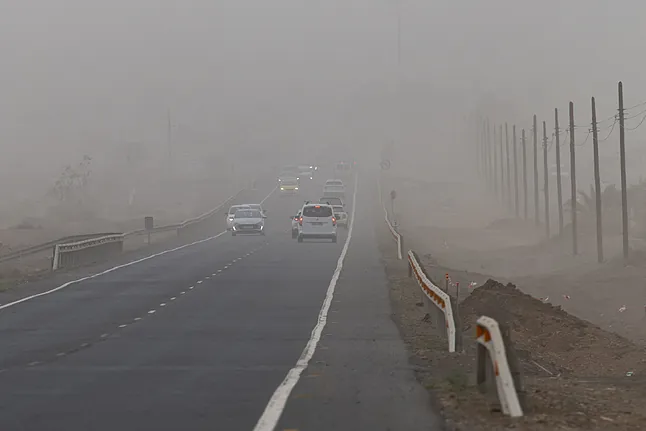
Saharan dust colors Spanish skies with orange alert and deadly PM10 particles.

  • Suspended particles with a diameter of 10 micrometers or less (PM10), Particulate matter (d < 10 µm) are a complex combination of several substances that vary according to the source of emission and geographical location.
  • Among its main components include organic materials and coal (fossil fuel combustion, biomass, and other industrial activities), sulfates, nitrates, metals, soil particles (silica, clay, and other minerals), sea salt (coastal areas), ammonium (emissions agricultural) and volatile organic compounds (plants, vehicles, industry).
  • The concentrations of PM10 are a key indicator of the quality of the air and has important implications for public health and the environment. These particles can penetrate into the respiratory tract, causing respiratory and cardiovascular problems.  - Aemet Blog | June 15, 2024


Particulate matter
 (PM) or particulates[a] are microscopic particles of solid or liquid matter, which are suspended in the air. An aerosol is a mixture of particulates and air, as opposed to the particulate matter itself.[1] Sources of particulate matter can be natural or result from human activities. Particulates adversely affect human health and have impacts on climate and precipitation
PM.10 with a diameter of 100 nanometers (nm) [0.1 mikrometers] or less
https://en.wikipedia.org/wiki/Particulate_matter# 


An N95 respirator is a disposable filtering facepiece respirator or reusable elastomeric respirator filter that meets the U.S. National Institute for Occupational Safety and Health (NIOSH) N95 standard of air filtration, filtering at least 95% of airborne particles that have a mass median aerodynamic diameter of 0.3 micrometers [300 nanometers] under 42 CFR 84, effective July 1995.[a]
https://en.wikipedia.org/wiki/N95_respirator?ysclid=mo4gl1q0we329835576


T=
1776525139 / Human Date and time (GMT): Saturday, 18 April 2026 at 15:12:19


___


The impact of dust from the Sahara over some parts of Spain


Is being advertised by Aemet that a mass of dust from the Sahara will cover this Tuesday, the Canary islands, and for tomorrow as the language of powder will be on the peninsula. 
Also a group of researchers from Spain have analyzed the effects that the arrival of saharan dust is in the biological composition of the air in the community of Madrid and its potential impact on the health of the population.


A mass of dust from the Sahara covers the Canary islands

The weather agency Spanish has announced that the last hours of this Tuesday, a tongue of dust from the Sahara to approach the south of the iberian peninsula to cover morning good part of the territory to the north of Castile and León.

The prediction has made the State Agency of Meteorology (Aemet) and collected by Sevimedia, where it is pointed out that the day of today, December 17, there will be “significant concentrations of calima in the Canary islands”, this tongue of dust from the Sahara will worsen even more the quality of the air in this region.

For its part, the Regional Center for Prediction of Dust in Barcelona, a body dependent of the World Health Organization, WHO, is of the opinion that intrusion will come in the noon by the south-east of the peninsula, and will cover areas to the south at the end of the day, to then be extended morning to the north and get close to the cantabrian region.

Dust from the Sahara and time anticiclónico in parts of the Spanish territory

Today, Tuesday, will continue the time anticiclónico in the peninsula and the Balearic islands, with clear skies or lightly cloudy. Only the approach of a front from the Atlantic will leave more overcast with rain in the west of Galicia, which could be locally strong and could end up affecting other places in the west end of the peninsula or the bay of Biscay west.

In other parts of the country, and in the interiors of the southeast quadrant of the peninsula, the river Ebro, it is expected abundant low clouds in the morning with probable mist and fog. The depressions in the north-east and the two plateaus, where they could be engelantes, this means that the droplets that make up freeze when you touch the ground, giving way to the formation of ice sheets.

Also, in the Canary islands are observed heavens little cloudy or clear and haze on the rise, without ignoring that there is significant concentrations.

With regard to the temperature and wind for the next few days, it is expected that the temperature rise on the peninsula and the Balearic islands, and down in the Canary islands. Is forecast to more heat in Santa Cruz de Tenerife, Las Palmas de Gran Canaria and Almería; and is expected to more cold and Lleida Logroño, Leon and Madrid.

The impact of saharan dust on the biological quality of the air of the Community of Madrid

The arrival of masses of air with suspended particles of dust from the Sahara is a phenomenon that is quite common in the South of the Peninsula begins to experience at times in the Community of Madrid.

However, do people really know the effects that this phenomenon can have for the health? It is also relevant to ask to what extent the dust of the Sahara, changes the compositionon the whole biological, the air that you breathe in Madrid when this happens?

These are precisely the questions that has sought to respond to a team of researchers from the Polytechnic University of Madrid , which was able to determine such changes taking as a model 4 events intrusion of dust from the Sahara that hit the centre of the iberian peninsula at various times of the year.

Ana M. García, one of the authors of the work, explained that the air we breathe carries particles abiotic as sulfur dioxide (SO2), ozone (O3), nitrogen dioxide (NO2), and particulate matter (PMs). But it also contains biological particles such as fungi, bacteria, viruses, and pollen grains, which can have direct effects on our health of the people, causing infectious diseases and different types of allergies and increasing respiratory symptoms in vulnerable individuals. 


Changes that are detrimental to the health of the people

The objective of the research was to determine whether these biological components of the urban atmosphere were altered significantly with the arrival of air masses from the Sahara or if, on the contrary, there were no significant differences, in addition to assessing whether any changes could be detrimental to the health of the people.

Garcia stated that the direct effect most important tends to be an increase in the concentration of PMs at the local level, it has been demonstrated that represents a great deal of harm to the health and whose pollution levels are monitored closely by the councils.

The expert pointed out that, in recent years, “it is paying special attention to the micro-organisms, in particular the type of bacteria and fungi, due to their small size they can travel associated with this particulate matter”.

And he added that when the deposition of mineral dust to the local scale can lead, therefore, to changes in the composition of microbial air that we breathe (aerobioma), adding new microorganisms or by increasing the amount of those already present. Until we have described the association of these phenomena with the dispersal of pathogens, especially of plants.

Register new microorganisms

To study this risk, the team selected 4 events intrusion of dust from the Sahara that hit the centre of the iberian peninsula at different periods of the year (one in winter and another in summer and 2 in the fall) and, through techniques of massive sequencing of the DNA, was analyzed the biological composition of the air in the days prior to, and during, the same to assess the effect produced on the quality of the air of Madrid from the point of view of the micro-organisms airborne.

Although initially there were major variations in the organisms present in the air with and without the presence of saharan dust, it was through a more detailed analysis that experts told noticeable differences.

Ana M. García explained that the team was able to detect species of microorganisms that appeared during the intrusion, but were not present in the previous days. The abundance of these species was very low (< 5 % of the total), which explains that not observe significant differences in the overall composition when compared to the days prior to the intrusion.

Among these species, some of which had been previously described as micro-organisms associated with arid environments, which supported the hypothesis of the team that these living beings came from the Sahara desert, Garcia said.

And he added that they have also identified some species bacterianas with potential pathogenof both animals and plants, associated to the days of intrusion and that did not appear in the previous days, which demonstrates the importance of making a follow-up of these phenomena for their possible impact on the health of the people.

There are to go deeper in the research

Despite the fact that the changes demonstrated in the composition of the air is reduced, the scientists highlight the importance of these and continue with the study of these phenomena, especially in the case of events more intense in the changes in the aerobioma may be larger and have the most important impact on the health of the people.

The scientist concluded that “Our results suggest that these particular phenomena of intrusion of dust from the Sahara have a low effect on the microorganisms established at the local level. However, the intensity of the intrusion investigated was relatively low, so that it cannot be ruled out that the events more intense, with loads of dust deposited superior to those analyzed in our study, could cause changes of greater magnitude in the aerobioma local”.


SOURCE:
https://aemetblog.es/2024/06/15/un-estudio-sobre-episodios-de-contaminacion-en-espana-por-particulas-pm10/


___


A new wave of dust will invade Spain in the next few days: take note of the date to avoid surprises. (EFE/Alvaro Cabrera)


Rain of mud

A new wave of dust from the Sahara will invade Spain in the next few days: take note of the date to avoid surprises

The haze will stain orange the country, and it is not excluded that the rains are accompanied mud

The temperatures iran on the rise during the next few days. As explained by the State Agency of Meteorology (Aemet), we will have about Spain a mass of air much warmer than usual. After a Holy Week passed by water, the increase in heat will be accompanied by a new wave of dust.

But the arrival of the dust in suspension from Morocco not only affect to Spain, but that will go up to reach european countries where they are kind of used to the haze. This weather phenomenon stain color orange the peninsula and it is not excluded that give rise to mud rain, according to Meteored.
When the calima, Spain

The thermometers will continue to be leaving high values. According to the forecast of the Aemet, Friday, and Saturday, will be restricted to 25 °C at various points, and even reach 30 °C in areas of the bay of Biscay, the Ebro valley and the interior of the southern half.

The Aemet warns that the powder will come to Spain for the weekend. The south wind will facilitate their entry, which will lead to haze and a worsening of the quality of the air. First enter in the Canary islands and then go closer to the peninsula. The haze will come to France, the United Kingdom, Switzerland, the Netherlands, Belgium or Germany, and will leave images unusual in Denmark, Sweden or Norway.


In addition, the rains that fall during the Saturday and Sunday may be accompanied by mud, alert the Agency. The storm Olivia will be guilty of the back to the instability. This front will arrive from the northwest, leaving showers in Galicia, where they can be strong, Asturias and the west of the plateau castellanoleonesa, as provided by Meteored. Also expect precipitation in the Canary islands, especially in the north of Tenerife and Gran Canaria.

For Sunday is expected to change drastically the time, with a decrease of the temperatures due to a mass of air over a cold, but then will be installed to the heat.


SOURCE:
https://www.elconfidencial.com/espana/2024-04-04/ola-polvo-invadira-espana-proximos-dias-fecha_3860715/


___


Meteo365.es - Air Quality - PM10 Particles_2026-04-18


Meteo365.es - Air Quality - Dust - Aerosol_2026-04-18


___


A study on air pollution episodes in Spain for PM10 particles

Article of Ricardo Sanz Barajas, Chief of section of climatology and users of the Territorial Weather Centre of Santa Cruz de Tenerife, territorial Delegation of AEMET in the Canary islands

Summary and Methodology

In this work delves into some aspects of the weather of the concentration of PM10 in SpainThe source of the information is EAC4, the reanalysis of atmospheric composition of the ECMWF. On the basis of data every three hours (only available at the date of preparation of this work) are calculated average values for resolutions temporary daily, monthly, and annual, which are displayed on maps and charts. Finally, we extracted daily concentrations that exceed certain thresholds, creating with them a climatology of episodes of three or more consecutive days. For all this, we use Python programs, macros in Excel, Surfer for the maps and the library Matplolib to generate the visualizations.

The PM10: components and thresholds

Suspended particles with a diameter of 10 micrometers or less (PM10), Particulate matter (d < 10 µm) are a complex combination of several substances that vary according to the source of emission and geographical location.

Among its main components include organic materials and coal (fossil fuel combustion, biomass, and other industrial activities), sulfates, nitrates, metals, soil particles (silica, clay, and other minerals), sea salt (coastal areas), ammonium (emissions agricultural) and volatile organic compounds (plants, vehicles, industry).


The concentrations of PM10 are a key indicator of the quality of the air and has important implications for public health and the environment. 
These particles can penetrate into the respiratory tract, causing respiratory and cardiovascular problems. In addition, high levels of PM10 can reduce the visibility, damage to the ecosystem and contribute to global warming.

The concentration levels of PM10 are considered hazardous when they exceed certain thresholds established by bodies of health and environment. According to the World Health Organization (WHO), the PM10 levels that pose a health risk are:

  • Annual average: More than 20 µg/m3
  • 24-hour average: More than 50 µg/m3

In many countries the national regulations may have limits slightly different, although they usually follow the guidelines of the WHO or set limits to its own premises based on local studies of public health. For example, in the European Union (EU), the limits are:

  • Annual average: More than 40 µg/m3
  • 24-hour average: More than 50 µg/m3, allowing up to 35 exceedances annual threshold.
Intrusion of particulate matter on Lanzarote and Fuerteventura

Mean monthly and annual

The average monthly values were calculated by averaging the values of a grid in seven regions are rectangular, as determined by these points latitude and longitude:

For the southeast region has worked with a polygon trapezoid to avoid the contribution of the coastal zone of algerian.

We will highlight some of the features of the monthly averages with the help of the graph that follows:

Almost all regions have two maximums, one main one, in the months of February (the Canary islands) and march (Peninsula and Balearic islands) and the other side, in the summer months, something more advance in the Canary islands.

The average concentrations higher and lower are located, as detailed in the following table:

The Central west region suffers in August the average monthly highest in Spain (23.45 µg/m3); and the Balearic islands, in December, the lowest (9.17 µg/m3).

The spatial representation of the annual average (2003-2023) can be seen in the following map:

Except for the area that encompasses the north of Portugal, as the main industrial center of the country, there are more areas in the Peninsula with concentrations that exceed the annual threshold of the WHO. Also in the Balearic islands and the Canary islands, where the isoline of 20 µg/m3 conforming to the coasts of western saharans.

The highest levels, between 17 and 20 µg/m3, are located in the area of Madrid, in the south of Galicia, Navarre, east and south of Andalusia.

The lower levels, between 10 and 15 µg/m3, are enjoyed on the cantabrian coast, in the Plateau, in the south of Portugal, the Balearic islands and some areas of the western islands of the Canary islands.

Episodes of three or more consecutive days with concentrations of PM10 > 50 µg/m3

Although several cities and autonomous regions have developed specific protocols for the management of episodes of high pollution of PM10, there is no universally accepted definition of events of a number of consecutive days with PM10 levels above certain thresholds, similar to the definition of AEMET to heat waves.

By analogy with the definition of AEMET, we're going to bring to light the episodes that concatenated three or more days with concentrations daily average of more than 50 µg/m3, by following the guidelines shared by the WHO and the EU.

We see in the map that follows the Canary heads the ranking of the regions most affected by these episodes (caused by intrusion of calima, almost exclusively), with an average of 1.7 per year, followed by the regions north-west and Centre-west, with averages of 1.2 and 1.1, respectively. The less frequented by these events are the northeast of the iberian peninsula and the Balearic islands, with an annual average of 0.2 episodes.

In the following map, we see that no region is located close to the threshold set by the EU, which allows for up to 35 exceedances of annual concentrations (average in 24 h) of more than 50 µg/m3However, in the Canary islands closer significantly to that threshold in 2015 (35 days), and 2022 (32 days).

If we group the episodes of PM10 concentration of more than 50 µg/m3 (average in 24 h) by its duration in three categories, from one day to three or more in a row, you get the following graph:


CONTINUES:
https://aemetblog.es/2024/06/15/un-estudio-sobre-episodios-de-contaminacion-en-espana-por-particulas-pm10/


___


Los cielos de España y Europa se tiñen de anaranjado por polvo del Sahara


The Skies Of Spain And Europe Are Stained Orange By Dust From The Sahara

Nature has its own ways of surprising humanity. Either through extraordinary landscapes, extraordinary species or natural events, there's always something that we look around. This time, Europe is mired in a haze color deep orange, and it is all due to a storm system that comes from the Sahara.

With skies deep orange and fitted with a dust pouring, Spain, and other parts of Europe were covered with what experts have dubbed storms Celia. A mix of coastal winds, heavy rains and dust of the desert gave life to a natural event that is uncommon in the skies of europe.


However, these natural phenomena many times also attracts certain harm to the human being. For example, this system of dust storms caused the worst air quality that Spain has lived.

The particles that are carried in these storms have a high density, which represents a danger to people with diseases of the respiratory or older adults. Meteorologists have warned that the storm is not only reach to the skies of Spain, but it will be extended until London and even other countries.

A scene worthy of the red planet

If we were to compare these skies oranges with a scene that we've seen before, surely many would speak of Mars. The thick dust and red that inhabits this planet seemed to have migrated to the heavens of the Earth and create an inhospitable environment that surprised many.

The videos and images in social networks did not wait, and many of them showed high levels of dust desert that was accumulating in the sky or on the ground. Even the villages in the mountains of the Swiss Alps saw the change of the snow white to a subtle orange.


All this is part of a phenomenon that began in the north of Africa to move forward by Algeria and Morocco to slide down through the mediterranean and to create this show in Spain and Portugal.

For now, it is expected that this storm will last the rest of the week and move more to the north of the continent, only to a lesser power. However it should be taken into account that the particles of dust from the Sahara can stay for up to three weeks in the environment, and they must all take their precautions.


SOURCE:
https://ecoosfera.com/noticias/polvo-sahara-europa-espana-2022/


__
eof