
.

- Yet it’s obvious that an op of such sensitivity and magnitude – as a means of “putting pressure” on Tehran – requires deep CENTCOM involvement and presidential approval.
- It was Western insurance paranoia that closed the Strait much more than the defensive potential of the Iranian drone/ballistic missile combo.
- Then the IRGC announced that the Strait was open to China; to other nations who engaged in negotiations – such as Bangladesh; and to Gulf nations that would expel U.S. ambassadors.
- Iranian FM Abbas Araghchi could not be more clear: “After the war ends, we will design new mechanisms for the Strait of Hormuz. We will not allow our enemies to use this waterway.”
T=1774144681 / Human Date and time (GMT): Sunday, 22 March 2026 at 1:58:01
___
Iran Moves to Total War Against the Death Cult

Structural paralysis. Meticulously programmed. Inexorable. Already in effect.
Attacking Iran’s South Pars gas field – the largest on the planet – is the ultimate escalation.
Neo-Caligula, in trademark Truth Social coward vociferation mode, has been desperate to blame the death cult in West Asia for it and excuse himself from any responsibility: he claims Israel attacked South Pars “out of anger” and the U.S. “knew nothing about this particular attack”. Qatar was “in no way, shape or form involved”. And Iran hit Qatar’s LNG in retaliation “based on wrong intelligence”.
Is that all there is? Then let’s keep dancing?
Hardly. More like the death cult used openly Zionist media in the U.S. to frame it all as a joint op – pulling the Empire of Chaos and Plunder deeper into an hubristic quagmire; dragging it into a Total Energy War with devastating consequences; and turning the Gulf petro-monarchies 100% against Iran (they were already campaigning against Iran, especially Saudi Arabia, UAE and Qatar).
Neo-Caligula can brag whatever he wants. Yet it’s obvious that an op of such sensitivity and magnitude – as a means of “putting pressure” on Tehran – requires deep CENTCOM involvement and presidential approval.
So the privileged scenario points once again to Washington losing control of its own foreign policy – assuming there was one in the first place.
All players involved – whose incapacity of reading the chessboard has been proven again and again – could not help believing that Tehran would finally fold after an attack on its precious energy security.
The Iranian response, predictably, was the total opposite: hardcore escalation. The list of targets for the counter-attack was published in no time – and will be followed to the letter. Starting with Qatar’s Ras Laffan refinery.
Watch those LNG trains

What’s crucially at stake in the South Pars tragedy are the LNG trains.
A “train” consists of components designed to process, purify and convert natural gas to LNG. They are named “trains” because of the sequential arrangement of the equipment – compressor trains – used in the industrial process to process and liquefy natural gas.
The Qatar 2 project in the massive Ras Laffan refinery was coordinated by Chiyoda and Technip, a Japanese-British joint venture. Same with trains 4 and 5, which compose the world’s largest LNG trains.
These trains are operated by Qatar Gas, ExxonMobil, Shell and ConocoPhillips. For all practical purposes, these are American and Western-linked installations, thus legitimate targets for Iran.
There are just 14 trains in the world – and it’s not hyperbolic to define that Western “civilization” depends on all of them. It takes from 10 to 15 years to replace one train. All of these 14 trains are within reach of Iran’s ballistic and hypersonic missiles. At least one of them was set on fire by the Iranian counter-attack. That’s how extraordinarily serious this all is.
The First West Asia High-Tech Total War
The South Pars escalation was inevitable after the new rules established by Iran on the Strait of Hormuz drove the Epstein Syndicate absolutely nuts.
It was Western insurance paranoia that closed the Strait much more than the defensive potential of the Iranian drone/ballistic missile combo. Then the IRGC announced that the Strait was open to China; to other nations who engaged in negotiations – such as Bangladesh; and to Gulf nations that would expel U.S. ambassadors.
And then, finaly, a new set of rules were imposed. It works like this.
- If your cargo was traded in petroyuan, you may get free passage.
- You must pay the toll.
- Only then you are free to go, navigating in Iranian territorial waters, close to the island of Qeshm, and not across the middle of the Strait.
Iranian FM Abbas Araghchi could not be more clear: “After the war ends, we will design new mechanisms for the Strait of Hormuz. We will not allow our enemies to use this waterway.” Whatever happens next, the Strait of Hormuz will have a permanent tool booth, controlled by Iran.
Prof. Fouad Azadi, whom I had the pleasure to meet in Iran years ago, already announced that ships travelling through the Strait will now have to pay a 10 % toll. That may generate as much as $73 billion a year – more than enough to compensate for war damage and U.S. sanctions.
Iran is already deep into what for all practical purposes is configured as The First West Asia High-Tech Total War.
Strategically, as defined by Iranian analysts, that implies a fascinating cornucopia of new terminology.
Let’s start with The Great Constriction, applied across the hyper-focused Surgical Attrition strategy. The target for the constriction has switched from the Israeli Defense Forces (IDF) to collapsing the very fabric of Israeli civil society.
Then there’s the 16-Mach Shield Breaker – whose tech superstars are the Khorramshahr-4 and Fattah-2 missiles, which reach terminal speeds of Mach 16, traveling at 5.5 km per second. [equivalent to 12,276 miles per hour (19,756 km per hour)].
Translation: as an enemy computer calculates an intercept vector, the missile warhead – a one-ton blockbuster – has already impacted, creating a Zero-Sum Defense Paradox: Israel spends millions of dollars attempting an interception with 100% probability of failure, while Iran spends a fraction to get a certified hit.
Next is The Doctrine of Four Vital Organs.
Israel’s 9 million people survive thanks to only two primary deep-water ports. That has led Tehran to move to Structural Paralysis mode, systematically focusing on four “death points”: the hyper-concentrated nodes of Israeli infrastructure that, if severed, will turn the death cult into a dark, thirsty, and starving cage.

The four vital organs are Hydrological Asphyxiation (hitting 85% of Israel’s potable water in five desalination plants);
The Blackout Protocol (hitting the Orot Rabin power station in the heart of the national grid);
A Food Siege, hitting the ports of Haifa and Ashdod, essential for Israel’s imports of the 85% of wheat it needs; and Energy Decapitation: focused on the Haifa refineries, the sole Israeli source of refined petroleum, and even more of a key target after the attack on South Pars.
Structural paralysis. Meticulously programmed. Inexorable. Already in effect.
SOURCE:
https://www.unz.com/pescobar/iran-moves-to-total-war-against-the-death-cult/
___
Israel's Strike On South Pars Hits Iran, And Iranians, Where It Hurts Most
- By Kian Sharifi and
- Hannah Kaviani
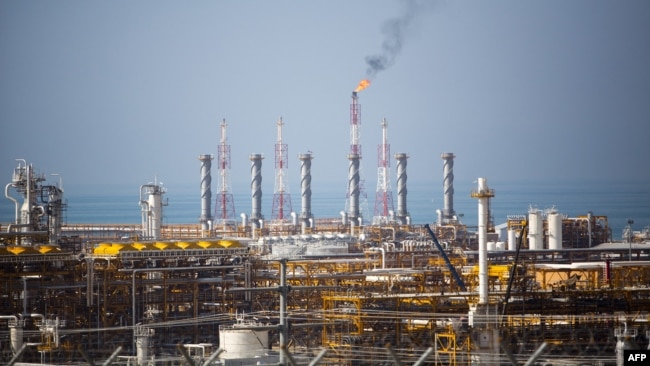
South Pars gas field facilities near the Iranian town of Kangan on the shore of the Persian Gulf (file photo)
When Israeli jets struck the South Pars gas complex near Asaluyeh, they hit more than pipes and compressors. They struck the single piece of infrastructure most essential to Iran's ability to function -- a field that provides 75 percent of Iran's domestic gas supply and powers roughly 80 percent of the country's electricity generation.
The strike halted output at two refineries with a combined daily capacity of around 100 million cubic meters, sending prices soaring and triggering Iranian retaliatory strikes on energy infrastructure in Gulf Arab states, including Qatar's Ras Laffan liquefied natural gas (LNG) terminal.
South Pars And North Dome Gas Field
The South Pars/North Dome gas field, which straddles the exclusive economic zones of Iran and Qatar, is the largest natural gas field in the world.

https://www.rferl.org/a/33710780.html?layout=1
A Target Long in Decline
South Pars was already struggling before the first bomb fell. Straddling the maritime border with Qatar in the Persian Gulf -- where the same reservoir is known as North Dome and supplies roughly 20 percent of global LNG -- Iran's side of the field has suffered years of chronic underinvestment.
Since Washington withdrew from a nuclear deal in 2018 and imposed harsh sanctions on Tehran, international companies including France's Total have departed, and the field's aging infrastructure has gone largely unrenewed.
Shahram Kholdi, a professor of international relations in Canada, says the field was already on borrowed time.
"The Islamic republic has invested very little in the oil and gas sector since Trump withdrew from the nuclear deal," he told RFE/RL's Radio Farda. "Many of these facilities were already in need of renovation. Qatar is extracting a far greater share of gas from the shared reservoir because our infrastructure has become outdated and deteriorated."
Even in peacetime, Iranians had experienced rolling gas shortages as the regime diverted supplies to petrochemical exports while running power plants on mazut -- a heavy fuel oil that blanketed Iranian cities in smog.

Strategic Logic, Human Cost
Israeli officials say the strike was coordinated with the United States and aimed at degrading the Islamic republic's capacity to sustain its military. But analysts warn the damage is impossible to contain to the military sphere.
Umud Shokri, an energy security analyst and professor at George Mason University, argues the choice of South Pars as a target is about as consequential as it gets.
"Targeting South Pars is worst-case because it underpins most of Iran's gas supply, feeding power generation, heating, industry, and petrochemicals," he said. "Disruption doesn't just hit exports, it hits daily life. Expect outages, shortages, and inflation almost immediately, meaning ordinary Iranians absorb the shock first."
Since the launch of the military operation, Trump has said there can be "no deal with Iran except UNCONDITIONAL SURRENDER!" And while endorsing regime change as the "best thing that could happen," Trump has also noted that it may not occur "immediately."
On the political intent behind hitting civilian-adjacent infrastructure, Kholdi puts it bluntly: "I believe the intended or unintended goal is to bring the population to a point where they demand the overthrow of this regime. I see no other logic to it."
But both analysts are skeptical that such logic holds.
Shokri argued the strikes "don't neatly destabilize" the clerical establishment. "They weaken it, yes, but also give it justification to tighten control and externalize blame," he said.
The Day After
But he is skeptical that civilian pressure will translate into political change mid-conflict. "No, never," he said when asked whether people under active bombardment would take to the streets. The more lasting danger, in his view, is what happens after the war ends.
SOURCE:
https://www.rferl.org/a/iran-south-pars-gas-israel-attack/33710653.html
___
Iran’s South Pars gas field generates $130 mln daily
Dec 5, 2023, 2:24 PM

Bushehr, IRNA – According to Zargham Heidarieh, an official from Bushehr province, southern Iran, Iran’s South Pars Gas Field (SPGF) generates $130 million per day.
The field has 13 refineries and 336 wells in the Persian Gulf, producing more than 705 million cubic meters of gas daily, Heidarieh said on Tuesday, adding that each refinery in the SPGF generates over 50 million cubic meters of sweet gas and 77,000 barrels of gas condensate. The field also produces other products such as sulfur, butane, and propane.
Therefore, each refinery in the SPGF generates $10 million per day, which amounts to $3.5 billion yearly, he said.
The SPGF is the world’s largest natural gas field, with ownership shared between Iran and Qatar.
SOURCE:
https://web.archive.org/web/20240720121810/https://en.irna.ir/news/85312783/Iran-s-South-Pars-gas-field-generates-130-mln-daily
___
Breaking News Live | Iran's Biggest Gas field, South Pars hit by US-Israeli strikes | Iran War

1,43 M
https://www.youtube.com/live/FkOLPZjWBhA?si=LpPekj0bQQ4bTk1N
18.3.2026 #OilAndGas #WorldNews #MiddleEastConflictTensions in the Middle East have escalated further after reports of fresh strikes
on Iran’s critical energy infrastructure. Iranian media claims parts of the South
Pars Gas Field were hit by projectiles, along with oil and petrochemical facilities
in Bushehr—though it remains unclear whether the strikes were carried out by
the U.S. or Israel. The developments come shortly after an earlier incident near
the Bushehr Nuclear Power Plant, which the International Atomic Energy
Agency confirmed was struck but reported no damage or casualties.
INTERNATIONAL NEWS
#IranIsraelWar #SouthPars #Bushehr #MiddleEastConflict #EnergyCrisis #BreakingNews
#Geopolitics #IAEA #WorldNews #OilAndGas
___
eof
18.3.2026 #OilAndGas #WorldNews #MiddleEastConflict
on Iran’s critical energy infrastructure. Iranian media claims parts of the South
Pars Gas Field were hit by projectiles, along with oil and petrochemical facilities
in Bushehr—though it remains unclear whether the strikes were carried out by
the U.S. or Israel. The developments come shortly after an earlier incident near
the Bushehr Nuclear Power Plant, which the International Atomic Energy
Agency confirmed was struck but reported no damage or casualties.
#IranIsraelWar #SouthPars #Bushehr #MiddleEastConflict #EnergyCrisis #BreakingNews #Geopolitics #IAEA #WorldNews #OilAndGas
