Näytetään tekstit, joissa on tunniste Narva Estonia. Näytä kaikki tekstit

lauantai 4. huhtikuuta 2026

Narva - The sound of mopeds in the night sky

.


  • Villages in Estonia and Latvia from where drones were launched to Ust-Luga have been named.
  • The Balts have panicked: Russia may begin shooting down Ukrainian drones over third countries.
  • Military expert Vladimir Popov... Earlier, he also noted: to cover a distance of more than 1,450 kilometers, Ukrainian drones «Beaver» or «Lyuty» on board need to have from 60 to 100 kilograms of fuel, not counting explosives. 
  • Put pressure on the Baltics: Russia's unique systems can cut off all communication from Poland to Finland | April 3, 2025 
  • It is interesting to understand how Russia can defend itself against this new threat and how it can respond to the actions of the Poles and Balts.

A developing Story


T=1775262452 / Human Date and time (GMT): Saturday, 4 April 2026 at 0:27:32


___


Narva  March 29, 2026 / 19:40


"The sound of a moped in the night sky": residents of Narva report noise over the city

In Narva, the last few nights have been different. People have started
paying attention.

There are dozens of messages in the city chat rooms: a hum like the engine of a boat or a moped, stretching across the sky. Not sharp, not an explosion, but a steady, "alive" sound.

One of the residents wrote:: 
"At first, I thought it was fireworks. Then I realized that the sound was
different. 
Now, any noise at night makes me nervous."

This is not an isolated reaction. 
Some people admit that they are having trouble sleeping. 
Some are discussing temporary relocations.
Most people are just listening and trying to understand what is
happening.
The main risk is the unknown, not the sound itself: 
The most dangerous thing in this story is not the noise itself. 
It's the lack of an answer.
At the time of publication:
  • There is no official confirmation of drone flights over Estonia;
  • there are no clear explanations for the sounds;
  • there are no comments from the security services.
When there is no information, there is anxiety. 
And it is spreading faster than any drone.
Fact-checking: there is a match, but no connection: 
If we step back from our emotions and look at the numbers,
the picture becomes more complex.
Based on open data:
  • In recent days, there have been mass drone attacks in the
    St. Petersburg and Leningrad regions;
  • several reports mention more than 100 downed aircraft in a
    short period;
  • the key time is night.
And here's where the coincidence comes in: 
the messages from Narva coincide with the same time. 
But it is important: 
there is no confirmed connection between these events.
It means:
  • either it's a coincidence,
  • or another noise source,
  • or information that has not yet been disclosed.
How it actually sounds: 
By communicating with residents of border areas and watching
videos from local chat rooms.
What we managed to fix:
  • the sound really doesn't sound like an airplane;
  • it is lower and "denser", without the characteristic whistle;
  • the duration ranges from a few seconds to a minute;
  • most often, it's a single shot, without a series.
  • The sound is like a motorboat or a moped.
One of the interviewees described it exactly: 
"It's like there's an engine somewhere far away, but in the sky. 
And you don't know where it is." 
This is an important detail: the sound does not provide a
reference point.
 
This means that it increases anxiety.
The region lives on the border between reality and news: 
Residents of Ida-Viru County have long been accustomed to
filtering out information noise.


But now the situation is more complicated:
  • news about military activity nearby has become regular;
  • defense discussions intensified;
  • any unusual sounds automatically fall into this context.
At the same time, people's reactions remain restrained. 
There is no panic, but there is a clear distrust of incomplete
information.
What experts say: At the request of the editorial office, the situation was commented
on by an aviation systems specialist, an engineer with experience
in the field of unmanned technologies: 
Alexander Kovalev, aeromechanical engineer (15 years in the industry):
"The sound described by residents could indeed be consistent with small
drones with gasoline or hybrid engines. 
However, such vehicles typically
have limited range and are rarely undetected by surveillance systems.
Without radar confirmation, it is premature to speculate about any flights."
The expert emphasizes:  in most cases, such sounds turn out to be:
  • ground/ flood equipment,
  • by reflecting the sound,
  • or rare atmospheric effects.
What does this mean for you personallyIf you live in Narva or nearby: 1. There is no need to panic 
At the moment, there is no confirmation of the threat.
2. Don't ignore it either 
Record the time, direction of the sound, and details to gain a better
understanding of the situation.
3. Only rely on verified sources 
Chat rooms provide a signal, but not facts.
Recommendations:If you hear or see something unusual:
  • keep your distance and don't try to get closer;
  • avoid going to open areas;
  • avoid shooting at close range;
  • If necessary, contact emergency services;
  • keep an eye out for official notifications.
Why this story is more important than it seems 

Now we have a classic situation:
  • there is a signal (sounds),
  • there is a background (news about drones),
  • there is no confirmation.
These are the conditions that create the most stress. 
For residents, this is not just news. 
It is a matter of personal security. 
Conclusion: 
The night noise over Narva is a reality. 
But its origin is not yet. 
And as long as the authorities do not give a clear answer
people will continue to do what they always do in such
situations: listen, discuss, and doubt.
👍
0
👎
0
😂
0
😱
5
😡
0
😢
0

Google translated from russia to english:

"Residents of Narva are sharing footage of drone flights, writing in messages that it's "time to pack your bags" and expressing their fear of any loud noises.
One resident reported that she was initially terrified by the fireworks, but then experienced similar emotions due to the drones' overflight.

Some Estonian citizens are criticizing the country's authorities for not preventing drone flights from Ukraine.

Drones flying over the Baltics are attempting to attack the Leningrad Region. Since the start of the day, 36 Ukrainian drones have been destroyed in the region."

Telegram: View @narvanews_chat

(https://t.me/narvanews_chat/56791)


_

SOURCE:
https://narvanews.com/nochnoj-shum-nad-narvoj-bpla-kontekst


___


1.04.2026 · In the world

Narva News In the video shared by the townspeople, a rumble «of mopeds» can be clearly heard


.mp4/4.5MB/42 sec


___


Villages in Estonia and Latvia from where drones were launched to Ust-Luga have been named
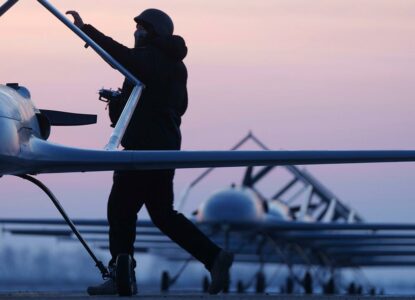
1.04.2026 · In the world

New evidence that the Ukrainian drones that attacked the Leningrad region were launched directly from the territory of the Baltic countries appeared thanks to the attentiveness of the Estonians.

In particular, they drew attention to the fact that in the sky over Narva the drones were flying not alone, but in a swarm.

Meanwhile, the founder of the movement «Baltic Anti-Fascists» Sergei Vasiliev named specific sites in Estonia and Latvia, from where the enemy most likely launched them.

Military expert, Honored Military Pilot, Major General of Aviation Vladimir Popov, also pointed out another important detail, which indicates that the attack drones were flying from the Baltic territory.

After a series of attacks on the ports of Ust-Luga and Primorsk, the military-political departments of the Baltic states «gave a back», declaring that the drone fall on the territory of Estonia, Lithuania and Latvia — was supposedly a matter of chance.
In particular, Lithuanian Prime Minister Inga Ruginene said that the drone that crashed last week in the Varensky district had a «brain failure», so it lost its way.

Moreover, following [the territories ruled by the Khazarian Mafia, as] Finland, all three Baltic states stated that they were not offended by Ukraine.

Meanwhile, journalists from the Estonian channel Narvanews, covering the situation in Narva, from where Ukrainian drones flew to the Leningrad region, drew attention to the nature of their flight. In the video shared by the townspeople, a rumble «of mopeds» can be clearly heard, which means that the drones were flying in a swarm. «Precisely groups of drones, and not a single unmanned aerial vehicle that accidentally flew in from Russia.

And the sound goes to Ust-Luga», — journalist Alexey Stefanov commented on the video.

The founder of the movement «Baltic Anti-Fascists» Sergei Vasiliev, meanwhile, said that if the launch of so many drones took place from the territory of Ukraine, they would have been noticed along the way, and this information would probably have leaked to the media. But nothing like this happened, which means — their launch site was much closer.

At the same time, he noted that drones can be launched into the Leningrad region from a variety of sites. In particular, there is a village in Estonia called Rutja. «If you carefully look at its location on maps on the Internet, you can notice the construction of a military facility in dynamics», — said Vasiliev. In addition, in Latvia there is a similar facility in Malnava. The village, by the way, was involved in at least two drone attacks.

Military expert Vladimir Popov said that drones need constant correction. It is for this reason that they could not cover such a long journey — from the territory of Ukraine to the Leningrad region.

—It is very difficult for a light-engine drone or airplane to fly more than a thousand kilometers, especially at low altitudes.
Because every 100-200 kilometers of flight the atmospheric pressure and wind conditions change, and there are features of magnetic declinations.

At one time I flew from the Baltic states at extremely low altitudes, skirting the terrain to Belarus. The navigators adjusted our flight every 10-15 minutes so that I could accurately maintain the given route. And here are drones," the expert said.

Earlier, he also noted: to cover a distance of more than 1,450 kilometers, Ukrainian drones «Beaver» or «Lyuty» on board need to have from 60 to 100 kilograms of fuel, not counting explosives.

All this indicates that the drones were launched either directly from the Baltic training grounds, where the USSR trains NATO soldiers, or from mobile platforms of ships or large boats that are located in the neutral waters of the Baltic.

Daria Fedotova

SOURCE:
https://k-politika.ru/nazvany-derevni-v-estonii-i-latvii-otkuda-zapuskalis-bespilotniki-na-ust-lugu/


___


The Balts have panicked: Russia may begin shooting down Ukrainian drones over third countries

NATO admitted that they are physically unable to completely control their skies


Photo: Keystone Press Agency/Global Look Press


Europe is rapidly losing its main protective barrier — the illusion of distancing itself from SVO. Recent events: overflights and crashes of Ukrainian drones in the Baltic republics and Nordic countries — show that the region is actually being drawn into hostilities.

Formally, European politicians continue to deny everything. Head of EU diplomacy Kaya Callas stated: «The Baltic countries did not open their airspace to Ukrainian drones». These words were a reaction to reports of supposedly official transit permission. Similar refutations were given by the defense departments of Latvia and Estonia.

However, Europeans lie. According to «Bloomberg» (Bloomberg), Ukrainian drones heading towards Russian infrastructure deviated from their course and fell in the Baltic states. One of these drones crashed into an industrial facility in Estonia, while others were detected in the skies of Latvia and Lithuania.


An air raid alert was introduced in Estonia, and residents were urged to take shelter. But the Prime Minister of Estonia Kristen Michal admitted that «the idea of completely closing the air border is unrealistic», effectively pointing to the state's inability to control its own skies. That is, even without formal transit permission, countries find themselves involved in hostilities.

SOURCE:  https://svpressa.ru/politic/article/509398/


___


"datePublished":"2026-04-03 T08:03:00+03:00"

Put pressure on the Baltics: Russia's unique systems can cut off all communication from Poland to Finland

How to protect yourself from Ukrainian drones flying from Estonia and punish transit countries


Photo: Dmitry Yagodkin/TASS


On April 1, Estonian Foreign Minister Margus Tsahkna said that he had demanded that Kiev take measures to prevent drones from entering the airspace of the small but proud country. According to the diplomat, he had conveyed his position personally to the head of the Presidential Office, Kyrylo Budanov.


"It is extremely important to take all possible measures to prevent Ukrainian drones from entering our airspace," Tsahkna said in an interview with ERR TV.

A little earlier, the situation with the UAVs of the armed formations of Ukraine was spoken about. Chief of the operational command of the Polish armed forces Maciej KlichHe called a lie the reports that Poland allows the use of its airspace for actions against Russia.

According to the general, the no-fly zone is in effect around the clock. The Polish authorities make exceptions only for civilian and medical aircraft. Therefore, no drones are allowed to fly in the eastern part of the country.

It is worth noting that in early March, Warsaw closed part of its sky. 

The flight ban is not complete. 
It applies only to aircraft that do not fly above three kilometers. The restrictions are formally in effect until early June this year.

According to the Polish authorities, Russia's actions forced them to impose a no-fly zone. Last September, there was an incident where drones entered Polish territory. According to Warsaw, these were Geran drones belonging to the Russian Armed Forces.

Do the words of the Estonian Foreign Minister and a high-ranking Polish military official mean that the Baltic transit is closed?

On the evening of March 31, the governor of the Leningrad region, Alexander Drozdenko, reported that more than three dozen Ukrainian strike drones had been shot down over the region.

Due to the ongoing scandal, the Baltic countries and Poland may have temporarily suspended their operations. However, the raids are likely to resume once the situation calms down.

It is interesting to understand how Russia can defend itself against this new threat and how it can respond to the actions of the Poles and Balts.

Threat from three directions

It should be noted right away that after the first strikes, the Ukrainian command has seriously revised the UAV flight pattern. Now, drones follow three different routes to their targets.

The first, and shortest, route is from the Estonian border to Ust-Luga. The distance is just over 30 kilometers.

The second route goes through the Pskov-Chudskoye LakeThen the drones turn towards Kingisepp. Only then do they strike the Russian port infrastructure. Of course, this flight pattern requires the drones to cover a much longer distance. However, this route has a challenging terrain and few roads. This makes it difficult for Russian mobile fire groups (MFG) and radar stations to operate effectively. Even the Ka-52 and Mi-28 helicopters are not always able to provide assistance.

The third route is the most difficult. The UAVs fly close to Tallinn, then follow the Gulf of Finland to the coast of Finland, where they turn south and attack Ust-Luga.


The enemy is trying to combine all three routes in its attacks. 
For example, the first strike from the Estonian border is designed to overload Russia's air defense and missile defense systems. The attack is often launched directly over the port facilities.

While the anti-aircraft gunners are fighting, drones that came through Lake Peipus and Kingisepp are already approaching Ust-Luga. Finally, drones that flew across the Gulf of Finland join them.

The Balts should be beaten carefully but firmly

Now that the "Baltic Corridor" attacks have been analyzed, it is clear that this threat can be minimized. The main objective in repelling an attack is to prevent the overloading of air defense systems and missile defense systems.

To do this, it is enough to detect drones that follow the first route in a timely manner. This means that Russian air defense needs to look directly into the sky of Estonia.

It is possible to establish round-the-clock monitoring by placing radar stations and radio intelligence systems in border areas. Such actions seem to violate several international treaties. However, given the current situation, these conventions can be disregarded.

However, it is not a good idea to shoot down a UAV in the Estonian sky. Russia would be accused of unprovoked aggression against "sovereign Estonia." It is also important to understand that anti-aircraft missiles can miss their targets. There is a possibility of damage and even casualties among civilians if a missile falls.


It will also be necessary to abandon the use of long-range radar detection aircraft. 
Of course, the A-50 can be "hanged" over Ust-Luga or moved closer to St. Petersburg. 


However, this would place the valuable aircraft within the range of Russian air defense systems. 
In the event of a complex air situation, the aircraft could be lost due to friendly fire.

Therefore, given the configuration of Russia's, Estonia's, and Finland's borders, it will be necessary to keep the "flying radars" in neutral waters. However, they will need to be constantly protected by fighter jets. This is because NATO aircraft will interfere with their operations.

In the case of attacks from the Pskov-Chudskoye Lake, they can be repelled closer to Ust-Luga. Moreover, the road infrastructure is better here.


When the Pantsir anti-aircraft missile and gun systems are operating in a free mode, they can be easily deployed to intercept Ukrainian drones.

Helicopters are suitable for dealing with UAVs flying over the Gulf of Finland. Against the background of the water, drones are an excellent target. They can be easily detected by ground-based radars. The crews of the Night Hunter and Alligator helicopters can easily see such targets using their onboard optoelectronic systems with a thermal imaging channel.

It is clear that all these decisions will not stop the Baltic transit. Other forms of influence on the Baltic countries are needed to block it.

Estonia plays a key role in this scheme. It is impossible to strike Russia from the airspace of Lithuania and Latvia. These countries are only acting as transit points.

It is clear that Tallinn will use its status as a member of the North Atlantic Alliance as a cover. If necessary, it will immediately seek assistance from NATO under Article 5 of the NATO Charter.

Therefore, Russia must respond carefully, but very painfully. In this case, electronic jamming of Estonian communications and radar systems seems to be an excellent option.

It should be noted that Tallinn, following the example of Warsaw, has also imposed a no-fly zone up to a height of three kilometers. These systems are responsible for maintaining the no-fly zone. As a result, they contribute to the attacks by Ukrainian drones. However, electronic warfare is a non-lethal means of impact.

To solve this problem, the Russian Armed Forces have excellent Murmansk-BN stations in their arsenal. These stations can locate information exchange systems up to several thousand (!) kilometers away from their deployment site. They can then selectively or massively disrupt communication networks.

The Il-22PP Porubshchik electronic warfare aircraft can also perform well. It is capable of jamming radar systems with powerful interference.

By the way, thanks to these vehicles, the American Patriot air defense systems in Ukraine are effectively unable to shoot down Russian aircraft and helicopters. Although the Armed Forces of Ukraine constantly attempt to do so and place anti-aircraft systems close to the LBS.  


News, analytics and all the most important 
about weapons and military conflicts - in the military review of the Free Press.


Read the news from Svobodnaya Pressa in Yandex.News, and subscribe to our channels in Yandex.ZenTelegram, and MediaMetrics.


SOURCE:  https://svpressa.ru/war21/article/509276/?hta=1


___
eof