

- Gaza: Hospitals receive 38 martyrs, death toll climbs to 53,977 | 26-May-2025
- US gave Israel $21.7 billion in military aid during Gaza conflict | 7 Oct, 2025.
- TRUMP-NETANYAHU’s Devilish Fake Truce in GAZA | Oct 24, 2025
- Haplogroup J1 - The Generations of Noah - Gaza Semites | 9th Jan, 2026
- J1-P58, the Central Semitic branch of J1, appears to have expanded from the southern Levant (Israel, Palestine, Jordan) across the Arabian peninsula during the Bronze Age.
- About 20% of Jewish people belong haplogroup J1-P58.
- In the Hebrew Bible, the common ancestor of all Cohens is identified as Aaron, the brother of Moses.
- Roughly half (50%) of all Cohanim belong to J1-ZS227.
- The acclaimed Jewish actor and director Dustin Hoffman appears to belongs to haplogroup J1-Z18271, which corresponds to the lineage of the Y-chromosomal Aaron.
- Arabs (Palestine Muslim) - AA (Semitic) - 55.2%, Nebel 2001[2]
- Arabs (Palestine Christian) - AA (Semitic) - 9,0%, Fernandes 2011[15].
T=1768293797 / Human Date and time (GMT): Tue. 13th Jan. 2026, 08.43
UPDATE:
Ezra A. Cohen - Benjamin Netanyahu WILL BE ARRESTED | 14-Jan-2026
https://t.me/Ezra_Cohen_Q17/2487
___
Israel’s Biggest Con Trick: Hiding the True Numbers It Has Killed in Gaza

Israel has penned us all into a ‘debate’, one entirely divorced from reality, that relates only to those killed directly by its bombs and gunfire – not the genocide it is waging by other means
The biggest con trick Israel has managed to pull off over the past two years is imposing entirely phoney parameters on a “debate” in the West about the credibility of the death toll in Gaza, now officially standing at just over 70,000.
It is not just that we have been endlessly bogged down in rows about whether Gaza’s medical authorities can be trusted, or how many of the dead are Hamas fighters. (Despite Israeli disinformation campaigns, the Israeli military itself believes more than 80 per cent of the dead are civilians.)
Or even that these “debates” always ignore the fact that, early on, Israel wrecked Gaza’s capacity to count its dead by destroying the enclave’s governmental offices and its hospitals. The 70,000 figure is likely to be a drastic under-estimate.
No, the biggest con trick is that Israel has successfully penned us all into a “debate”, one entirely divorced from reality, that relates only to those killed directly by its bombs and gunfire.
The truth is that far, far larger numbers of people in Gaza have been actively killed by Israel not through these direct means but through what statisticians refer to as “indirect” methods.
These people were killed by Israel destroying their homes and leaving them with no shelter. By Israel destroying their water and electricity supplies and their sanitation systems. By Israel levelling their hospitals. By Israel starving them. By Israel creating the perfect conditions for disease to spread. The list of ways Israel is killing people in Gaza goes on and on.
Imagine your own societies levelled in the way Gaza has been.
How long would your elderly parents survive in this hellscape?
How well would your diabetic child fare, or your sister with asthma, or your brother with cancer?
How well would you cope with catching pneumonia, or even a common cold, if you hadn’t had more than one small meal a day for months on end?
How would your wife deal with a difficult childbirth if there were no anaesthetics, or no hospital nearby, or a barely functioning hospital overwhelmed with victims from Israel’s latest bombing run.
And what would be the chances of your baby surviving if its mother could produce no milk from her starvation diet? And if you could not give the baby formula feed because Israel was blocking supplies from entry into the enclave? And if, anyway, the contaminated water supply could not be mixed into the formula powder?
None of these kinds of deaths are included in the figure of 70,000. And all precedents show that many, many times more people are killed through these indirect methods than directly through fatal injuries from bombs and bullets.
According to a letter from experts in this field to the Lancet, studies of other wars – most of them far less destructive than Israel’s on the tiny enclave – indicate that between three and 15 times more people are killed by indirect, rather than direct, methods of warfare.
The authors conservatively estimate an indirect death toll four times greater than the direct death toll. That would mean, at a minimum, 350,000 Palestinians have been killed in Gaza through Israel’s actions.
The reality is likely to be even worse. That is without even mentioning the hundreds of thousands of Palestinians who have been left with horrific injuries and psychological trauma.
Israel’s war planners know exactly how this direct-to-indirect ratio works. Which is why they chose to destroy nearly every home in Gaza, to bomb the power, sanitation and water facilities, to level the hospitals, and to block aid month after month.
They knew this would be the way Israel could carry out a genocide while offering its allies – western governments and its army of lobbyists – a “get out of jail card” for their active complicity.
Donald Trump’s so-called “ceasefire” is just another layer of deception in this endless game of smoke and mirrors. The UN’s child protection agency, Unicef, reports that less than a quarter of aid trucks are getting into Gaza, past Israel’s continuing starvation blockade, despite Israeli commitments agreed as part of the “ceasefire”. Apparently, this doesn’t register as a gross ceasefire violation. It goes unnoticed.
Unicef reports further that in October alone, at the start of the “ceasefire”, nearly 18,000 new mothers and babies had to be hospitalised in Gaza from acute malnutrition.
The genocide isn’t over. Israel may have slowed the rate of direct killings it is committing by bombing Gaza, but the indirect killings continue unabated. And so does the Israeli-engineered “debate” in the West, one designed to obscure and excuse the mass murder of Gaza’s population.
SOURCE:
https://www.unz.com/jcook/israels-biggest-con-trick-hiding-the-true-numbers-it-has-killed-in-gaza/
___
TRUMP-NETANYAHU’s Devilish Fake Truce in GAZA

Thank you Lord Jesus Christ, our Savior and Protector of children. Thank you that Your mercy is greater than the sin of the world. Thank you for taking these cruelly slaughtered, innocent people into Your glory.
- We have shared this report with tears in our eyes. Thank you that this information reaches many, according to Your will. - Amén
__
But He said, “Leave the children alone, and do not forbid them from coming to Me; for the kingdom of heaven belongs to such as these.” - Matthew 19:14
- https://biblehub.com/matthew/19-14.htm
___
TRUMP-NETANYAHU’s Devilish Fake Truce in GAZA.
Ceasefire with Hamas Terrorists, Non-Stop GENOCIDE in Cold Blood among Palestinian Children, Civilians

CONTINUES
SOURCE:
https://graviolateam.blogspot.com/2025/10/trump-netanyahus-devilish-fake-truce-in.html
___
Hallelujah — Why Did Leonard Cohen Spend 5 Years Writing This Song?
A search for the secret chord.


Hallelujah, Leonard Cohen’s iconic song, was off to a slow start. When he wanted to release the album with the song on it, Columbia Records first rejected it. An independent label later released it in 1984. It was mostly ignored until John Cale did a cover version of it. A few years later, Jeff Buckley did his take. That seemed to open the floodgates. Hundreds of artists have since covered it, making it one of the most covered songs ever.
A powerful song
What makes this such a powerful song? We know that he poured his heart and soul into it for five years or longer. He filled notebooks with lyrics that were never used, a hundred verses or more. He was trying to resolve something through the song. He said:
This world is full of conflicts and full of things that cannot be reconciled. But there are moments when we can reconcile and embrace the whole mess, and that’s what I mean by ‘Hallelujah.’
— Leonard Cohen
Embracing the whole mess. The love, the power, the pain, the beauty, the helplessness. He covers the gamut of human experience. But he always comes back to hallelujah, which means “Praise God” or “give thanks to God”.
The song is about his (and our) relationship with God and the meaning of life. The lyrics, pregnant with symbolism, convey powerful images, but the meaning behind them remains obscure. He hints at some of the deep spiritual questions in life, without offering a clear answer. Perhaps that’s what makes it so powerful: we resonate with the desire to resolve our own relationship with the divine.
The lyrics also hint at something. The very first verse starts with the secret chord that pleased the Lord. What chord is he talking about? I doubt Leonard knew, as he ends the verse with the baffled king composing hallelujah.
Here’s my take on it.
First verse
I heard there was a secret chord, that David played, and it pleased the Lord.
But you don’t really care for music, do you?
Now it goes like this, the fourth, the fifth, the minor fall and the major lift.
The baffled king composing hallelujah.
He starts by establishing what the song is about in the first line. The secret chord means that there’s a secret to life, to living it in a way that pleases the Lord. It’s what we’re all looking for, which is why this song resonates with so many of us. We want to know what the meaning of life is. What’s the purpose of it all?
The second line is another clue: you don’t really care for music, do you? Maybe it’s not about music at all, and music is just a metaphor. The secret chord is about finding harmony. We need to find a way to create the beauty and the harmony not just in the music, but in life. We need to find a way to live in harmony with life, including between a man and a woman.
Then he goes on to describe a chord progression, but he still ends with the baffled king composing hallelujah. He’s expressing his confusion. He’s the baffled king. He’s composing this song, which is all about Hallelujah — praising God. He sees the beauty, but he sees also the conflicts, the whole mess as he puts it. He’s trying to come to terms with loving and praising God, and the mess of power and human love and all the conflicts it brings.
Second verse
Your faith was strong but you needed proof. You saw her bathing on the roof.
Her beauty and the moonlight overthrew you. She tied you to a kitchen chair.
She broke your throne, and she cut your hair,
and from your lips she drew the Hallelujah.
Get Francis de Geus’s stories in your inbox
Join Medium for free to get updates from this writer.
The second verse goes into the conflict and struggle between love and power, and how love often brings the loss of power. He starts by showing the juxtaposition of faith and proof. The key here is that faith is your starting point. If your faith is strong, you’ll see the proof. The proof of what? Of God’s love. Faith is about trusting in God’s presence, goodness and love.
The rest of the verse is about human love between a man and a woman, and how a woman’s love takes away his power. He’s tied up in the kitchen, which is the woman’s domain. His throne — a symbol of his power — is broken by a woman, and cutting his hair is how Delilah was able to take away Samson’s power. So here we see a loss of power, as love and vulnerability take its place.
Third verse
Well, maybe there’s a God above.
But all I’ve ever learned from love is how to shoot somebody who outdrew you. But it’s not a crime that you’re here tonight. It’s not some pilgrim who claims to have seen the Light. No, it’s a cold and it’s a broken Hallelujah
The third verse shows he’s wavering, doubting God’s existence, and back to power. All I’ve ever learned from love is how to shoot somebody who outdrew you. So again, he’s talking about using power to protect himself. He acknowledges that in this state he’s not seeing the Light. He’s lost his way, leading to a very cold and broken connection with God.
Last verse
Now I’ve done my best, I know it wasn’t much. I couldn’t feel, so I tried to touch. I’ve told the truth, I didnt come here just to fool you.
And even though it all went wrong, I’ll stand right here before the Lord of song. With nothing, nothing on my tongue but Hallelujah.
The last verse is a summation. It’s where he looks back and says, I’ve done my best, but he also acknowledges it wasn’t much. I couldn’t feel, so I tried to touch. He couldn’t feel what? God’s love. So he tried to touch God through the touch and love of a woman. He’s being honest about it, he isn’t trying to make it look better than it is. He’s extremely humble, admitting it didn’t go so well, but he’s facing God with nothing but Hallelujah on his tongue. He doesn’t blame God for his mistakes, he’s just thankful to God, which is the right attitude.
The secret chord
Now circling back to the beginning of the song. The secret chord. Are we any closer to knowing what it is? I don’t think so. At the end of the song — at least in this version of the song — he praises the Lord after acknowledging he didn’t get it right.
So how can we get it right? What is the secret chord? That’s the key (no pun intended) to the whole song. The key to God’s love, the key to harmony, the key to living life. Why did he spend years writing additional and alternate verses to the song? He was trying to answer a spiritual question through his music. The song was part of his conversation with God.
The real song, where that comes from, no one knows. That is grace. That is a gift. And that is not yours.
— Leonard Cohen.
But perhaps the song wasn’t meant to give us the full picture. The lyrics raise questions and hint rather than give us anything concrete. This leaves us with a vagueness that’s an invitation to discover our own secret chord.
The chord that comes to mind for me is not a musical chord, but a chord of three qualities: love, truth and freedom.
Each quality has its own energy and vibration. By combining them, they blend into a chord that forms the foundation for a fulfilling and successful life.
These are the God qualities that are latent in each of us. It’s up to us to bring them out. When we honor and express them, we live a life of integrity, and that pleases the Lord.
I think the song encourages us to look for our own secret chord. Did Leonard find his?
I believe he did.
___
Leonard Cohen - Hallelujah
(Official Live in London 2008)
(Official Live in London 2008)

https://youtu.be/YrLk4vdY28Q?si=PxU5K9VvjlSiXhX7
___
Hallelujah! The remarkable story behind this joyful word


It begins with the violins — orderly and baroque. The choir rises. The audience rises. And before you know it, the concert hall, church, rec center or school auditorium fills with the triumphant sound of one of the most beloved musical works of the season: Handel’s “Hallelujah” chorus.
Over the next four minutes (and change) the choir will repeat the word hallelujah 48 times, but the audience and musicians never seem to tire of it. Credit Handel’s vibrant melody, but also the almost mystical power of that combination of vowels and consonants.
HalleLUjah!
HalleLUjah!
Hah-lay-ay-loo-YAH!
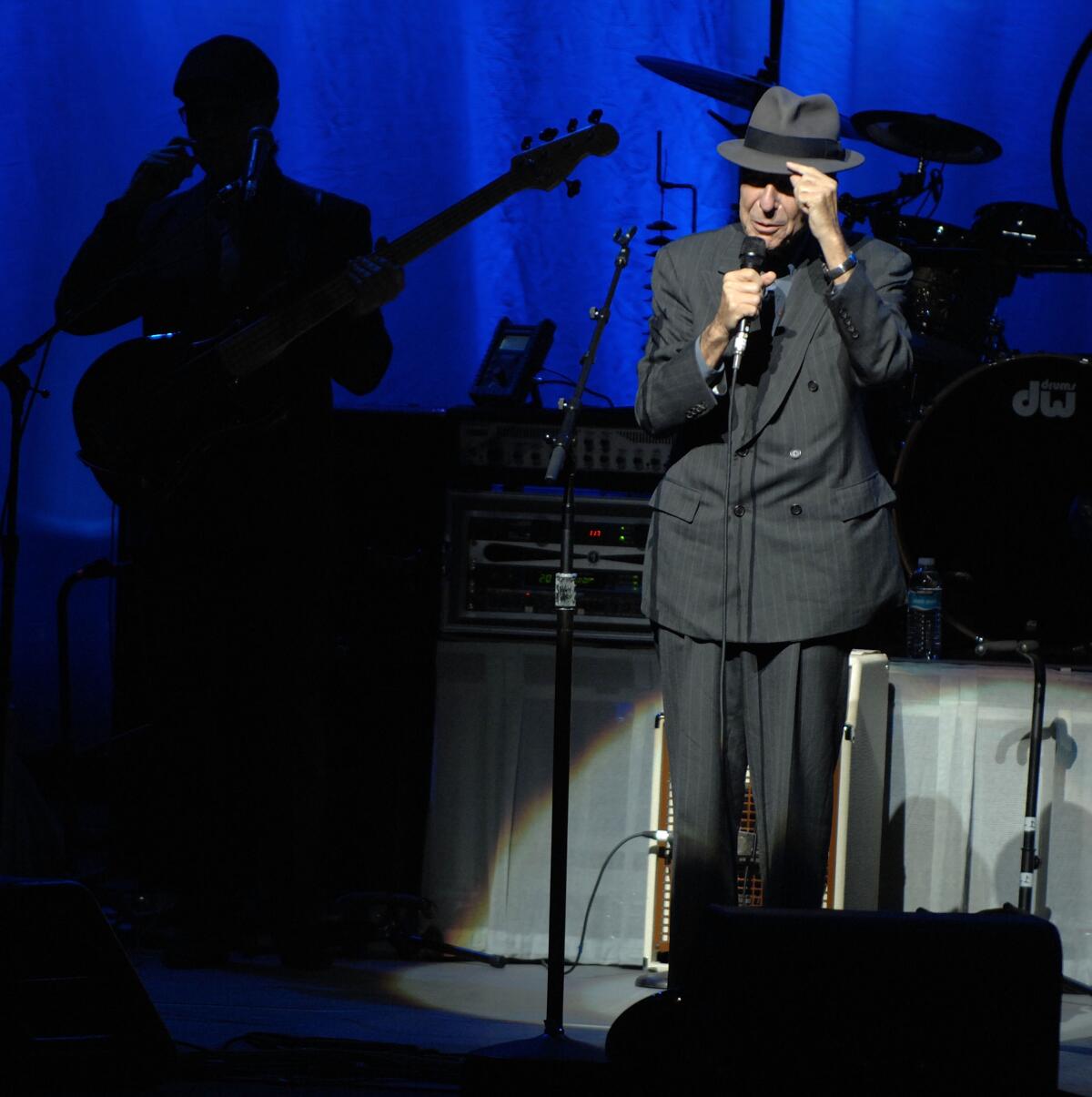
Leonard Cohen performs at England’s Manchester Opera House in 2008. His 1984 song “Hallelujah”
has been covered innumerable times by a wide variety of artists.
But what does hallelujah mean, exactly? And why does it continue to resonate with us, untranslated, thousands of years after it first appeared in the Hebrew bible?
And what is it about hallelujah that inspires composers and songwriters to deploy it so frequently and reverentially from Handel to Ray Charles to Leonard Cohen?
The Oxford English Dictionary defines hallelujah as “a song or shout of praise to God,” but biblical scholars will tell you it’s actually a smash-up of two Hebrew words: “hallel” meaning “to praise” and “jah” meaning Yahweh, or God.
But that’s just the official meaning. For Grant Gershon, director of the Los Angeles Master Chorale, hallelujah is a perfect word because it can take on different meanings.
“It’s this sound that is just so full of possibilities,” he said. “You can fill it with whatever you need to say or communicate.”
In Handel’s great chorus, the word is joyous, victorious, accompanied by trumpets and drums. In Sergei Rachmaninoff’s “All Night Vigil,” however, hallelujah reflects a more quiet devotion. Repeated over and over again, it serves almost as a mantra.
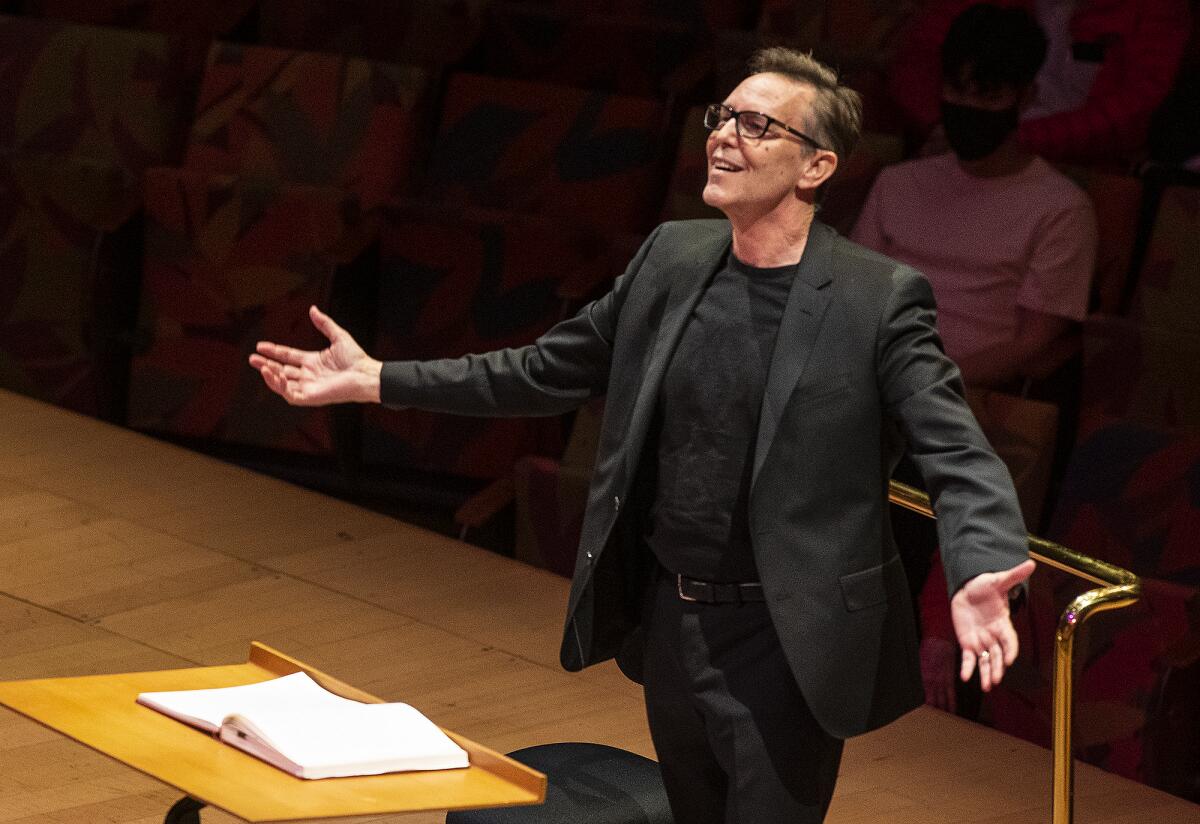
Conductor Grant Gershon says of the word Hallelujah: “It’s this sound that is just so full of possibilities.”
“I imagine an older Russian person in front of an icon, just murmuring to themselves, ‘Hallelujah, hallelujah, hallelujah,’ ” Gershon said.
As a side note, the Russians add an extra vowel sound to their hallelujah and drop the “H” so it is pronounced Ah-lay-lu-ee-yah. That opens up even more possibilities to the liquid, fluid approach to the word, Gershon said.
Hallelujah first appears in the Book of Psalms — a compendium of sacred poems in the Jewish Bible that dates to the 5th or 4th century BC. There it generally prefaces the beginning of a passage or shows up at its conclusion.
“Hallelujah functions as a summary,” said Chris Blumhofer, assistant professor of New Testament at Fuller Theological Seminary in Pasadena. “It’s meant to usher you into the experience of praising who God is and what God’s done.”
Sarah Bunin Benor, director of the Jewish Language Project and a professor at Hebrew Union College in Los Angeles, said hearing the word makes her think of the Hallel — a recitation of Psalms 113-118 chanted by observant Jews on holidays.
“We say it on Rosh Hodesh, the first day of the month celebration. It’s part of the Passover Seder,” she said. “It’s a very joyous prayer, very beautiful and very meaningful.”
Hallelujah shows up just four times in the New Testament, all in the Book of Revelation. All four come at the climax of the text, when God delivers his people from the destructive power of Babylon. In response to this deliverance the people cry out, “Hallelujah!”
“They are praising the salvation from oppression and violence,” Blumhofer said. “They are praising God for delivering his promises and protecting his people.”
Scholars can’t say for sure why hallelujah was preserved intact when nearly every other Hebrew word in the Bible was translated first into Greek and then into Latin (amen is another notable exception). Markus Rathey, a professor of early Christian music at Yale University, said it suggests the word was already charged with an emotion that transcended its linguistic meaning.
“I must say, personally, hallelujah sounds so much more beautiful than simply just ‘Praise the Lord,’” Rathey said. “Hallelujah is almost music already, even without a musical setting.”
That musical power comes through no matter the spelling. The Oxford English Dictionary lists eight English transliterations from the Hebrew, including alleluia, allelujah and hallelujiah. There’s even an adjective: hallelujatic.
All those vowels lend themselves to music.
“It’s like the perfect word to sing,” Gershon said. “It has all these long vowels, and all the consonants are liquid as well. It feels like this beautiful flowing stream of sound.”
Historically, the word has offered composers and vocalists the opportunity to use the voice in unusual ways, Rathey said.
“Because it’s only one word and it has that final long ‘ah,’ it inspired composers to write very beautiful, almost instrumental lines that put celebration and the sound of music in the foreground,” he said. “The focus is not on the word anymore; it’s really on playing with sound and virtuosity.”
Thousands of works of classical liturgical music use hallelujah, in part because there was a great need for them. In the first half of the traditional Mass in the Catholic, Anglican and Lutheran traditions, there are two biblical readings separated by several musical pieces. One of them is “Hallelujah.”
“There were ‘Hallelujahs’ that were sung by the congregation, but at a major church it could be an opportunity for a composer to create a larger-scale piece that is performed by a choir,” Rathey said.
Hallelujah was seen as so joyous that it had to be put away for the 40 days of Lent. It was considered too celebratory for such a subdued time of the ecclesiastical year.
There are stories of choir boys in the Renaissance making a tiny coffin and putting the word hallelujah in it, only to resurrect it at Easter.
“Even if you don’t notice that it’s gone, I know the feeling on Easter morning when all of a sudden you are singing it again,” Rathey said. “It’s almost like a beautiful dress that you get out for celebration on Easter morning.” (In fact, Handel’s “Messiah,” composed in 1741, was originally intended for Easter week.)
There is no set time that the word is sung (or not sung) in the nondenominational church that Deborah Smith Pollard attends in Michigan, but she said it shows up when the spirit, emotion and joy begin to crescendo.
“When the praises are so high, somebody is saying hallelujah,” said the professor who studies gospel music at the University of Michigan-Dearborn. “Maybe it’s pastor, or maybe it’s somebody in the choir singing it. All of a sudden, you might see members of the audience singing or saying hallelujah.”
Smith Pollard also sees the word being used outside the church. She is also a radio host, and for the last two years she’s hosted an annual gospel concert and fundraiser put on by DTE Energy, which provides heat for many people in the Detroit area. The event is called “Hallelujah for Heat.”
Smith Pollard thought it was a cute name for when she first heard it. Then her furnace broke down in a cold Detroit winter.
“When we got it working again, the first thing I said was, ‘Hallelujah!’” she said. “You immediately go: Praise God, I’ve got heat again!”
“You don’t have to be in the church, or a Christian, or tied to the Jewish community to use that word,” she said. “Hallelujah shows up in the community.”
It shows up in Ray Charles’ “Hallelujah I Love Her So,” where the singer uses it to implicitly thank the divine for bringing the woman next door into his life. Hip-hop artists like Chief Keef and Logic have titled songs “Hallelujah” as they celebrate their own success. Recently, the L.A.-based band Haim released a Fleetwood Mac-inspired song in which the word serves as a way to acknowledge the blessing of having friends and family help them through life’s challenges.
But by far the most popular and famous use of hallelujah in popular music is Leonard Cohen’s haunting and frequently covered “Hallelujah,” written in 1984.
The song does not rely on biblical quotations, but it does make use of biblical stories: It’s about David, who consorts with Bathsheba, and orchestrates her husband’s death so he can marry her. And it’s about Samson, who, instead of saving his people from a hostile army, runs off with Delilah, who cuts his hair, leaving him powerless.
But ultimately, the song is about all of us — our failings, our imperfections, and our desire to have a relationship with the unknowable divine, said Marcia Pally, author of “From This Broken Hill: God, Sex and Politics in the Work of Leonard Cohen.”
“He articulates in the song what we know about ourselves,” she said. “It’s about our relationship with the transcendent and with other people, how we breach those relationships, and sever them, and yet still we have to come back to hallelujah.”
Amen. (But that’s another story.)
SOURCE:
https://www.latimes.com/california/story/2021-12-20/hallelujah-the-remarkable-story-behind-this-joyful-word
___
eof
